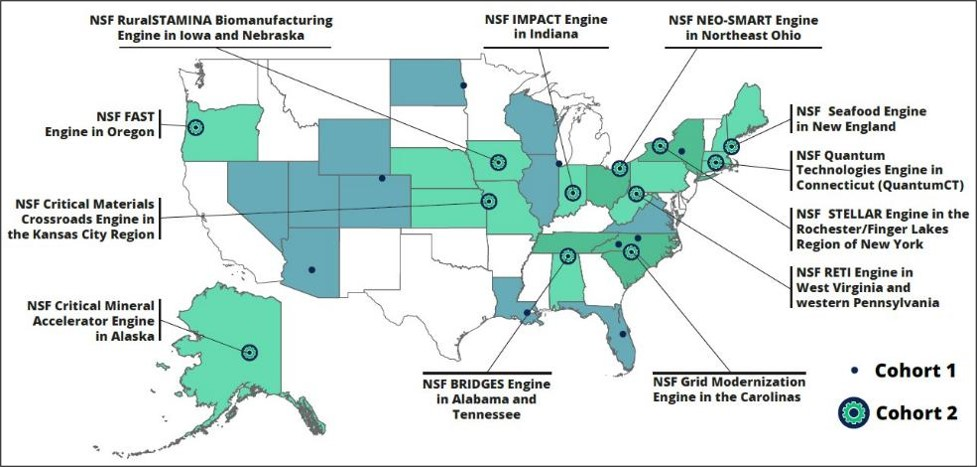
The new NSF grants, with the potential of $160 million in funding apiece, will support 12 regional technology clusters that are spearheading science and technology concentrations across the country.gettyThe U.S. National Science Foundation has made its second round of NSF Regional Innovation Engines (NSF Engines) awards to 12 teams across 20 states. Most of the newly announced teams are led by a major research university.The NSF Engines program was established to advance cutting-edge, multidisciplinary research and technology development in key focus areas. It seeks to:increase commercial investment in research and development activities across distinct geographic regions;create partnerships between industry, academia, government, nonprofits and local communities to foster scientific innovation; spur economic development and train more Americans to become technicians, researchers, practitioners and entrepreneurs who can address regional workforce needs. Each team, headed up by a university or industry leader, receives an initial award of $15 million over two years. Those teams that demonstrate progress on achieving well-defined milestones can eventually receive up to $160 million each in NSF funding over the next 10 years. The intent is for the teams to develop regional coalitions of researchers, institutions and companies to conduct research and development in key science and technology areas.The 12 teams announced this week join nine others that were selected in the first funding round in 2024. A map of the two cohorts can be found here.The 12 newest NSF Engines span several critical technologies and applications. They range from enhancing energy grid security and increasing the production of the materials manufacturers use for batteries, semiconductors, and medical devices to maximizing the yield of critical mineral mining extraction and advancing semiconductor production and quantum computing. Awards were made to:NSF BRIDGES Engine in Alabama and Tennessee, led by the HudsonAlpha Institute for Biotechnology. NSF Critical Materials Crossroads Engine in the Kansas City Region, led by the University of Missouri-Kansas City. NSF Critical Mineral Accelerator Engine in Alaska, led by the University of Alaska Fairbanks. NSF FAST Engine in Oregon, led by Oregon State University. NSF Grid Modernization Engine in the Carolinas, led by the University of North Carolina at Charlotte. NSF IMPACT Engine in Indiana, led by Indiana University. NSF NEO-SMART Engine in Northeast Ohio, led by Case Western Reserve University with more than 70 regional partners. NSF Quantum Technologies Engine in Connecticut, led by the University of Connecticut. NSF RETI Engine in West Virginia and western Pennsylvania, led by West Virginia University in collaboration with the University of Pittsburgh, Carnegie Mellon University and the U.S. Research Impact Alliance. NSF RuralSTAMINA Biomanufacturing Engine in Iowa and Nebraska, led by Iowa State University. NSF Seafood Engine in New England, led by the Northeastern Regional Association of Coastal Ocean Observing Systems. NSF STELLAR Engine in the Rochester/Finger Lakes Region of New York, led by the University of Rochester."These new NSF Engines will be transformational for America’s innovation infrastructure — helping secure our national competitiveness in technologies and future industries that will be critical to our economic and national security for decades to come," said Brian Stone, performing the duties of the NSF director, in a news release. "These engines will unlock innovation and enable technologies that will improve the quality of life and result in good-paying jobs for all Americans.”The NSF Engines program has already demonstrated that it can generate significant returns and impact. The initial investment of $135 million in the first nine NSF Engines has attracted more than $2 billion in matching commitments from private industry, philanthropy and state and local governments. Those investments are now advancing technologies in several critical areas, including advanced chipmaking, next-generation artificial intelligence, agriculture and food production, disaster preparedness and energy storage.
NSF Names, Funds 12 New University-Led Regional Innovation Engines
NSF has made another round of Regional Innovation Engines awards to 12 multi-partner teams across 20 states. Most of the teams are led by a major research university.
607 words~3 min read