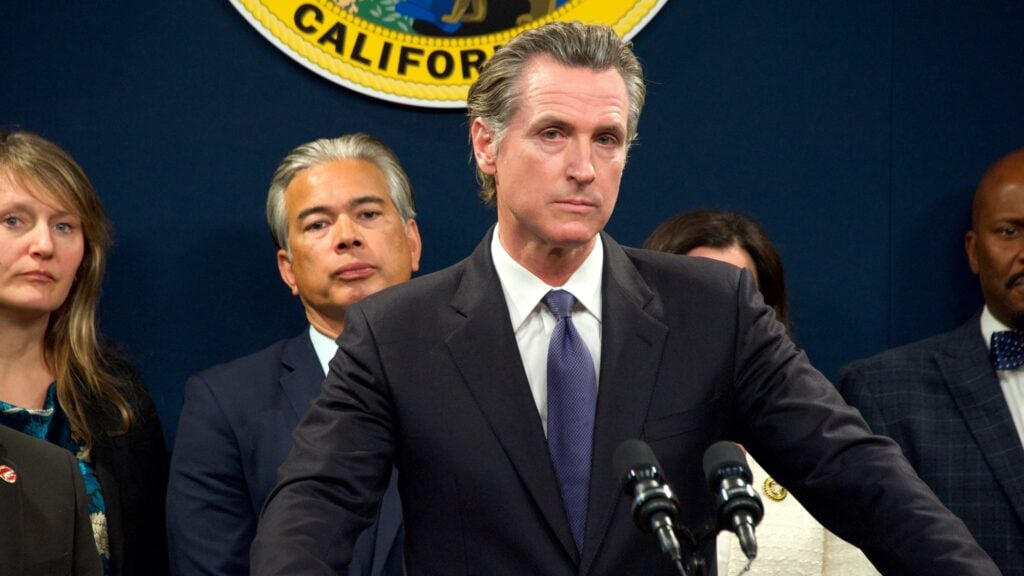
“The president may not be familiar because he didn’t take the time to sign the bill, that what we were promoting — and by the way, take a look at that housing bill that was done federally,” Newsom said during a press conference. “Looks a lot like what we’ve been doing here in the state of California.”Newsom, a favorite for the 2028 presidential race, made the comments while signing California’s housing bill on Monday, which centers on cutting red tape and reducing impact fees on new residential housing.
He pointed to recent efforts to streamline development by reforming the enforcement of the National Environmental Policy Act and the California Environmental Quality Act, two environmental review laws critics argue have slowed housing construction through excessive regulation.“And I wasn’t joking when I said, ‘Looks a lot like California,’ which may have been one of the reasons Trump didn’t sign it,” Newsom said. “But I thought there was a lot of good thinking and a lot of smart work that was done on it.”The federal housing bill became law Saturday without Trump’s signature. Under the Constitution, legislation passed by both chambers of Congress automatically becomes law if the president neither signs nor vetoes it within 10 days, excluding Sundays.Trump had previously announced he would not sign the legislation in an effort to pressure Congress to pass the SAVE America Act.“I will not sign the Housing Bill, which has been fully approved by Congress and sent to the White House, in PROTEST over the fact that the United States Senate is not capable of passing THE SAVE AMERICA ACT,” Trump wrote on Truth Social.Congress ultimately made no progress on the SAVE America Act, but Trump opted not to veto the housing measure, allowing it to become law. The legislation aims to lower housing costs by reducing federal regulatory barriers and encouraging states and local governments to ease restrictive land-use policies.Among its provisions, the law directs certain federal grants toward local governments that approve more housing construction, encourages zoning reforms that allow greater residential development, and creates benchmarks to evaluate state and local housing policies.HOUSING BILL WOULDN’T OFFER MUCH AFFORDABILITY RELIEF UNTIL AFTER MIDTERM ELECTIONSThe bill passed both the House and Senate with bipartisan support. Trump had been scheduled to sign it during a Capitol Hill ceremony last month but abruptly canceled the event, urging lawmakers instead to prioritize the SAVE America Act. He later dismissed the housing bill as “a yawn.”With the measure now in effect, both parties are expected to tout it as a bipartisan response to voters’ concerns about housing affordability and inflation ahead of the 2026 midterm elections, with Democrats likely to emphasize Trump’s failure to sign the legislation.