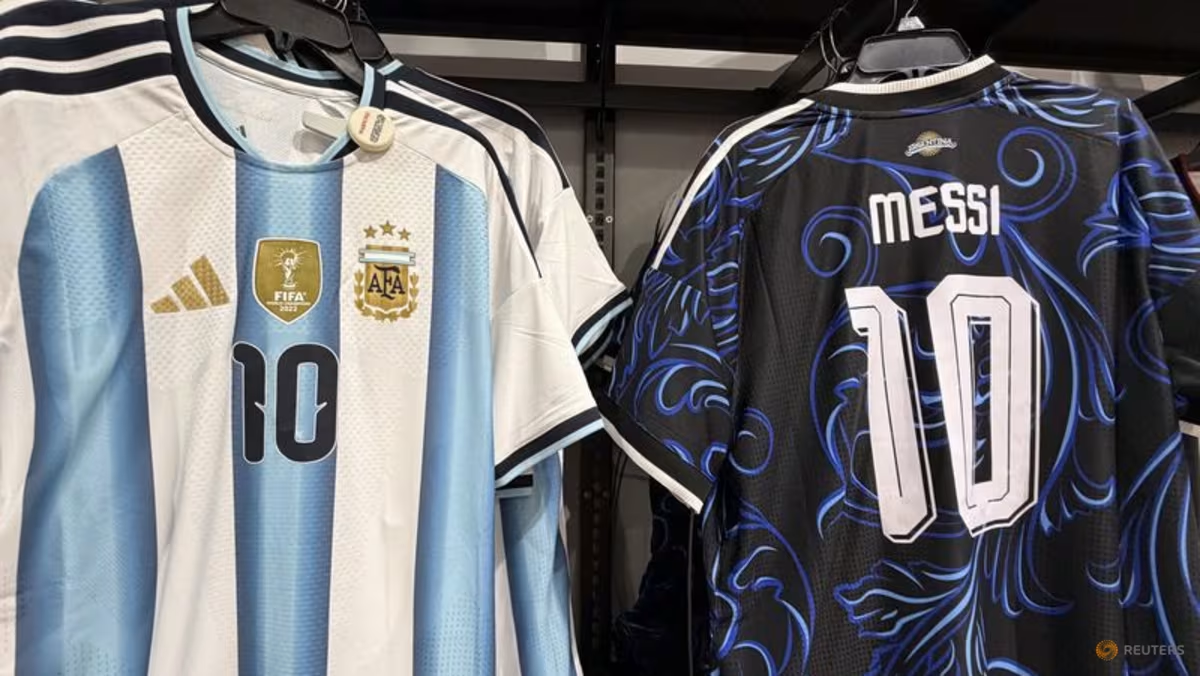
Get free access to the most comprehensive World Cup coverage in The Athletic app.There are a handful of things that unquestionably evoke Argentina: the aroma of a Sunday asado drifting through the streets, a spoonful of amber-hued dulce de leche, the melancholic rhythms of tango and the thunderous yet emotional matchday roar of “goooooooooool” rising from stadiums and out of windows.Then there is fileteado porteño, a less widely known but no less distinctive national art form. With its curling lines, elaborate flourishes and vivid colors, this form of embellished lettering adorns storefronts, delivery trucks and the iconic buses of Buenos Aires.Adidas brought this visual language to Argentina’s national team for the 2026 World Cup, incorporating swirling blue fileteado-inspired motifs into a black away jersey. When the reigning World Cup champions take on England in Wednesday’s semifinal in Atlanta, they will do so wearing this shirt.And if Lionel Scaloni’s team win, the shirt will instantly earn a place in the country’s football folklore. The shirt’s swirling design is a tribute to the fileteado tradition (Luis Robayo/AFP via Getty Images)Argentina’s famous striped home shirt is virtually untouchable, while away kits have generally been understated alternatives, most often in navy. The fileteado jersey is a bold and perhaps surprising choice for a nation that has tended to be traditional in the design of its national team strips. In 2018, the team broke with convention by wearing a black away shirt for the first time. Four years later, it made an even bolder choice with a purple jersey that became an unexpected phenomenon, drawing global attention when it was revealed the design represented gender equality.Historically, Argentina’s away jerseys have carried an uneasy place in the national team’s World Cup folklore. The association dates back to the 1962 tournament in Chile, when Argentina wore blue at a World Cup for the first time and was eliminated in the group stage. The superstition only deepened after Argentina also wore an alternate shirt in its World Cup final defeats in 1990 in Italy and 2014 in Brazil. Inside Lionel Messi's biggest career momentsWhile Argentina has wrestled with the uneasy history of its away jerseys, other national teams have increasingly transformed football shirts into canvases for cultural storytelling. Nigeria’s celebrated 2018 World Cup away kit drew inspiration from the legendary 1994 Super Eagles shirt and traditional adire textile patterns. Mexico’s beige-and-burgundy 2022 away jersey incorporated Aztec symbolism. This year, Belgium made a bold choice, paying tribute to surrealist painter René Magritte with a pink-and-blue design featuring the inscription on the collar “Ceci n’est pas un maillot” (“This is not a jersey'”). Très joli.Belgium played in a Magritte-inspired second shirt (Alex Grimm/Getty Images)The return to black in 2026 is more than another change in color. For the first time, the players are carrying a piece of Argentine cultural identity onto the field, part of a broader tradition of national teams using their kits to showcase the art, history and visual language of their countries.“This is going to be a cultural artifact that people will hand down for generations,” Sam Handy, the general manager of Adidas football said in an Instagram post describing the jersey back in March. “Who knows? They might win it, right? And if they happen to win the World Cup in this jersey, it achieves this huge cultural value.” But what exactly is this obscure, and perhaps lesser-known, art form that Adidas chose to bring into the spotlight? The origins of fileteado porteño date back to around 1900, when waves of Italian immigrants arrived in Argentina seeking opportunity. Many found work painting horse-drawn merchant carts that transported goods throughout Buenos Aires.Using leftover marine paint, artisans began decorating the otherwise ordinary wagons with colorful flourishes, elaborate scrollwork and ornamental lettering inspired by the lavish European decorative styles fashionable at the end of the 19th century. The word filete comes from the Latin filum, meaning thread, a reference to the thin, flowing lines that define the style. Porteño simply refers to the port city of Buenos Aires.Bold floral motifs intertwined with vines. Symmetrical scrolls framed ornate cursive lettering. Bright colors surrounded portraits, saints, horses, tango singers and neighborhood heroes. It transformed everyday objects into works of art.Signs painted in the fileteado style (Eitan Abramovich/AFP via Getty Images)As Buenos Aires modernized, fileteado migrated from carts to trucks and eventually to the city’s famous colectivos, the brightly decorated buses that became moving galleries throughout the capital. Unlike the European-inspired tastes embraced by the city’s upper classes, like tango and futbol, fileteado is a visual expression of working-class Buenos Aires. It reflected immigrant communities, neighborhood pride and local humor. Artists incorporated popular sayings, tango lyrics, religious symbolism and portraits of cultural icons, including Eva Perón.It became a distinctly Argentine way of beautifying everyday life and telling stories. “The important thing to understand is that fileteado began as a decorative art. It combines ornamentation, scrollwork and lettering, but it was primarily decorative. It was not commercial advertising in the traditional sense,” Gustavo Ferrari, one of the most prominent fileteado artists from Buenos Aires whose work has been sold worldwide, tells The Athletic.“The fruit seller’s cart, the baker’s cart and the milkman’s cart would be decorated with fileteado ornamentation, which was always the principal element. They might also include boastful phrases, something like: ‘Here comes so-and-so, the best in the neighborhood’ or lines taken from tango songs.”After the carts, fileteado moved onto trucks and buses. The name of the bus company became the principal lettering. The destinations were painted in simpler letters, with some ornamentation and flowers, but usually not as densely decorated. Trucks, meanwhile, continued the tradition of the carts with ornate, almost exaggerated designs to give a third dimension to a two dimensional object. But it was mostly a low-brow artform. For the working class, just like futbol is.“Except in 1970, when artists Esther Barugel and Nicolás Rubió organized the first gallery exhibition devoted to fileteado,” Ferrari adds. “It helped recast fileteado as an art form in its own right. From there, it moved onto signs, paintings, album covers and other graphic work, gradually becoming part of the visual identity of Buenos Aires.”
The iconic art form that inspired Argentina’s World Cup semifinal shirt
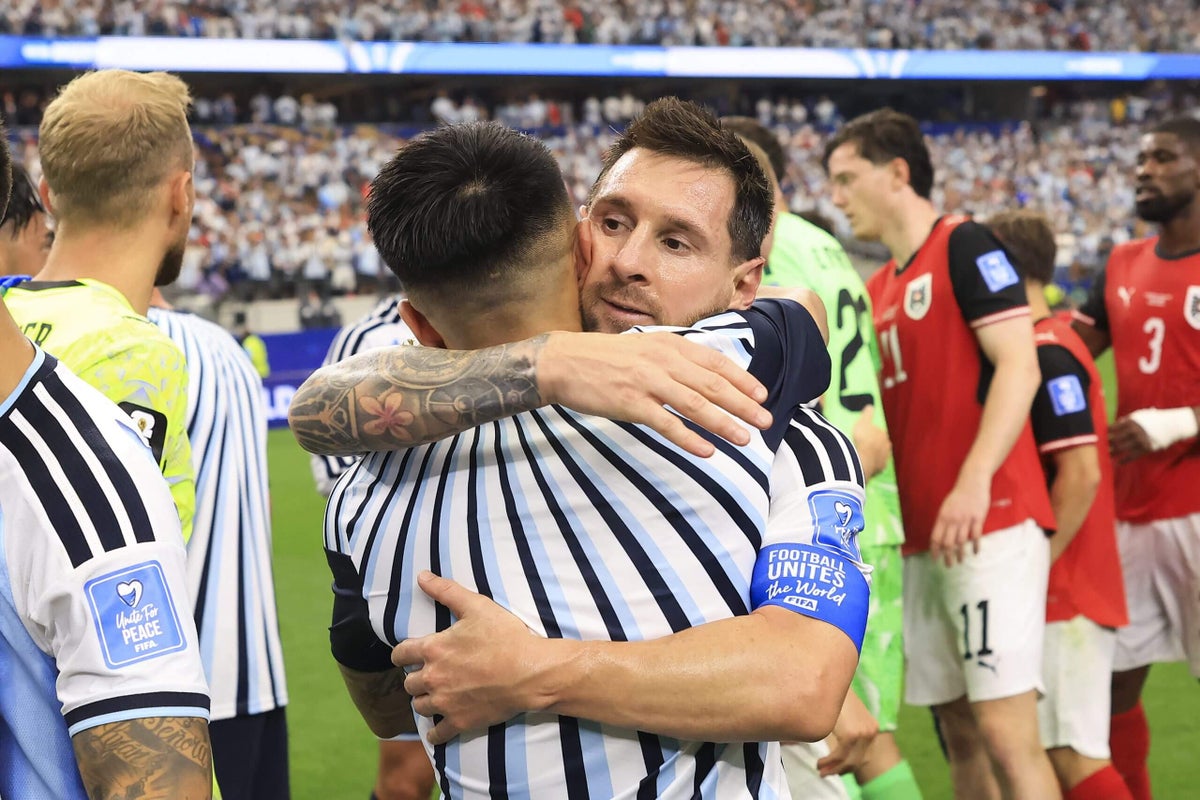
Lionel Messi and his teammates will line up in their 'away' shirt, which is inspired by the style of fileteado porteño
1,821 words~8 min read