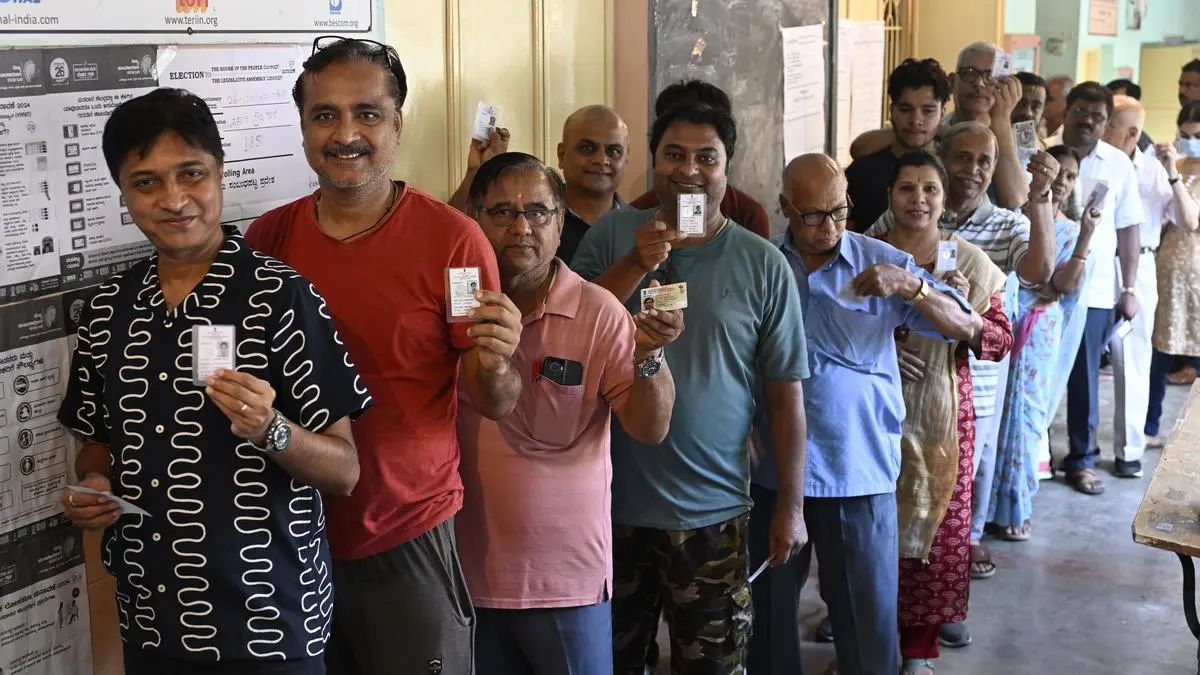
India is on the verge of its most consequential electoral redrawing in nearly 50 years. The number of Lok Sabha seats each State holds has been frozen since 1976, and the 2027 Census is set to finally unfreeze it, redistributing roughly 281 new seats across 36 States and Union Territories.As per the “Delimitation Bill 2026” tabled in the Lok Sabha on April 16, 2026, the government planned to distribute the seats, in a way that it kept the current proportional distribution of seats between States intact. Or, in other words, each State and Union Territory is supposed to receive a 50 per cent increase in their seat count.However, such an arrangement contradicts one of the fundamental aspects of the Constitution — “one vote, one value,” being championed by members of the ruling polity for long.The dilemmaIf the current share of each State/UT in total parliamentary seats is maintained, as put forth in the Delimitation Bill 2026, Rajasthan will have 14 lakh voters in each constituency, Karnataka 13 lakh voters, and Bihar and Uttar Pradesh will have 12.8 lakh voters each. But States like Tamil Nadu will have an average of 10.6 lakh voters per constituency, Odisha and Uttarakhand - 10.5 lakh voters per constituency and Kerala - only 9 lakh voters per constituency. Consequently, one vote in Rajasthan will have far less value than a vote in Kerala.According to Prashant Bhushan, public interest lawyer in the Supreme Court of India, “The core of India’s delimitation debate lies in balancing two competing principles. One is the principle of equal weight of every vote, which requires constituencies to have roughly the same number of voters so that no citizen’s vote carries more weight than another’s. The other is federalism, which implies that States should not lose political influence simply because they were more successful in controlling population growth.”M.R. Madhavan, President, PRS Legislative Research, puts it simply, “Article 81(2)(a) says every State gets Lok Sabha seats in proportion to its population, and Article 81(2)(b) says that within a State, every constituency must be equal to every other. If you add these two, it effectively means every constituency in the country should have the same population.”That principle, however, has been suspended for half a century. “Inter-State allocation of seats is frozen at the 1971 census, and intra-State boundaries at the 2001 Census — both until the first Census after 2026,” Madhavan said. The freeze flows from the provision to Article 81(3), introduced by the 42nd Constitutional Amendment in 1976 and extended by the 84th Amendment in 2001, based on the logic of giving the different States of India, some time to stabilise their rapidly-expanding population.Federal logic of a mature nationSrinivasan Ramachandran, Former Secretary and Research Officer, Government of Tamil Nadu, argues, “The whole issue is not the number of seats. It is about the proportion of seats for the States. In a federal country, not only people should be represented, but the units of the federation should also be properly represented.”“This is the principle behind the European Union also. This is the principle behind, say for instance, even the US or Canada. Whereas, we have Rajya Sabha also based on population, in no other federation it is based on population. We’ll have to think of representation in a federation as different from representation in a unitary State. First, that mindset should go,” he says.EAC-PM paper’s dangerous recommendationsA recent paper on the proposed delimitation exercise by the Economic Advisory Council to the Prime Minister (EAC-PM) recommends splitting of certain existing constituencies into two or three, in such a way so as to maximise voter turnout. Although nothing is wrong with the aim of maximising voter turnout in a democratic nation, the underlying logic used to explain such splits is linguistic polarisation, and gender and caste of the urban voters.The paper finds that linguistic polarisation is a significant contributor for motivating voters to vote, and as such recommends those constituencies should be split where linguistic polarisation is possible (that is two or three dominant languages are present) and in such a way so as to maximise linguistic polarisation. The paper also finds urban women to exercise their voting rights more, and communities like SC and ST to generally mobilise more, and as such splitting of constituencies with high concentration of these categories can positively impact turnouts.The EAC-PM paper proves that turnout can be engineered. Reconciling equal votes with equal States is a design problem that no working paper can solve, and one that the Commission cannot dodge.Saurabh Suryawanshi is an internPublished on July 14, 2026
Constitutional challenges in the delimitation math
Explore India's constitutional challenges in electoral delimitation, balancing equal representation and federalism amid impending seat redistribution.
759 words~3 min read