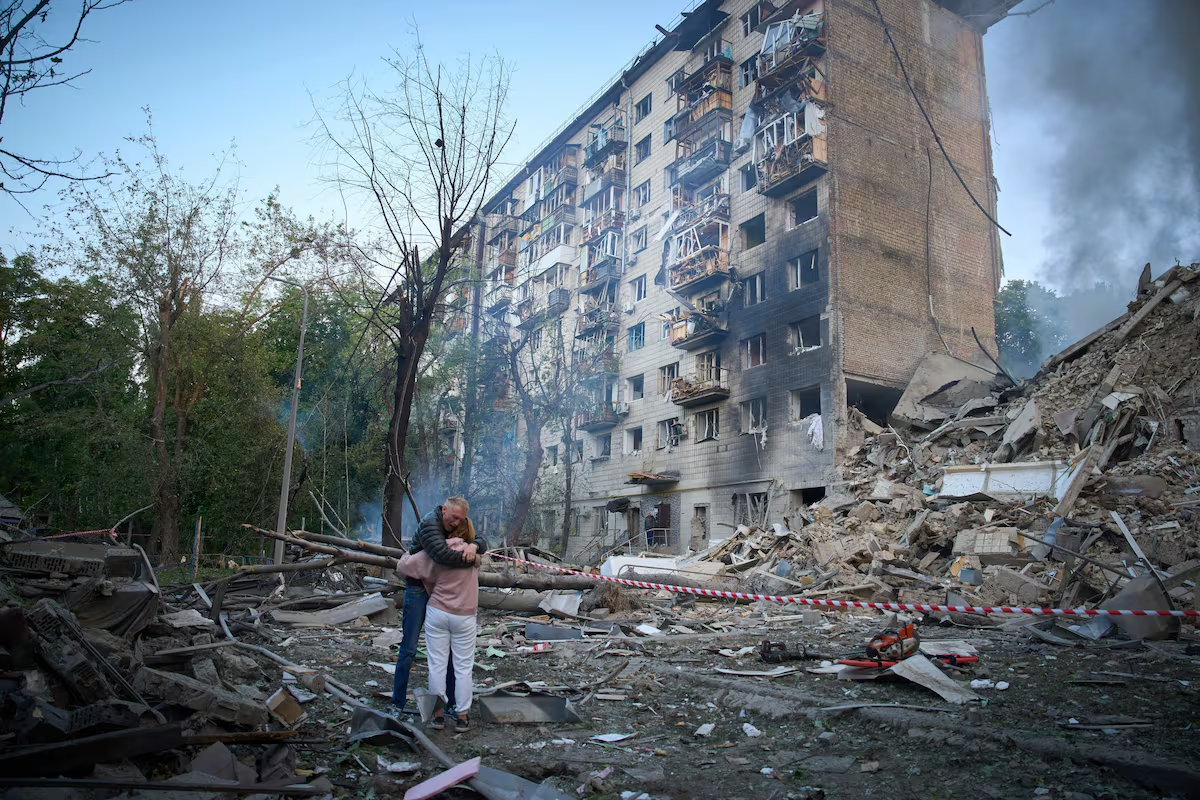
Lawfare Contributing Editor Mykhailo Soldatenko sits down with Eric Ciaramella, Senior Fellow at the Carnegie Endowment for International Peace, and Samuel Charap, Senior Political Scientist at the RAND Corporation, to take stock of the U.S.-led negotiations between Ukraine and Russia. They discuss the improvements in Ukraine's position, the structure of negotiations, territorial questions, and security commitments to Ukraine.Click the button below to view a transcript of this podcast. Please note that the transcript was auto-generated and may contain errors.Transcript
[Intro]Samuel Charap: We could debate where, where the fault lies for this, but I don't think there is really a credible alternative that Putin's looking at for, even to explore a process that could be there to explore what a credible alternative to continued fighting might look like.Mykhailo Soldatenko: It's Lawfare Podcast. My name is Mykhailo Soldatenko, Lawfare contributing editor, and I'm joined today by Eric Ciaramella, senior fellow at the Carnegie Endowment for International Peace and the contributing editor at Lawfare, and Samuel Charap, distinguished chair in Russia and Eurasia policy and senior political scientist at Rand Corporation.Eric Ciaramella: The sense I got is that they've moved away from some of these stranger kind of hybrid proposals on the Donbas and the territorial issue is just sort of frozen for the time being while, you know, Ukraine is fighting for more of an advantage strategically.Mykhailo Soldatenko: Today, we are taking stock of the U.S.-led negotiations between Ukraine and Russia. After active diplomatic engagement in 2025 and early 2026, negotiations became virtually dormant. We are discussing the main issues that parties addressed during the active phase of the talks and pondering about potential solutions for future negotiations.[Main Podcast]So Eric, Sam, last time we talked, both of you agreed that one of the main obstacles to a negotiated settlement is Russia's war optimism. Basically, their conviction that they can achieve their objectives on the battlefield and that time works in their favor. Given recent Ukrainian drone strikes, including deep into Russia, that disrupts Russian logistics, create fuel shortages and bring war closer to ordinary Russians.Do you think there is a chance to decrease Russian war optimism in such a way and make Kremlin to make reasonable concession? Or you think this will just lead to further escalation and the continuation of the war of attrition? Let's start with, with Eric.Eric Ciaramella: Great. You know, we're definitely in the middle of a different phase of this war whereby Ukraine, through its drone strikes, not only deep inside Russia, but also the so-called middle strikes against Russia's logistics corridor that connects Crimea to Russia has put a significant amount of pressure on the Russian military effort in a way that we haven't seen so far in this war.So I think the, the Russian military and, you know, more broadly, the Russian economic sort of managers have been forced to contemplate and make trade-offs that they did not have to in earlier years in this war.That being said, I would hesitate to say that we're in the midst of seeing Russia's war optimism really diminish because ultimately what it comes down to is one man's calculation. And I have yet to see real evidence that the challenges that Russia's facing have been interpreted by Putin himself as fundamentally necessitating a, a change in, in strategic approach.So, it could very well be that, you know, what we're seeing from the outside is serious enough in terms of the challenges inside Russia that Putin simply hasn't grappled with them yet because, you know, whether he's isolated, getting fed bad information from his commanders, kind of ignoring the problems or so on, you know.But I think we won't really, the, the challenge with kind of looking into the crystal ball here is that because this war hinges so much on one person's decision-making, and he himself is a black box, and he may very well not have any idea himself what course he wants to take over the next six to 12 months, we won't really see a change in Russian approach until the decision has been made at the top.So all of these kind of signals that we're trying to interpret, reading the tea leaves, there was this recent essay by a Russian oligarch in “The Economist” that people are making a lot of, you know, hay out of. To me, it's all, it's not necessarily background noise. I mean, it is kind of important to, to analyze these different signals, but to me, it doesn't, it's not yet determinative of what the, the Russian leadership and specifically Putin is thinking.So, you know, that being said, I think the course that Ukraine is, is taking makes a lot of sense, and I think if we were to assess where Ukraine stands strategically now versus a year ago, you know, whereas the Russian side of the equation is a black box, as I said, the Western side appears to have changed dramatically, where the narrative, you know, when the Trump administration came into office last year was that Ukraine was on an inexorable path to defeat.I think now, and you saw it just at the NATO Summit recently, there's a sense that actually, you know, the, the initiative, at least on the battlefield, is trending somewhat in Ukraine's favor and that, you know, ultimately maybe the jury is still out on how this war ends. And I think it's given a little bit of a push to Ukraine's efforts to try and potentially secure a little bit longer runway of, of Western and specifically U.S. support.Mykhailo Soldatenko: Eric, just a, a short follow-up. So, during one of the press conferences, Putin acknowledged that there are problems even though he minimized the impact of those in his speech. Do you think that he might, he may understand the scope of problems but just ready to incur costs because, considering how much he's invested in this war? Do you think that's also an option?Eric Ciaramella: I do, and I, I mean, it's clear that he's been willing to sustain a much higher level of pain than Western policymakers, I think, expected. You know, if we would've cast forward and seen the degree of, you know, economic pressure that Russia's been under, he's, he's certainly been willing to subject the Russian population to it.You know, whether, whether he truly understands and, again, whether we truly understand, I mean, we're looking at this from the outside, and we have just fragmentary information and because, you know, it's so hard for Americans and Europeans to really understand what's going on, on the ground in Russia these days, you know, we may, we may be overstating it, we may be understating it. So, you know, for sure he recognizes that there are problems, but I do think, going back to what I was saying earlier, that he doesn't, at least there's no evidence at this point, that he sees those problems as severe enough or unmanageable enough that he needs to change course strategically speaking.Mykhailo Soldatenko: Sam, what are your thoughts on that? And do you think Ukraine right now is in better position than it was when negotiations virtually became dormant in early 2026?Samuel Charap: Well, I think, you know, without question that the, the factors that Eric identified are objectively, if you were to objectively assess the Russia's military prospects, they're, you know, nowhere near as bright, so to speak as they were in February 2026.But as he also notes, Eric, the key question is how those objective factors get translated into the subjective perceptions and particularly those of one man. And then there's the added question about, like, let's just say he might even know all of this and his optimism might be diminished, he has very little incentive to let that on in public, right? And so the public bravado that we hear from Putin a lot doesn't even necessarily tell us what's going on in, in his head, given that he is speaking to a domestic audience. He's got, you know, legislative elections coming up and he has his own domestic popularity, which is reportedly sinking, to, to worry about.So, I think the best we can say is that based on observable empirical evidence, that, that Russia should be less optimistic, and therefore Ukraine is in a relatively better position. However, the question is how you convert pressure into, the kind of pressure that Ukraine is, is, is putting on Russia, into a better outcome for Ukraine. And there, you know, if we've seen this historically, if, you know, one side lacks a credible alternative to continuing the war, they're more likely to continue it even if, you know, the, the optimism factor isn't there.And I think that connects to the question about negotiations because at this point, and, you know, we could debate where, where the fault lies for this, but I don't think there is really a credible alternative that Putin's looking at for, even to explore a process that could be there to explore what a credible alternative to continued fighting might look like.So, you know, I think objectively the situation has improved for Ukraine in this context, you know, relatively speaking. But how that can be converted into a better outcome in the context of a end game scenario is a, is sort of a separate, you know, one level, a separate question in a way.Mykhailo Soldatenko: So the negotiations were structured where Washington would actually act as a mediator even though it supported one of the parties to the war for a long time. And Europeans were out of negotiations, but they were coordinating the position with Ukrainians. Do you think this structure can produce a negotiated settlement or it should be changed? And what would be your advice about how to structure negotiations, Eric?Eric Ciaramella: Can it work? I think theoretically, yes. If you had American negotiators who really understood the issues deeply and were credible interlocutors with the Europeans. Given the broader state of affairs in transatlantic relations, I think there's very obvious skepticism on the European part that the American side is taking into account European interests in these talks.I think you're right that the U.S. side, I mean, it's really inconceivable for the United States to be a true mediator in this sense, and I don't think a mediator in a classical sense is really even needed in this case. But I think what's been disappointing is that there have been several windows of opportunity since this administration took office to potentially get a more serious negotiation underway.The Ukrainian side while reluctant at first, came around to seeing it as valuable. I think the Ukrainian side has tried to, you know, use these talks in a way to actually make meaningful progress, and I think it's the, the American side's lack of organization, expertise, policy coordination, I mean, the sheer fact that you have two American negotiators without any team of their own who are simultaneously also responsible for negotiations with Iran, I mean, to me it, it, it's really makes very little sense, and I think it's unfortunate because the administration has repeatedly squandered opportunities to get something more serious going.So in a theoretical sense, yes, a trilateral format with significant coordination with the Europeans and input from them could work. I think with the current cast of characters I'm pretty skeptical if they return to that same model that they've used in the past.Mykhailo Soldatenko: Sam, your thoughts?Samuel Charap: So I wanna start with the question about mediator, because I've actually, I found this to be something that, you know, you hear actually from, including European leaders like Macron after the G7, or no, it was after the European Council meeting which came immediately after the G7, where he said that, you know, Europe supports Ukraine, it therefore it can't be a mediator.I think if you look historically at how conflict negotiations have worked, the mediator isn't necessarily neutral. Just look at the U.S. role in negotiating, you know, the end of the Yom Kippur War and subsequent agreements between Egypt and Israel, and Israel and Syria respectively. It's not like there was any question about where U.S. loyalties were at that point. I mean, at the beginning of that war, the U.S. didn't even have diplomatic relations with Egypt. Clearly, you know, the U.S. sympathies were, were on one side of this, and the U.S. was in fact militarily supporting Israel.So the fact that the U.S. continues to both sell weapons to the Europeans for Ukraine and provide intelligence and various other support, even if at much lower levels than before, does not disqualify it from being an effective mediator. And I think we need to put aside the idea that a mediator has to be neutral. I think that's been a hold-up for the Europeans taking a more active role in this.So, that's one piece. So in theory, and here I agree with Eric, like you could have U.S. mediation. It's more about the parties' view about the mediator's objectives. If the parties think that the mediator is there to, you know, find a, a, a, a good deal for them both or to find some sort of fair compromise, then that can work.I do think that you know, a more direct involvement of the Europeans would be quite useful both because of the deficiencies in the U.S. approach that Eric highlighted and because they, you know, they have stakes in the outcome. They care more about the details than the U.S. does. And so, you know, I, I think having them involved in some way would be useful for a better outcome. There's a problem of course with representation and, you know, you're not gonna, you can't have 30 representatives for Europe around the table with, at that point, and they, they have yet to settle on or appoint a, a point person for this. That's the mediation question.I think really the, the problem with the U.S. approach so far has been less about the fact that the U.S. has been leading it, and more in the deficiencies on process. I mean, we just, we haven't seen things that are associated with how this has been done successfully in the past. So, you know, a continuous process where we've seen, in this case, an episodic one. So, you know, historically when you're dealing with complicated international disputes like this, you need to actually get people in a room, like, regularly, not every few months, or in this case, you know, we're, we're almost going on six. That just doesn't work to get through these issues. You know, you need to have some idea of getting all the issues on the table at the same time so that there's a degree of trade space between them, and we can get to this later. Like, that hasn't happened.You wanna maintain a degree of confidentiality when so far these have all been media circuses really around these things. You know, you want to actually have the parties be the ones who are owning the process and the outcomes. And here, again, the U.S. has sort of both ran with its own ideas about how the process should be run, and proposed its own solutions without seemingly much input from at least both sides as opposed to letting them sort of take the baton and thus be bought into it and have some stake in its success.So I could keep going. I mean, I think that the process matters here, and it's, it's treated as a secondary thing, like all you need to do is get the people in the room. But actually, it kinda matters about, like, how you structure it. And I think we've seen that it's gonna take a whole lot more than an episodic, you know, meeting every once in a while to work through a lot of these complicated issues.Mykhailo Soldatenko: Yes. What do you think, what's the theory of the case from Vitkov and Kushner, why they structured it in such a way? What would be their argument? Do you think maybe they think that experts would complicate, prolong the process? What do you think? What's the theory of the case there?Samuel Charap: I mean, I don't wanna put words in their mouth, but I think that the based on what I've seen, Kushner's comments on his experience in the first term negotiating the Abraham Accords, is that he doesn't have much regard for the traditional approach to conflict diplomacy. And, and he thinks that taking a more freewheeling business, like, based on his business experience approach is sort of how you get things done.And he's, was reinforced in that by his perceived success with the Abraham Accords. And even early on with Gaza, that, you know, this wasn't done the traditional way and they're trying to do these things with creating new structures and avoiding the UN and not having any people in their teams who are, you know, do, who do this for a living. Yeah, I, I think it's a sort of view that the traditional way of doing things has failed, and that they're gonna try something based on how they know negotiation.Mykhailo Soldatenko: So turning to substantive questions. So, based on prior negotiations, it looks like the territorial questions was not, were, was not the most important for the Russians. But right now it appears, and party represented it as so this is the core thing. And then Zelenskyy said, and U- U.S. representative noted that this is the only issue that remained to be resolved, like 10% of the deal. So, do you have any explanation why the territorial question became central? As opposed to other questions, Sam?Samuel Charap: Well, I mean, I think there are a few reasons. One is that the U.S. made it central, that it was put on the table by Steve Witkoff and the, the meeting in Moscow before Anchorage. And, you know, I think it was therefore it became the first order issue when it might not have been had there been a different approach.And then I think, you know, the Russians came away from Anchorage with the view that this was already decided, and essentially the, the Donbas was, like, gifted to them, and that's what the U.S. promised, at least this is what is alleged. And so there's a second element here, which is like, "Okay, we got a concession. Why should we give it up if it's already been gi- provided to us?" Of course, this just doesn't really make much sense given that the U.S. can't, like, snap its fingers and make Ukraine withdraw, I think as it has discovered over the last year.And I think the second piece is maybe more problematic, which is that it has become, I think, it will be challenging for Putin to end the fighting without having taken the rest of the Donbas, given the number of times he has publicly committed to that. And I think territory has grown in importance as a result of the repeated, you know, invocation of it by Putin, which I think he himself has boxed himself into a corner in a, you know, this began all the way back in the fall of '22 when he announced the annexation, therefore giving himself less room for maneuver.I think we've discovered that there's a bit more room for maneuver and that no one's talking about all of Zaporizhzhia and Kherson anymore. But, And I do think this is not necessarily a insurmountable problem, but it is, to a certain extent, a problem of his own creation as well as the sort of U.S. negotiation, one could argue, mistake.Mykhailo Soldatenko: Eric, what are your thoughts on that? And do you think it's possible to reach a ceasefire along the line of contact if we will include the negotiations of other issues and connect them with the territorial question?Eric Ciaramella: Yeah. I, I basically agree with Sam's assessment that it was a, a big American blunder to put this on the table early on and to reduce the negotiation to, you know, quote unquote, “land swaps," which Steve Witkoff talked about, you know, repeatedly as if it were as simple as just redrawing lines on a map. Even if it were that simple, that in and of itself is highly complicated.But I think the Russians played a part in creating this problem insofar as I think they leaned in to Witkoff's naive approach and led him to believe that the territory was the main issue, and if only the American side could unlock this door by pressuring the Ukrainians to withdraw, everything else would fall into place. And my view is that were this door to be unlocked by dint of this pressure on the Ukrainian side, which again, didn't pan out, it would have opened into another ante room with a bunch of other locked doors on much more complicated issues related to Ukraine's military and broader European security and yada, yada, yada, all these other things that have been on Russia's laundry list.So I, I think it was a combination of Witkoff's blunder and Russian craftiness about trying to get an early major concession and then pocket it and move the goalposts that we are in this place. I'm not sure on Sam's point that the, the territory has become sort of a thing in itself and it's now very hard for Putin to retreat from, you know, I, I don't know. I think he's still firmly enough in control of the Russian system whereby if he redefined victory he can kind of talk his way out of anything. That gets to your point, Mykhailo, on a ceasefire in place along the current line.Mykhailo Soldatenko: If I may, just to follow up on that, do you think it's still, even though he controls the media environment in Russia and everything, there are still limits considering how many Russians died. You still need to come up with some sort of a tangible outcome in order to present at home. And so, if you don't have demilitarization, if you don't have Ukraine neutrality, so the, maybe the territory sounds like, something that ordinary people can understand, like returning Donbas that Putin said was sort of his goal back from 2022.Eric Ciaramella: Listen, I think the Russians will take whatever they can get, and they will spin it as a victory. I think there are many ways to construct the disaster of this war as a victory, as you saw with some of the recent articles and telegram posts by people in the so-called patriotic camp, where they've been trying to make the case that, okay, Russia's initial aims in the so-called special military operation were achieved and then more, and, you know, resetting and taking a pause, maybe a long-term pause, an armistice, actually is in Russia's favor.So, I see the possibility of redefining victory as available to Putin at any point, that he doesn't necessarily need something more on the, quote-unquote, "demilitarization side" or neutrality or anything like that. Of course, he would love to have those. But that's for the question of selling it to the public.The bigger question is what he feels he needs and wants for his own sense of accomplishment and winning, and I think, I mean, it's clear because the war hasn't stopped, that Putin doesn't feel like it's there yet. So, it could be that this pressure that we were talking about at the beginning of the podcast gets him into a place where he does end up scaling back his objectives It just, we, we're not there yet. So we don't know until the moment when he decides that it's not working.And it was similar with early in the war when Putin made the decision to pull back troops from Kyiv. You know, he was very bullish. I mean, as, as Sam was saying, you know, there's a lot of bravado in public up until the moment that they make a pivot, and then they make you think that the pivot was the plan all along, and in that case, it was a goodwill gesture, and of course we did that, and, you know, yada, yada, yada. So you won't know it until you see it. But you could be running at 100 miles an hour on the Russian side saying, you know, "Victory or nothing," and then suddenly they pivot on a dime and Putin is selling a different vision.So I think from the pu- from the domestic narrative standpoint, Russians would be, most Russians, certainly not the hardcore, you know, ultra-nationalist types, but the vast majority of Russians would be fine with whatever theory of victory they're sold in propaganda channels.Mykhailo Soldatenko: Sam, what do you think about this, and what are, are the issues that can be used to, sort of, decrease the importance of the territorial question?Samuel Charap: So I, I think this is sort of a negotiating tactic question. You know, given that territory is a zero-sum issue, if I were constructing this negotiation, I would put that to the side and try to work on everything else, and then come back to it and, and basically test the proposition that you put forward, Mykhailo, that under the right circumstances, if some of the other political and security issues were addressed, that this issue might fade in importance.I don't know that's to be the case, but none of us do because, you know, we haven't played out that scenario. And I think that is the, that would be the move in terms of what, where a mediator would, would, should take the conversation going forward, just to say, "Okay, we're not gonna get agreement up front on this territory issue. Let's work on other issues and then come back to it at some later point."And, you know, maybe it will become easier to deal with if there are mutual understandings on some of the other big, big-picture issues. I don't know, but I think that testing that proposition is absolutely critical in terms of next steps in, in a, in a, in a negotiation process.Mykhailo Soldatenko: Eric, what do you think about proposals that were put forward about territorial questions, about mutual withdrawal of Russian and Ukrainian forces, so-called Donnyland, so the creating a special economic zone on the territory that Ukraine currently controls? Do you think this is still relevant, or with the change of the strengths of the Ukraine negotiation position, it's right now can be relevant?Eric Ciaramella: I mean, I think some of those proposals were a bit too creative. It's good, it's good to be creative, but there's a, a limit to that. I mean, at some point, the, the mechanisms for some kind of demilitarized zone and, and sort of, monitoring and verification along the front would be necessary. I mean, that's sort of a basic requirement of any ceasefire holding.And so how you structure a withdrawal and so on, you know, would have to be the, the subject of negotiation. My understanding is actually on the more technical sides, if you take the, the question of the Donbas and its ultimate disposition off the table, that some of the talks that happened in the Middle East earlier this year, where you had the head of Russian military intelligence participating, that there was actually a reasonably constructive fact-based discussion of how a ceasefire could be implemented and, and some sort of, you know, pullback or, or whatnot.But that would be only if the line were agreed on the political level, and then how would you implement it and so on? I mean, that, there's a lot of complications here related to, you know, third country forces and different kinds of verification measures. Sam has written a lot about this, you know, the ability to use remote sensing and so on and so forth. Th- these to me are all problems that can be worked out if there's the political will on both sides and the general acceptance that, you know, we have a line and we're working from a common sheet of music here.But I think some of the other, like, stranger proposals that it would become a completely demilitarized zone, maybe policed by Elon Musk's drone, sort of army, to me it sounds kind of dystopian, and I, I just don't see how those proposals go beyond concepts that sort of appear fine in, in a single paragraph on a paper, but how you can actually implement those in reality.So, the sense I got is that they've moved away from some of these stranger, kind of hybrid proposals on the Donbas, and the territorial issue is just sort of frozen for the time being while, you know, Ukraine is fighting for more of an advantage strategically.Mykhailo Soldatenko: An important development that happened during the negotiations, and surprised many people, that the Trump administration showed its readiness to give Ukraine Article 5 like security guarantee, and even, even present it to Congress for approval. And Zelensky noted that they agreed the security guar- bilateral security guarantee with the United States 100% of the text. And so basically, based on the reports and prior drafts, so ba- under this guarantee, if there is an armed attack from Russia in the future, the United States will determine measures, including armed force, in defense of Ukraine.So Sam, you wrote an op-ed in December together with Jennifer Kavanagh from Defense Priorities, arguing against such a security guarantee. Could you please lay out the logic behind your arguments?Samuel Charap: Sure. I mean, the, the basic problem with it is it's not credible, and that has to do with the fact that it, it would depend on a Russian view that we would do something in the future that we're unwilling to do in the present, namely intervene directly to fight against Russia and Ukraine. And, you know, I think that inherently lacks credibility.And, you know, for the U.S. there are secondary problems here, which is that if this guarantee were, comes to fruition and were tested by Russia and Ukraine, it would call into question all of the U.S.'s other, you know, global security commitments. And, you know, that it could in fact embroil the U.S. in a war with Russia on Ukrainian territory that might escalate to the nuclear level.So, but the main problem is the credibility problem, and it's hard to get around that. And I think that the, the, you know, just in the way that you mentioned the formulation was made it seems to me the choice is between something narrow and credible and something broad, like this Article 5 style guarantee, and not credible. I think we can make credible commitments based on our demonstrated ability to, or willingness to do certain things to help Ukraine. We can codify that and with the right kind of sort of snapback mechanisms, and that, I think, you know, that could affect Russia's calculus. I think we're going, going for something like an Article 5 style guarantee is unlikely to be credible and could, in fact, induce Russia to test it so as to undermine the other U.S. security commitments.Mykhailo Soldatenko: Eric, what are your thoughts on that?Eric Ciaramella: Yeah, I mean, unfortunately, I agree that in this case it was another massive blunder by Steve Witkoff to put this on the table as if one could just snap one's fingers, copy the language, and everything would be hunky dory. Article 5 is about so much more than the text of the Washington Treaty.You know, it's about decades of political and military commitments that are highly credible and deter Russia by dint of the assumption that an attack on any part of NATO territory would produce an American military response. I mean, you can debate how much Trump has undermined that, but I think there's still enough doubt in the Russians' mind about, you know, what would happen that still NATO is able to deter, you know, a, an attack because of all the suite of activities which includes, you know, the deployment of U.S. forces and the stationing of U.S. forces in Europe.So you would have this alternative Ukrainian scenario where there would be a promise of U.S. intervention, but no forces there. So that's one. You have contingency planning, you have joint defense planning. You have all these other things that wouldn't exist in this case. And so I do worry that it is a, you know, a check that would be written without the money in the account, and it would be very worrying if, if Russia tried to call our bluff on that.That said, I agree that there are credible commitments that can be made, and I wish that the conversation had focused more on, you know, what, what it would look like to ramp up support for Ukraine concretely in case of a violation, and to put the resources behind it to make that credible. I think that's completely within the powers of the United States. I think the support is there in Congress to do something like that. I think the support is there with the Europeans.But it's a shame that actually, both the U.S. and Europe in different ways have been focusing on things that are very, very hard to see as achievable. In the European case, it's this coalition of the willing and the deployment of forces into Ukraine. I mean, I think that's a, that's a real long shot as well. But then rather than broaden the discussion, they've just focused on these kind of, you know, shiny headlines, whereas you could really envision an alternative that would be, you know, maybe less headline grabbing, but really focused on building up Ukraine's long-term military capacity and integration with, with NATO militaries. And so, I hope that the next phase of the discussions were to focus a little bit more on that.Mykhailo Soldatenko: So let me play a devil's advocate. So the arguments in Sam's piece with Jennifer Kavanagh, it seems that the, the second and third argument about the damage to credibility of U.S. commitments and potential pressure on the U.S. and risk of war, they actually can be used to make an argument that this will be credible.So, it's important for the United States to have credibility of its commitments, including NATO. That's why when the promise is made, keeping it is part of the national interest. And second, when push will come to shove, there will be a lot of pressure on the U.S. to keep its word. So can it be, and Russians would probably understand that, and if there is like 20% chance of war with the United States, that can deter them.And additionally, with all the other mechanisms that you mentioned, we, we can use them together with the Article 5 like guarantee. So there would be double deterrence from other elements. What do you think about that? Why do you think that this is inherently not credible?Samuel Charap: Well, it's inherently not credible because it promises to do something that the U.S., in the future, that the U.S. is currently unwilling to do, right?Mykhailo Soldatenko: But there is no promise right now, so the addition would be-Samuel Charap: You're suggesting the commitment in itself would so radically change the U.S. conception of its national interest that it would behave in 180 degrees different from the way it is behaving now, when we have lots of evidence that the U.S. is willing to intervene even without prior promises. Many U.S. interventions came without, you know, the commitment actually existing to begin with.So, I mean, I think basically what that requires is to dismiss the sort of structural U.S. national interest limitations in the context of Ukraine that have been revealed in the, in the context of a war. And either we can pretend like they don't exist or, and thus potentially be engaged in a bluff with potentially catastrophic consequences. You know, ei- and either way, either the U.S. is intervening and is engaged in a war or it's not and its credibility globally is called into, into, into que-Mykhailo Soldatenko: Yeah, and that's, that's exactly this consequence of the reduced credibility.Samuel Charap: I'm not saying that the, the, if it were to happen, that it necessarily wouldn't have any impact on Russian decision-making. But there are two additional problems to the one we're, we're sort of trying to talk ourselves in to tying the U.S. hands and sort of altering its conception of national interest by creating a commitment.One is the reality that wars like this don't really end cleanly, and the chances of war breaking out again after a ceasefire are quite high. So, you know, we're, we're sort of extending that commitment in the context when we, we might well, much more so than in the context of, they, you know, extending it to West Germany when the line the inner German border was established, even if it wasn't formally agreed. Here, you know, we have no guarantee that there's going to be a, a, a durable ceasefire.And, you know, the, the second piece of, of it is from a negotiation process standpoint. So as you noted, Mykhailo, this document was conceived of exclusively in the U.S.-Ukraine context. So we had, we had a separate negotiation where, you know, the Russians and the Europeans were not involved, where the U.S., you know, allegedly has put these kinds of promises on paper.So, which gets to another problem with the way the negotiations have been structured. They've been conducted in silos. So you have a U.S.-Ukraine agreement, you've got a Europe-Ukraine agreement, you've got a U.S.-Russia agreement. There's some 20 points vaguely operating in the ether, and that poses two issues, which is, like, we have no idea if the Russians have signed off on this U.S.-Ukraine security guarantee that apparently is 100% or 90% or 95% agreed, and whether, in fact, they would agree to stop the war if it were issued. And second, it denies you trade space, right? So, like, unless you have all the issues on the table with all the parties in the room, you can't actually identify trades.Mykhailo Soldatenko: Yeah. Do you think that might be still, there might be, still be a chance to get Russian approval of this commitment, considering their position in 2022 in Istanbul talks? And also that such a commitment would, would confirm Ukraine, would provide Ukraine a commitment outside NATO, which should be, satisfy Russian desire not to have Ukraine in NATO.Samuel Charap: I mean, like, I don't think we can look to Istanbul and say, therefore, Russia should accept this. The fundamental difference was that that was a collective multilateral security guarantee to which Russia would have been a party This is not that, right? And so, so basically nobody knows the answer to your question, right, Mykhailo? 'Cause we haven't really tested the proposition, and you know, I have my reasons to be doubtful.But, you know, like, I think if it were traded away for something, for example, that could be a useful way of handling it in a negotiation. And hey, if you think that this, the U.S. can credibly make such a commitment, and if it is possible that Russia would sign off on it, and if it is in fact true that it would lead to a durable peace, then, you know, I think there's an argument to be made. I think all those pro- those three ifs are hard for me to imagine.Mykhailo Soldatenko: Eric, you wanted to say something?Eric Ciaramella: Yeah. I mean, I was pretty skeptical of the Istanbul arrangement because I fundamentally didn't understand how Russia could be party to this agreement. But I also, I think it suffered from the same problem that Witkoff's Article 5 proposal suffers from, which is that it was never credible that the United States was going to intervene militarily on Ukraine's behalf.I think the question, Mykhailo, that you're asking is whether a commitment in and of itself is enough to sort of change the underlying calculus on what American leaders perceive to be the national interest. And that, to me, is, it's a real long shot. I mean, even Ukraine's most ardent supporters in Congress have not made the argument that the United States should intervene militarily on Ukraine's behalf. They've made the argument that we should provide everything in our arsenal and enable long-range strike and all of that kind of stuff, but they've never made the argument that the United States military should intervene. So to me, it would require such a fundamental shift in the logic of what our leaders in both parties perceive to be the national interest that I think a commitment on paper wouldn't be enough to do that.So that gets me back to, you know, what is achievable in terms of codifying the types of things that we've already done and ma- and pushing the envelope there to make it a lot clearer to the Russians what the consequences would be if they invaded again. And I think there is still plenty of room to make a robust, credible, long-term commitment to Ukraine.I don't actually think that that commitment in and of itself needs to be negotiated with Russia, which is where I might differ a bit with Sam. I think that it can be done in U.S.-Ukraine channels. If it comes out of U.S.-Ukraine channels and is truly credible in terms of reflecting what the United States has done and is willing to do and is presented to the Russians, then again, I think that it will, in our way, create facts on the ground that they then have to contend with. And they will have to realize that like, yes, the United States is prepared to make a long-term commitment to Ukraine's military and combat power.The Russians will say, "Well, they've been doing it for four years. They seem to be ready to continue that course. We're gonna have to deal with that scenario." And I think then they will negotiate from the understanding that that is gonna be the new status quo. And rather than put that up for negotiation too, we would kind of set our position as, yes, at a minimum, there is gonna be this long-term Western Ukrainian military, milit- military technical relationship, and that is like a bare minimum that Russia's not gonna be able to touch.So again, I think we have leverage in order to make our commitment clearer and more credible through Congress with our allies, but that hasn't been the discussion because I think Witkoff and Kushner tried to take the easy way out and just propose something that sounded good on paper but didn't really have anything behind it.Mykhailo Soldatenko: Eric, so you mentioned about the snapback clause in a potential ceasefire where if Russia violates a ceasefire, there would be an increase of support from Western partners to Ukraine, similar to one the West provided to Ukraine during this war. So my question is, do you think that Ukraine would still have certain reservations about this?Bec- and Sam mentioned that ceasefires, they are often violated, that Russia already during this war already showed that it can incur tremendous costs, that other leaders would not, would finish the war a long time ago. And Ukraine would still feel vulnerable to that because Russia may just think, “Yeah, okay, there will be the same level of support, but we want to achieve our objectives again.” So do you think, what do you think about that? And maybe the combination of this snapback provision with the Article 5 like guarantee may reinforce each other.Eric Ciaramella: Let me give the example on the intelligence side. So there is draft language, which is in the Intelligence Authorization Act for this year, which came out of committee, the Senate committee, in a bipartisan vote. It was supported by Senator Cotton and Senator Bennett, and again, ended up voted out of committee overwhelmingly. And it outlined a sort of three phase schema for our intelligence support.So number one, that the United States would continue supporting Ukraine with kind of actionable military intelligence, targeting information, so on and so forth, as it has been doing until such time as there was an agreed ceasefire. Then in phase two, that the United States would transition into a longer-term capacity-building relationship between the U.S. intelligence community and the Ukrainian services in sort of a kind of peacetime or armistice time scenario. And that three, if there were a, a renewed invasion, that the United States would go back to providing the actionable real-time targeting information that it had been providing before.To me, that is eminently reasonable, and it does codify a future commitment that I think is credible in this case. If you were to broaden that out and, you know, look at the security assistance side, what I would say is that snapping back to what we originally did in February 2022, I mean, that's beside the point because that was a completely different scenario where up until the moment of the invasion, the United States had only provided Javelins and Stingers.We've since provided F-16s and tanks and HIMARS and ATACMS and all of that. So the goalposts have moved substantially. But you take, you know, where we are now, you envision out what a sort of peacetime capacity building relationship would be with the Ukrainian military to ensure that, you know, it's combat capable, sustainable, and so on.And then whether it's through the creation and resourcing of stockpiles, which could be located in parts of Europe, other parts of the world, et cetera. You know, we have such things for Israel. You know, again, you can get allies to contribute, and then you could resource defense production plans to actually fill those stockpiles. And then there would be a key kind of, you know, break glass sort of infrastructure where Russia would see, okay, well, you know, the Ukrainian military is continuing to be trained, reformed, et cetera, armed in this peacetime. It's still a significant force that we're gonna have to contend with, unlike the Ukrainian military that existed in February '22. And in addition, there are all these other weapons that are sort of waiting in the wings, and the U.S. has promised to ship these to Ukraine in a moment of emergency.I mean, to me, that kind of comes together when you stitch these different agreements together, give it a name, give it a political governance mechanism that, you know, looks something more like the North Atlantic Council or whatever it is that would be the governance mechanism for Ukraine, the United States, and the key allies that sign on to this. I mean, to me, that looks pretty credible, and it's not Article 5 per se, but it is a pledge to do something in the future which would be highly punitive to the Russians, and it's much more credible than any of these vague commitments.Mykhailo Soldatenko: Sam, what are your thoughts on that?Samuel Charap: So, I think that I would try to conceive of snapback as like total snapback, so that any benefits that Russia receives from the, a potential agreement would be tied to ceasefire compliance, to include any commitments to military and political military restraint. So it loses those two, and presumably those would be also valuable for Russia.And then I would just say, generally speaking, we're not talking about silver bullets of deterrence, that if Russia is determined to go to war, these are not going to, like, be insurmountable roadblocks. What we're talking about is creating a sort of infrastructure of deterrence that, you know, can affect, in some substantive way, Russia's potential calculus in the future.And, you know, first and foremost, that's gonna be a very capable Ukrainian military serving as a deterrent, but these can contribute more. We shouldn't look to any single thing as the sort of silver bullet for fundamentally altering Russia's future calculus.Mykhailo Soldatenko: Thank you, Sam and Eric, for joining Lawfare Podcast.Eric Ciaramella: Thank you, Mykhailo.[Outro]Mykhailo Soldatenko: The Lawfare Podcast is produced by the Lawfare Institute. If you want to support the show and listen ad free, you can become a Lawfare material supporter at lawfaremedia.org/support. Supporters also get access to special events and other bonus content we don't share anywhere else. If you enjoy the podcast, please rate and review us whenever you listen. It really does help.And be sure to check out our other shows, including Scaling Laws, Rational Security, Allies, The Aftermath, and Escalation, our latest Lawfare Presents podcast series about the war in Ukraine. You can also find all of our written work at lawfaremedia.org. The podcast is edited by Jen Patja with audio engineering by Noam Osband of Goat Rodeo. Our theme song is from Alibi Music. And as always, thanks for listening.