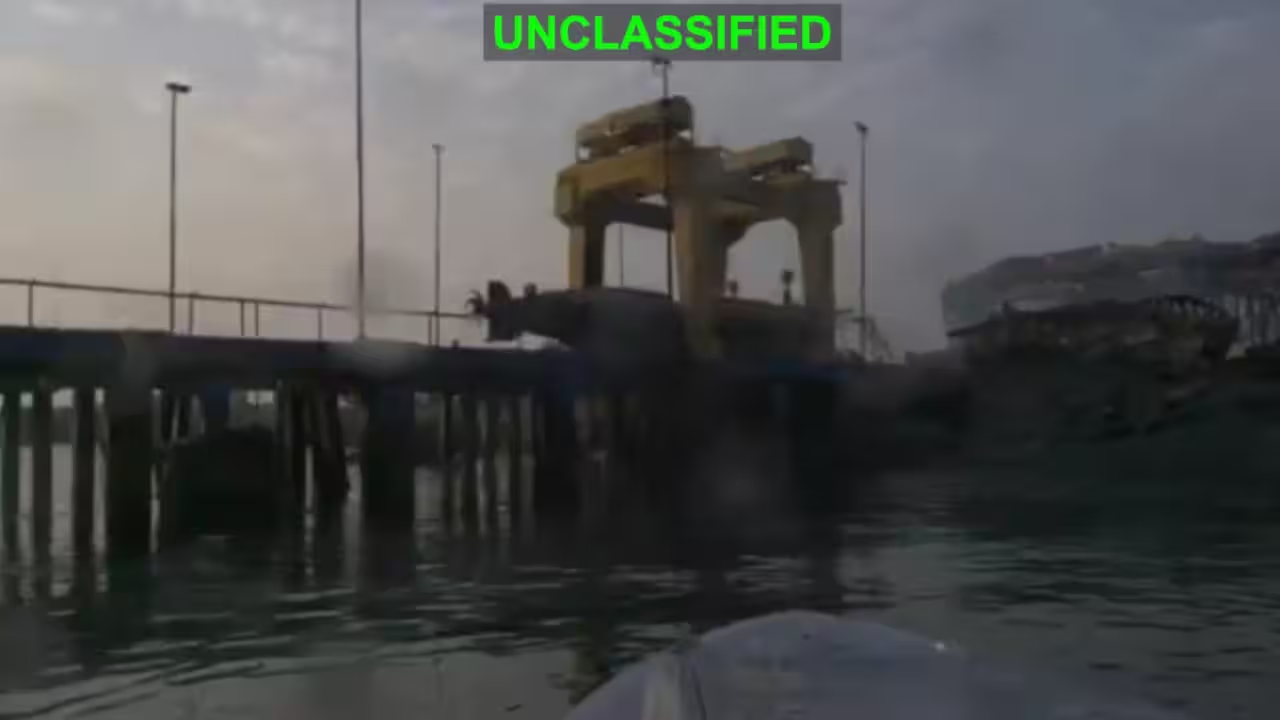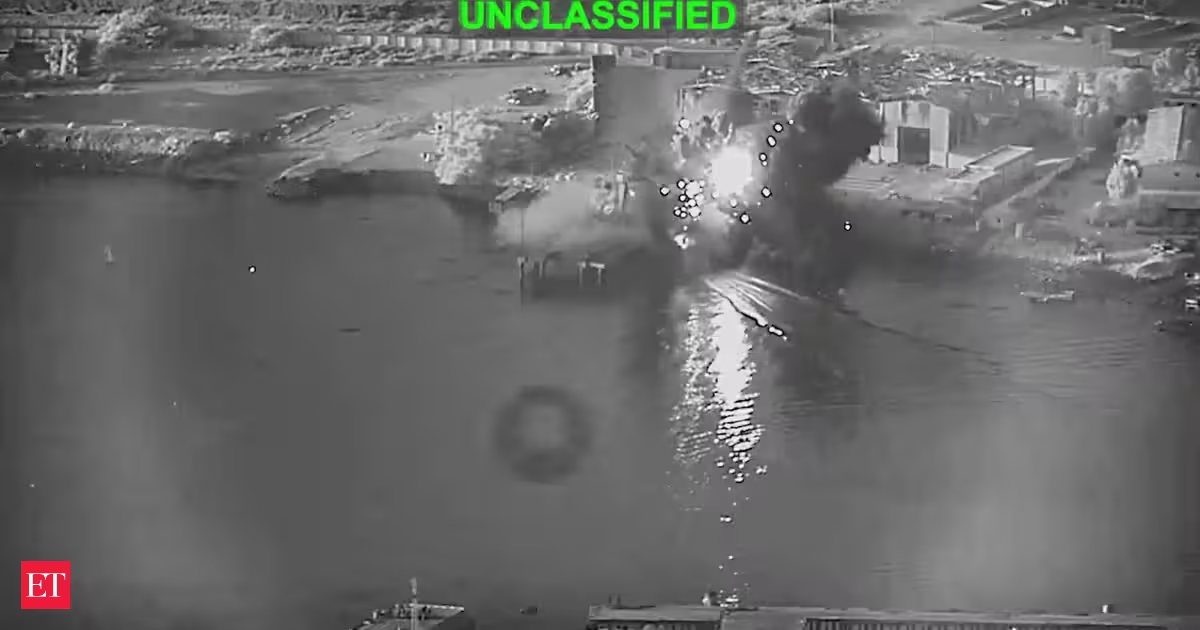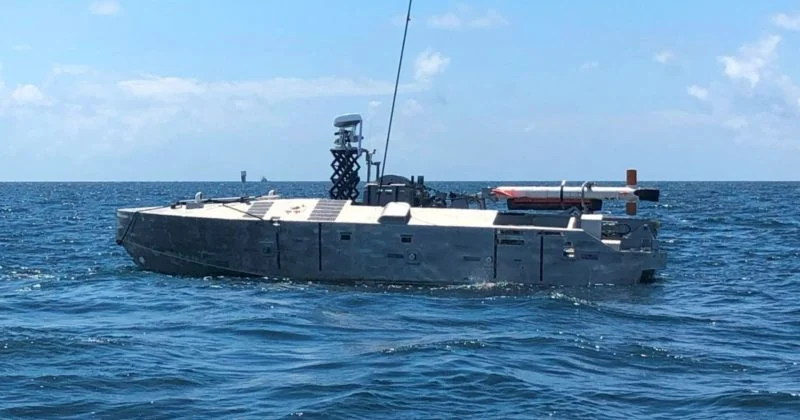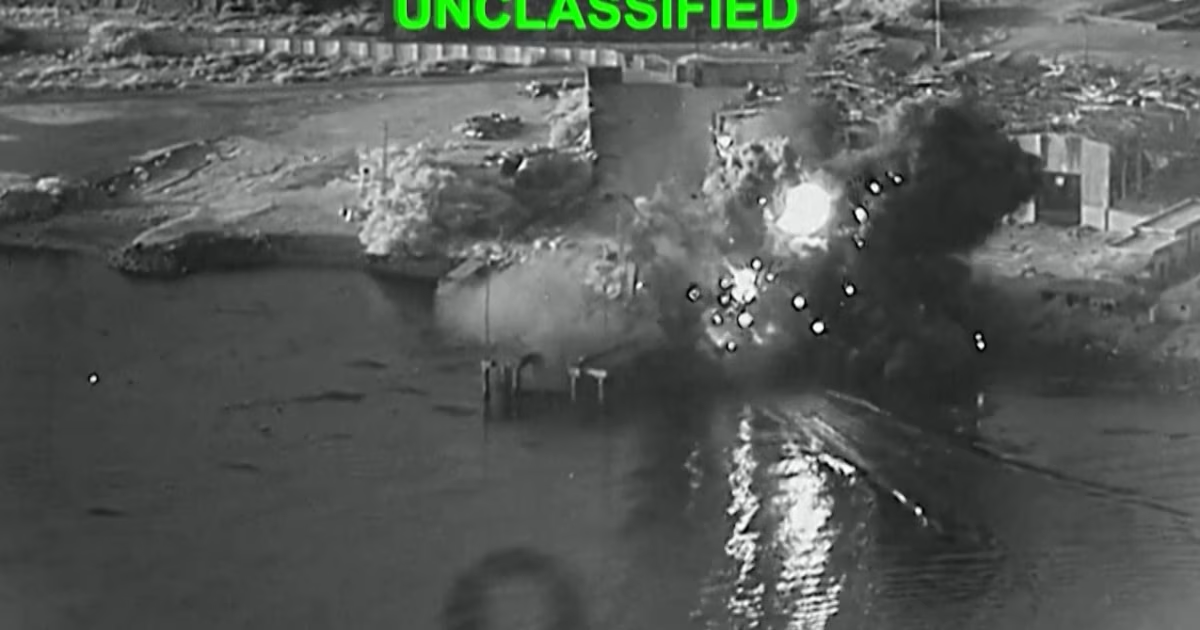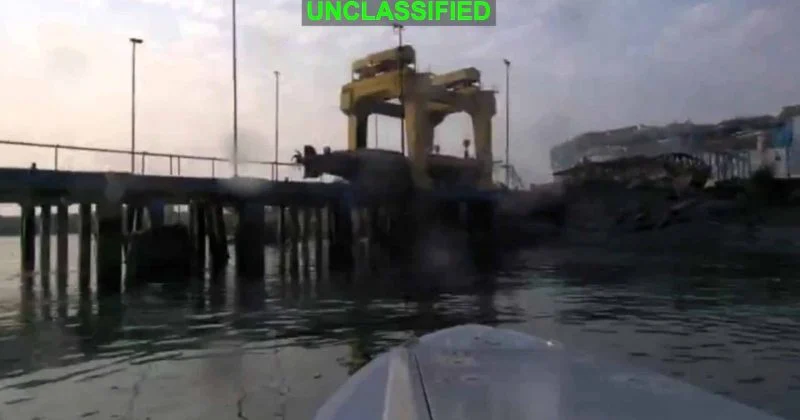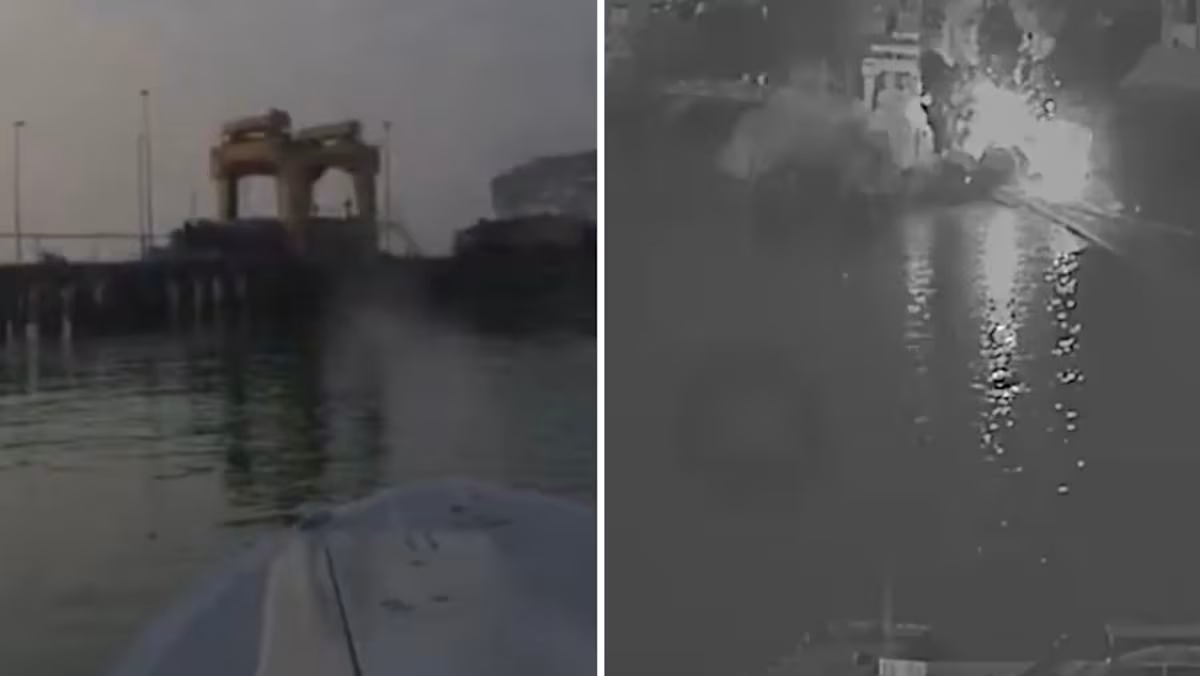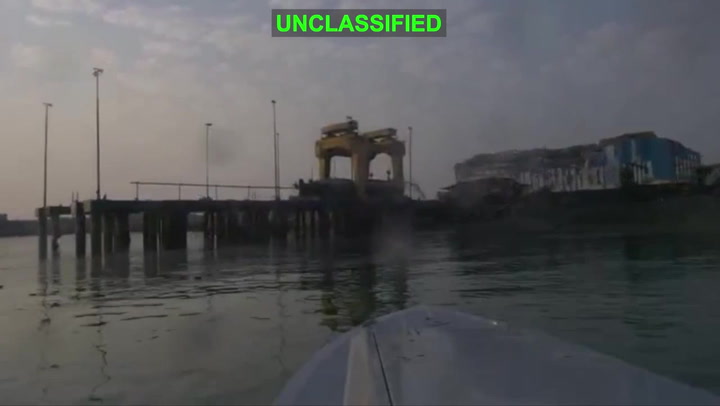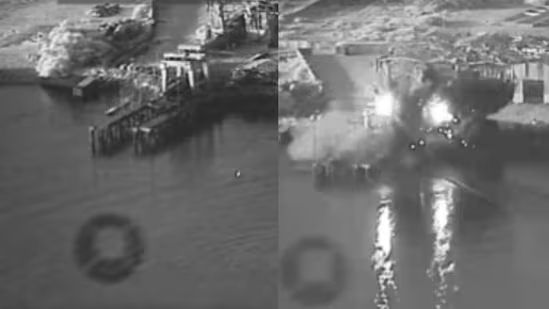
Sea drones, costing much less than a naval-class warship, are proving more effective in warfare, easing cost efficiency for conflict-hit nations like Ukraine. With tensions swiftly escalating in West Asia, the US on Sunday used armed sea drones in combat for the first time, attacking a submarine and a ship maintenance facility at Iran's Bandar Abbas naval base, the Pentagon said.The US Central Command said it struck a port at Bandar Abbas naval base with three Corsair unmanned surface vessels on Sunday. (X/@CENTCOM)The US’s Corsair sea drone was seen for the first time in the ongoing conflict when Washington rescued the crew of a downed Apache helicopter near the coast of Oman in June.In a post on X, the US Central Command said it struck a port at Bandar Abbas naval base with three Corsair unmanned surface vessels on Sunday. It also shared a video of USV moving toward a dock and exploding upon impact.What is a sea drone?Essentially, a sea drone is an unmanned maritime vehicle, operated on or under the water. From surveillance to striking, they are used for a vast range of tasks.Sea drones are used for surveillance, mine detection, enemy activity tracking, and some are even deployed for combat roles, proving useful in both routine monitoring and high-risk operations.What is the US's Corsair sea drone?Manufactured by Texas-based Saronic Technologies, the Corsair is a 24-foot boat-like sea drone. The autonomous surface vessel is designed to operate without a crew.The Corsair sea drone has a range of 1,000 nautical miles (nm), a carrying capacity of 454kg and a top speed of 35 knots.The drone is operated by Task Force 59, the US Navy's first unit dedicated to unmanned systems. The unit, created in 2021 and based in Bahrain, began inducting the Corsair in West Asia in late March.Sea drones growing crucial in warfareWhile the US strike caught the spotlight, attacks using unmanned maritime vehicles have been spearheaded by Ukraine during the course of its war with Russia.Kyiv has sought to revolutionise naval warfare, just as unmanned aerial vehicles have changed the skies.Ukraine has been using unmanned vessels since at least 2022, when Russia launched a full-scale invasion of the Volodymyr Zelensky-led country, according to The Wall Street Journal..WSJ reported that strikes by ‘Sea Baby’ – an unmanned surface vehicle, which is a product of Ukraine's Security Service– were key to Kyiv destroying a bridge connecting occupied Crimea with Moscow in 2023. The Kerch Bridge was instrumental for Moscow in arms supplies for Russian forces in southern Ukraine.Sea Baby is an unmanned surface vehicle, which is a product of Ukraine's Security Service. (u24.gov.ua)Kyiv engaged kamikaze drone boats, each worth $300,000, to sink 13 Russian vessels and damage many more, according to Bloomberg.Ukraine is producing and deploying four million drones – aerial and maritime – a year, a number far higher than the US's, 50,000, Bloomberg reported.Observers say Ukraine, which many – including then US president Joe Biden – believed would fall within days of the invasion, has held on to its ground by deploying technology that could counter or minimise Russia’s massive military.Other countries arming tooFrom Europe to China, countries are racing to boost their arsenal of unmanned vehicles.Last month, the Donald Trump-led US administration gave four Ocean Aero Triton autonomous underwater and surface vehicles to the Philippine military to strengthen Manila's maritime security abilities, the US embassy said.The solar-powered sea drones, acquired by the Philippines and valued at $13 million, can operate for up to 30 days without crews.Ocean Aero Triton autonomous underwater and surface vehicles were given to the Philippine military by the US in June, 2026. (oceanaero.com)Manila’s move to boost its strength in the waters came as its ties with China were being tested. Beijing, in May, installed a floating structure in Scarborough Shoal, a triangular atoll in the South China Sea, which Manila said was an integral part of its territory. This issue arose because Beijing claims almost the entire South China Sea despite a 2016 arbitral ruling that invalidated China's claims.As Manila lodged a diplomatic protest with China, Beijing removed the floating structure, clarifying that it was only meant for “scientific work”, Reuters reported.After the row over the floating structure, China also imposed sanctions on the Philippines' defence secretary in June.China and TaiwanChina has been heavily investing in drones. The People’s Liberation Army (PLA) unveiled a unit of large unmanned underwater vehicles (UUVs) at the country’s Victory Day military parade in September 2025. These included the HSU100, which can be deployed for intelligence gathering, and the AJX002, known for its mining capabilities.Beijing aims to control the South China Sea, said Benjamin Blandin, a research fellow at the Institute for National Defense and Security Research in Taipei, in a Bloomberg report.It already uses the 58-meter, 500-tonne Orca JARI-USV (unmanned surface vehicle)-A for anti-submarine warfare and patrols. The USV is equipped with phased-array radars and an unmanned helicopter.Orca JARI-USV is equipped with phased-array radars and an unmanned helicopter. (janusdefense.com)In response, Taiwan relies on a strategy to choke the waterway between it and China with cheap anti-ship weaponry.USVs, like the Magura developed by Ukraine, are expected to play a crucial role in Taiwan’s fight to counter China's power.The island is also developing its own maritime weapon: the Kaui-Chi attack USV, and its government plans to procure 1,320 such USVs, according to Bloomberg.Magura, manufactured by Ukraine's Uforce, are expected to play a key role in Taiwan's counter to China. (AFP)Thomas Shugart, a former US submarine captain and an adjunct senior fellow at the Center for a New American Security, told Bloomberg that unmanned vehicles, above and below the sea surface, are the need of the hour.“They are the kind of thing we need more of -- distributed, survivable, relatively affordable systems that can help deny China the ability to use the seas around Taiwan and the First Island Chain,” Shugart said.Japan in the mix tooJapan has contracts with IHI Corp and Mitsubishi Heavy Industries Ltd for weapons production and has allocated around $600 million for coastal defence drones in the current fiscal year, Bloomberg reported.The country’s defence ministry last month said that developing an asymmetric defence posture combining "inexpensive, mass-produced" unmanned aerial and underwater drones "has become a more urgent priority than ever before”.Japanese defence minister Shinjiro Koizumi had told Bloomberg TV that drones were critical military technology for Tokyo. “I believe the Japanese self-defence forces must become the world’s best military at utilising unmanned assets, so we will firmly invest there,” he said.Uforce, the Ukrainian company that manufactures Magura and other attack drones, was among the firms that made a pitch to Japan for delivering thousands of unmanned sea vehicles.Oleg Rogynskyy, the Ukrainian chief executive of Uforce, said that the interest in USVs was high. “Combat-proof is absolutely key to anything moving forward here,” he said.Uforce, according to Bloomberg, was in talks with other countries across the Indo-Pacific too and aims to build at least two manufacturing facilities in the region.The pros and consWhile sea drones are increasingly becoming more common for maritime security, operating large fleets poses its own challenges.Underwater vehicles are more expensive and complex than surface vehicles because they operate submerged and are more difficult to communicate with.But these can operate in high-risk areas and perform key tasks such as intelligence gathering, mine-laying and missile strikes. They add depth to a country’s naval force and help protect crewed ships and submarines, especially in conflicts that could drag on.The relatively low cost of sea drones – where a US warship might cost between $10 billion and $15 billion, a Ukrainian sea drone costs much less, at around $250,000 – offers militaries with small budgets and limited manpower the ability to take on more than their weight.Max Hastings, in an opinion piece for Bloomberg, spoke of the ability of drone warfare by citing a Rudyard Kipling poem, 'Arithmetic On The Frontier'.“A scrimmage in some border stationa canter down some dark defiletwo thousand pounds of education drops to a ten rupee jezailthe squadron’s boast, the crammer’s prideshot like a rabbit in a ride.”In essence, the 1886 poem conveyed that a country may spend large sums on training and educating officials, but in a moment, a low-cost weapon can eliminate those soldiers.Hastings cited the poem to reflect on how the US pays around $4 million every time a Patriot missile shoots down an Iranian drone in the West Asia conflict, while Tehran bears a much smaller loss -- ranging between $7,000 and $35,000.Asmita Ravi Shankar is a Senior Content Producer at Hindustan Times, based in New Delhi. She covers breaking news and focuses on crime, geopolitics, and the domestic political landscape. She has an eye for the intricacies in criminal investigations and a keen interest in how diplomacy and complexities affect politics, within India and globally.
US strikes Iran port with sea drones: Why militaries around the world are rushing to get them
Sea drones, costing much less than a naval-class warship, are proving more effective in warfare, easing cost efficiency for conflict-hit nations like Ukraine. | World News
1,664 words~8 min read