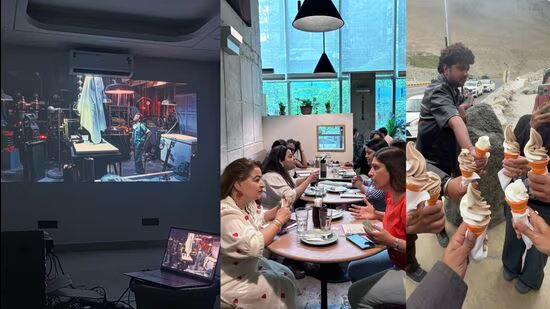
For many non-theatrical film screenings in Delhi, this has been a ritual: silence, cinema, discussion. Today, the silence hangs in Mool, a basement used for film screenings and discussions. Arnab from Camera Commune, paces by the white walls of the basement, helming the proceeds of the evening smoothly. It is The Young Karl Marx (2017), chosen to mark the birthday of the father of communism. Once the film is over, a discussion will follow.What led to this culture around films in the capital? Recent reports have flagged an 83% drop in the footfall of multiplexes since 2016, from 49,000 people a day in 2017 to 21,541 in 2024. While management ascribes it to people skiving off to NCR cities like Noida and Gurugram instead of Delhi for inexpensive tickets, what they miss is the rise in alternative modes of film-watching in the city.
A screening of Mrinal Sen’s ‘Chorus’ (1974)
| Photo Credit:
Special Arrangement
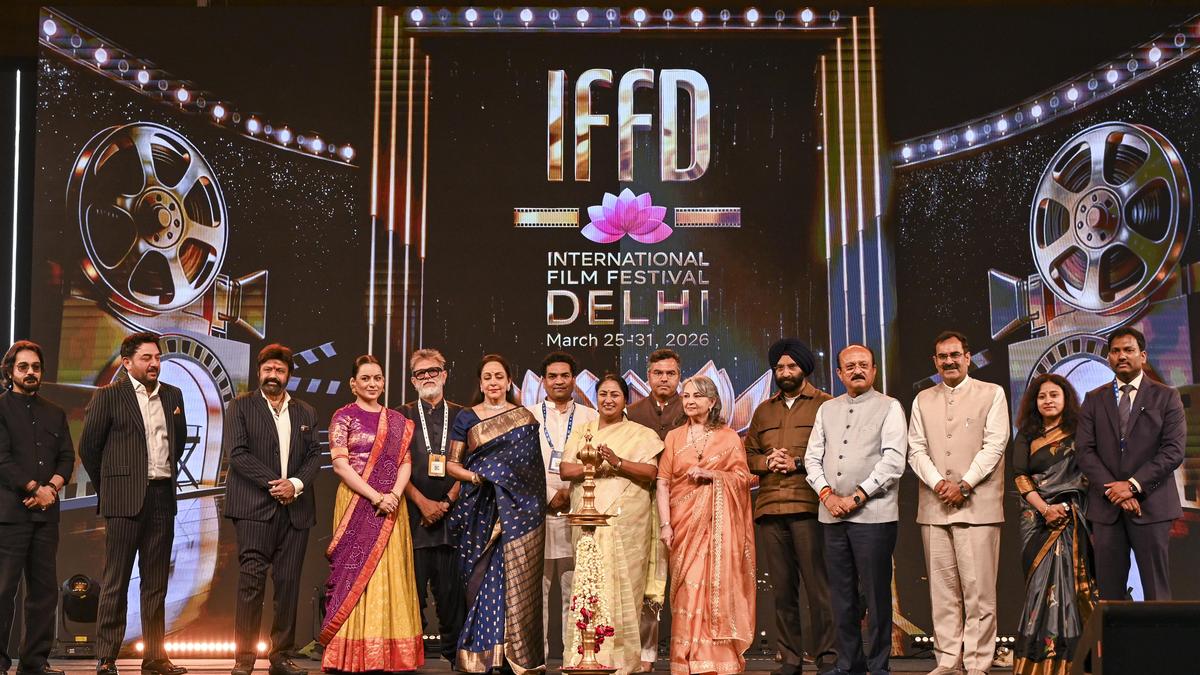
Delhi’s film club culture began in 1959 with the founding of the Delhi Film Society by Vijaya Mulay, Marie Seton and Muriel Wasi. Vijaya Mulay, then an Education Officer in Delhi, Marie Seton, a British actress and experienced activist of the British Film Society movement, and Muriel Wasi, an educationist and a bureaucrat, came together to establish the Delhi Film Society. Their inaugural film was Battleship Potemkin (1925). Since then, the film society culture of the city has seen a rise and fall, going out for a bit in the 1980-90s with the rise of video, satellite TV and multiplex. Today, consistent, if scattered, film club culture thrives in the city, with occasional festivals enjoying a formidable turnout.Chiefly, there are two Delhi film festivals: The Delhi International Film Festival (DIFF) and International Film Festival of Delhi (IFFD). Here, films and discussions alone are not the focus. The two festivals arrive with the complete shebang: Met Gala-esque red carpet photo points for stars, business networking sessions, masterclasses by veteran filmmakers, social-media glitz and hype. This year, in its first edition, IFFD offered an eclectic line-up, pairing global cinema with commercial crowd-pullers such as Dhurandhar 2 (2026).