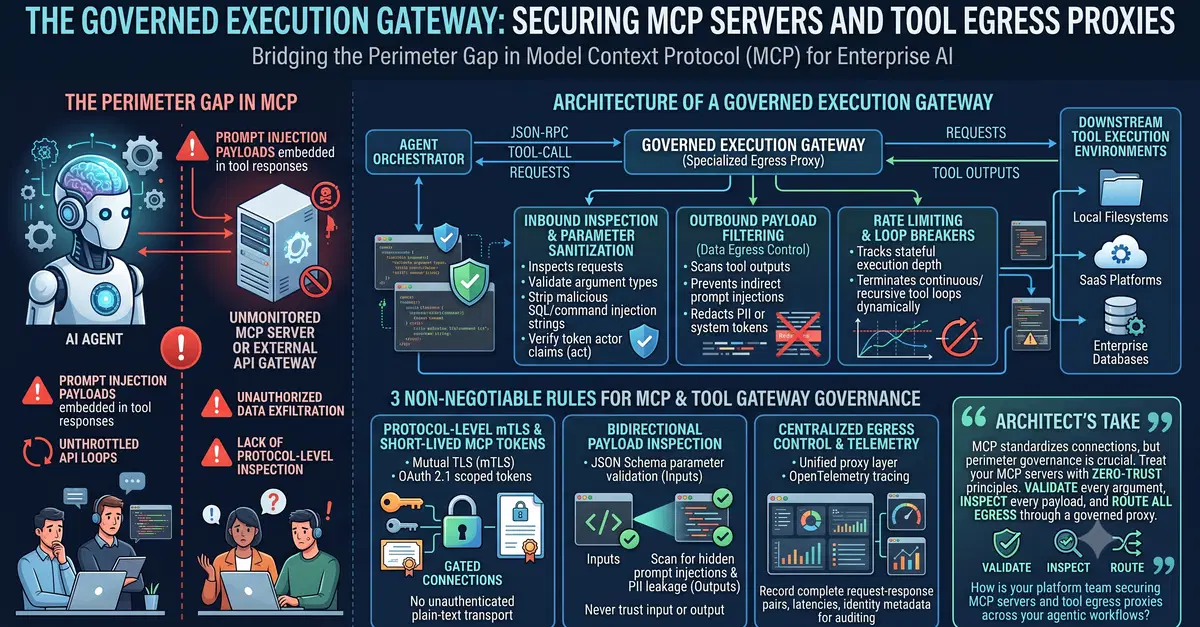
The Model Context Protocol is the connective tissue between LLMs and external systems — filesystems, databases, APIs, browsers, internal tooling. In a well-functioning agentic deployment, MCP lets a model read documents, query databases, and take actions in the world. In an adversarial deployment, MCP becomes the mechanism by which attacker-controlled content reaches a model's context window and convinces it to take actions the user never authorized.
We previously covered the RCE class of MCP vulnerability and AEGIS detection at the network layer (Anthropic MCP RCE: 7,000 Servers Exposed). This piece is about a different and subtler problem: the confused deputy — the provenance gap in the protocol design itself — and the specific attack paths that flow from it.
What Is the Confused Deputy Problem in MCP?
The confused deputy is a classic access-control concept: an entity with legitimate authority is manipulated by an untrusted party into exercising that authority on the untrusted party's behalf. In MCP, the confused deputy is the model itself.
Here is the structural problem: when an MCP tool call returns a result, the protocol carries the content of that result into the model's context window. It does not carry cryptographically attestable information about where that content came from, who produced it, or whether it has been tampered with in transit. The model receives a tool_result and must decide how to act on it based on its content — but the content could come from a trusted server, a compromised server, a DNS-rebinded endpoint, or a webpage that an attacker controls and has stuffed with instruction text designed to override the model's behavior.