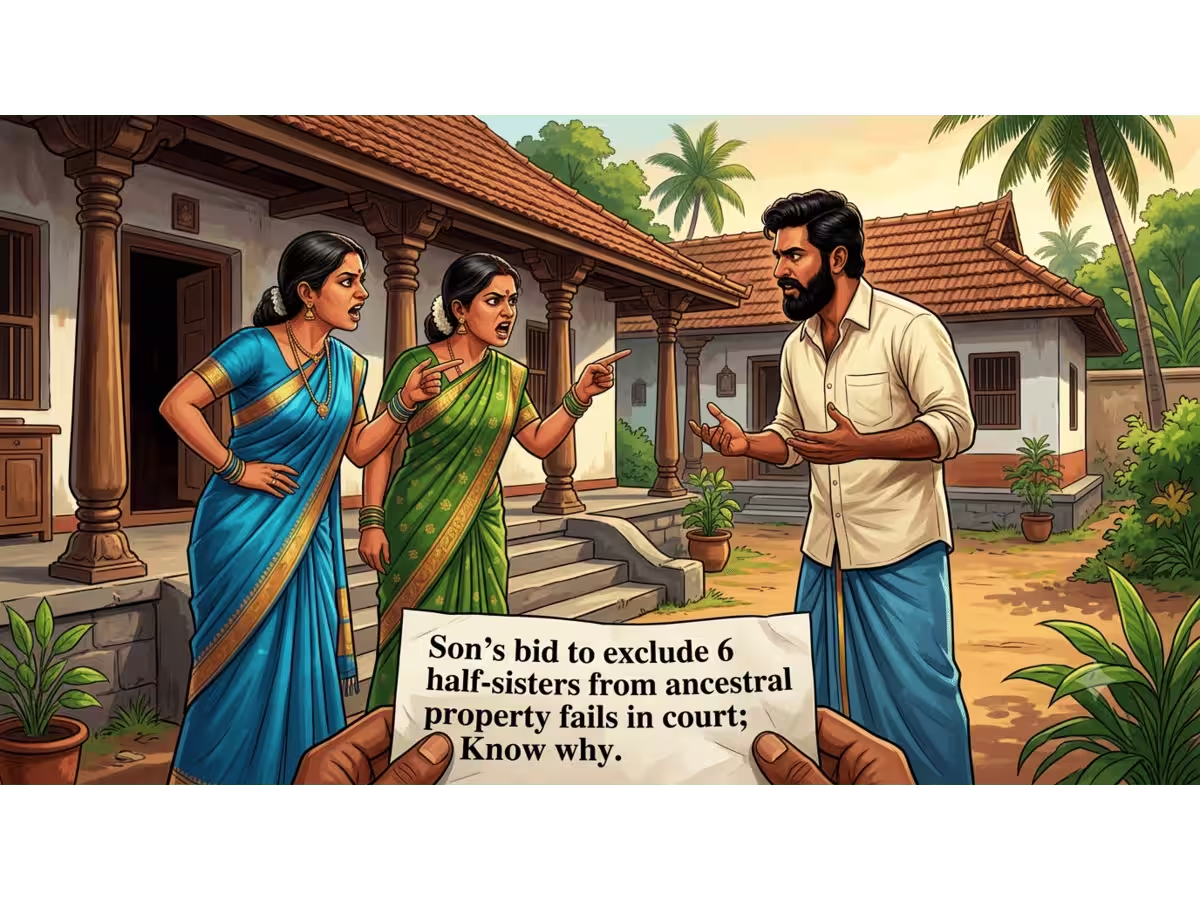
The Andhra Pradesh High Court recently ruled that six half-sisters were entitled to a share in their father's ancestral property despite opposition from their half-brother. The court observed that though their father had executed a relinquishment deed in favour of the son, he could relinquish only his own share and not the daughters' independent rights in the ancestral property.The primary dispute between the half-brothers and sisters revolved around the two properties owned by the grandfather in Andhra Pradesh: 'A' and 'B'. Property 'A' is a land measuring 780 sq.yards, and property 'B' is a house in Ramanayyapeta, Kakinada, Andhra Pradesh measuring 300-square-yard.To give you some background on their family dynamics, the son lost his mother when he was around 7 to 8 years old. His father remarried and from this second marriage, he had six daughters while from his first marriage, he had a son and a daughter.The family tree is as follows:
How did this property dispute start?Turangi Somaraju's father had purchased some properties and passed away without a Will (meaning he died intestate). As a result, his properties became ancestral and Somaraju, being his only son, inherited them. Later on, Somaraju got married and had a son and a daughter with his first wife.Also read: Can a property buyer be evicted if the seller's title is forged or defective? Know what the law saysHowever, when Somaraju's first wife died, his son T. Satyanarayana was 7 to 8 years old. As time went on, Somaraju got married for the second time with someone called Raghava (second wife). With her, he had six daughters.When Satyanarayana grew up, he allegedly tricked his father and obtained his thump impression on a document called relinquishment deed on March 16, 1998. Satyanarayana told Somaraju that someone named Bonthu Suryanarayana was challenging their property's title and a court case had to be filed. However, no such case was filed, and there was no dispute with a man called Bonthu Suryanarayana.The relinquishment deed for which Somaraju gave his thump impression said he had relinquished all the rights to the property in exchange of Rs 80,000.(This relinquishment deed later became the main defence on whose strength Satyanarayana denied a share in Somaraju's property to his six half-sisters (Raghava's daughters).Also read: For 36 years brothers fought among themselves to get late elder sister’s property; Brother with sister’s registered Will wins for this reasonWhen Somaraju (father) subsequently got to know about this fraud, he immediately executed a registered cancellation deed and, along with his daughters, sought partition of the properties.Satyanarayana disputed his father's claim, asserting that Raghava was merely Somaraju's 'concubine' and that her six daughters were not entitled to any share in the property. The litigation ultimately reached the Andhra Pradesh High Court, which upheld the daughters' rights in the ancestral property.Moreover, during the pendency of this case, Somaraju had died, and so his second wife Raghava was sought to be brought on record as a legatee on the strength of Somaraju's Will dated March 18, 2008. This Will said that Somaraju's share in this ancestral property will go to Raghava.Satyanarayana's lawyer argued that the preliminary decree granting Somaraju's share to his second wife under a Will dated March 18, 2008 could not be sustained unless the Will was proved in accordance with Section 67 of the Indian Evidence Act. The Andhra Pradesh High Court rejected the contention, noting that the order bringing the second wife on record had never been challenged and therefore could not be questioned at the stage of the second appeal.Also read: Property sale revived after 9-year payment delay: Telangana HC lets buyer keep property deal alive with 12% interest penaltyKeep reading to find out why the half-sisters of Satyanarayana won the case.Why the half-sisters of Satyanarayana won the case?Adnan Siddiqui, Partner at King Stubb and Kasiva, said to ET Wealth Online: "The half-sisters succeeded because the defendant failed to substantiate either of his core defences, while the plaintiffs established both legitimacy and entitlement under Hindu succession law."According to Siddiqui, the father unequivocally deposed that he had married the second wife after the death of his first wife and that the six daughters were born from that marriage. The defendant produced no evidence to rebut this, despite admitting receipt of the pre-suit notice, failing to identify the second wife in court, and leading no independent proof of illegitimacy. Siddiqui says that his reliance on an alleged relinquishment deed also failed because the document was never produced or exhibited in accordance with the Indian Evidence Act, 1872, while the father had executed a registered cancellation deed disputing its execution and consideration. Siddiqui says: "Further, as both sides admitted the properties were ancestral and had devolved intestate from the grandfather, the daughters' entitlement arose by birth as coparceners under Section 6 of the Hindu Succession Act, 1956, rendering any purported relinquishment ineffective beyond the father's own undivided share."Andhra Pradesh High Court order and discussionJustice V. Gopala Krishna Rao gave this judgement on June 15, 2026 (case no. APHC010251382012)A summary of the judgement is as follows:Raghava's six daughters are not illegitimate childrenThe property was originally owned by Somaraju's father and after his demise, was inherited by him. So it is not a self-acquired property but rather an ancestral property in which Raghava's six daughters are entitled to one share on par with their father Somaraju.Before the court, Somaraju himself asserted that the six daughters are his own, born through Raghava, his second wife. So they are not illegitimate children. Satyanarayana did not give any evidence to the court to dispute this particular aspect. So the high court accepted them as legitimate.Somaraju claimed he did not get any money from signing the relinquishment deed which was obtained by fraudThe high court observed that Satyanarayana did not submit the relinquishment deed as evidence in court and neither did Somaraju ask the court for its cancellation. But Somaraju asserted that the contents of the Relinquishment deed are false.He himself pleaded that he has not received any amount as mentioned in the relinquishment deed and said that Satyanarayana fraudulently obtained the deed from him. The high court observed: "Therefore, it is for the defendant (Satyanarayana) to prove the alleged recitals in the alleged relinquishment deed. The alleged relinquishment deed is not even produced by the appellant (Satyanarayana) and the recitals in the relinquishment deed are not proved by the appellant (Satyanarayana)."Even if it is accepted that the relinquishment deed is true, then also Somaraju cannot give away others' share in the propertySatyanarayana's lawyer argued before the high court that based on this relinquishment deed (which is not presented to the court), his half-sisters cannot get a share in the property.However Satyanaryana's own father Somaraju told the court that he did not get any money as stated in the relinquishment deed and that this deed was obtained fraudulently by Somaraju.The Andhra Pradesh High Court observed that even if it is assumed that the relinquishment deed is true, Somaraju can relinquish only his undivided share in the ancestral property. The relinquishment deed on whose strength the share in property is denied is itself under disputeThe high court said that Satyanarayana did not produce the relinquishment deed as evidence and the recitals in the deed were disputed by Somaraju from the beginning. Somaraju had pleaded that Satyanaryana had obtained a relinquishment deed by fraud and did not pay any consideration of Rs 80,000 as mentioned in the alleged deed. The high court referred to a case law: Suhrid Singh @ Sardool Singh Vs. Randir Singh & Ors (AIR 2010 SUPREME COURT Page 2807 ) and said that the ratio laid down in the aforesaid case law is that "the sale deed cannot be cancelled except by an order of a competent court". Here, in the present case, the plaintiff has not sought any relief of cancellation of the relinquishment deed and the very basis of execution of the relinquishment deed itself is disputed by the appellant. High court order:The second appeal was dismissed at the stage of admission, confirming the judgment and decree of the First Appellate Court. So now after this litigation, the property can get partitioned and:? T. Satyanarayana (son) gets a share.? The six daughters through Raghava get their respective shares.? The daughter through the first wife gets a share.? Somaraju's own share devolves upon his second wife (Respondent No.8) under the Will.