JavaScript Atomics and SharedArrayBuffer in 2026: Practical Patterns for Cross-Worker State
This article was written with the assistance of AI, under human supervision and review.
Most cross-worker communication problems stem from treating workers as isolated processes when the workload demands shared state. Teams reach for postMessage by default, serialize multi-megabyte data structures on every frame, and watch their real-time audio pipelines stutter under 100ms message latency. The browser gives developers true shared memory through SharedArrayBuffer, but production codebases rarely exploit it because the API surface feels foreign and the security requirements seem burdensome.
The failure mode here is subtle but expensive. A video processing pipeline that bounces 1920×1080 frames through postMessage spends 15-20ms per transfer just copying pixels. That overhead compounds across worker boundaries until the entire system misses its 16.67ms budget. Meanwhile, a SharedArrayBuffer-backed ring buffer eliminates the copy entirely and keeps the same workload under 2ms.
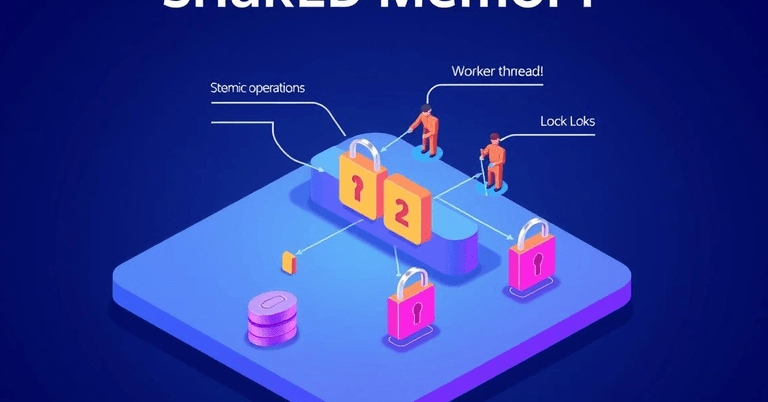
The correct approach places pixel data in shared memory once, then coordinates access with atomic operations. Workers read and write the same underlying bytes without serialization. The synchronization primitives—Atomics.wait, Atomics.notify, compare-and-swap—replace message passing with lock-free coordination that runs in microseconds instead of milliseconds.