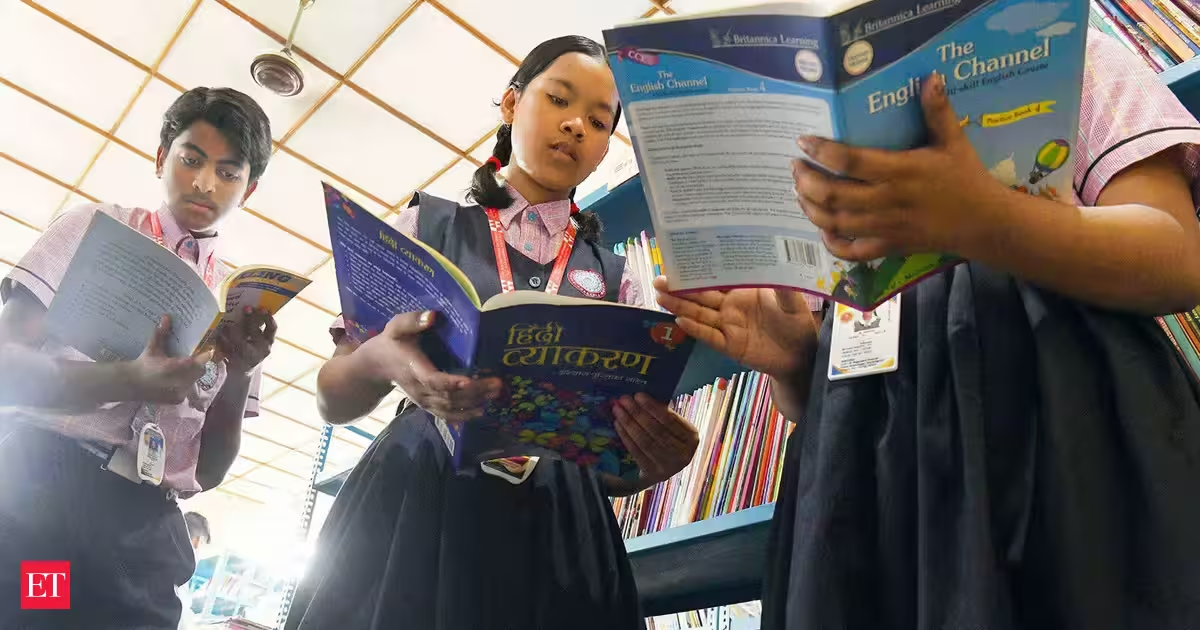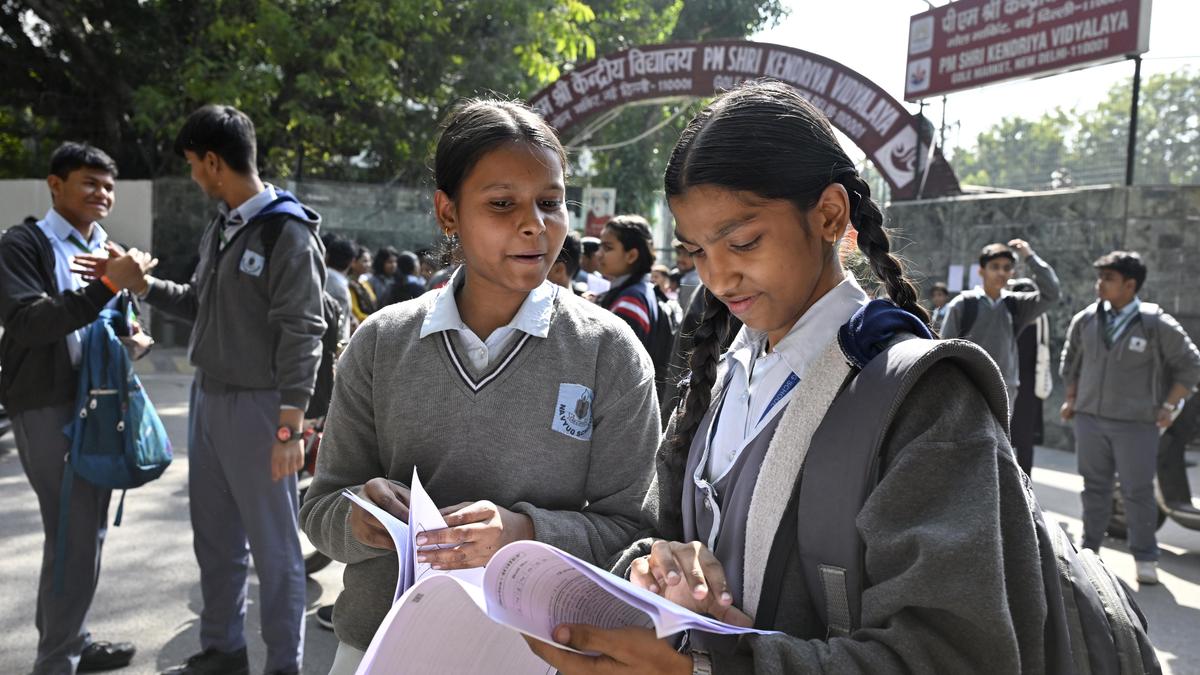
The July 10 circular follows an earlier circular released by CBSE on June 29, which stated that the three-language formula will be applicable from Class 6 onwards
| Photo Credit: Shiv Kumar Pushpakar
While third language (R3) will not be part of the board exam for students who enter Class 10 from 2027-28, the Central Board of Secondary Education (CBSE) has stated in its latest circular that students "must clear the school-based R3 assessment” in Class 10 to be awarded the Secondary School Examination Pass Certificate.This means that if students do not clear the internal assessment in their crucial board year, schools will be required to reassess unsuccessful students before the final results are declared, the circular dated July 10 stated. Language decorum: Editorial on the three-language formula in CBSE schoolsIt further stated that if a Class 9 student fails to qualify in the school-based R3 assessment, they will still be promoted to Class 10 for the 2027-28 academic year. However, they must clear the pending Class 9 R3 assessment while studying in Class 10. The July 10 circular follows an earlier circular released by CBSE on June 29, which stated that the three-language formula will be applicable from Class 6 onwards, with students required to learn three languages, of which two must be native to India. However, those students in Class 7, 8, and 9 who had already opted for learning an additional foreign language apart from English can continue to study the foreign language. In addition, they will learn a third language native to India. Earlier, students in Class 9 had dropped the third language, but CBSE guidelines issued on June 29 and later on July 10 have made it compulsory from academic year 2026-27 and for Class 10 in 2027-28. The circulars do not apply to the current Class 10 batch in 2026-27. Legal challengeAlso, the Education Ministry has submitted its response to a writ petition challenging the CBSE’s circulars on three-language policy. The petitioners have demanded that the CBSE restore its previous April 9 position, which effectively deferred the compulsory third-language implementation at the Class 9 level until the 2029-30 academic session. In a nine-page counter-affidavit filed on July 13, accessed by The Hindu, the Ministry defended the policy. Following a Supreme Court notice issued on May 27, 2026, Subhash Chand, Under Secretary in the Department of School Education & Literacy, filed the government’s response.The Centre stated that “Education” rests on the Concurrent List of the Indian Constitution, meaning both the Union and State governments share the responsibility of implementing the National Education Policy (NEP) 2020 framework.It has further stated that the implementation of the three-language formula serves legitimate public objectives, including promotion of multilingualism, preservation of Indian languages, cognitive development of learners, and advancement of the constitutional values of national integration and cultural diversity. Published - July 14, 2026 02:20 am IST