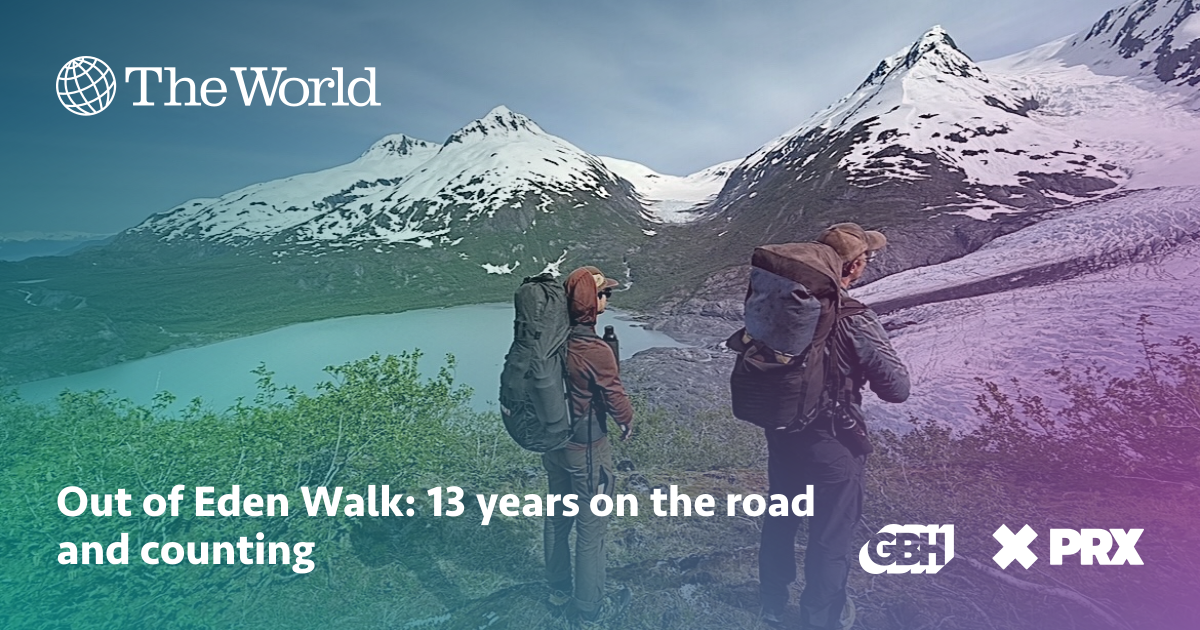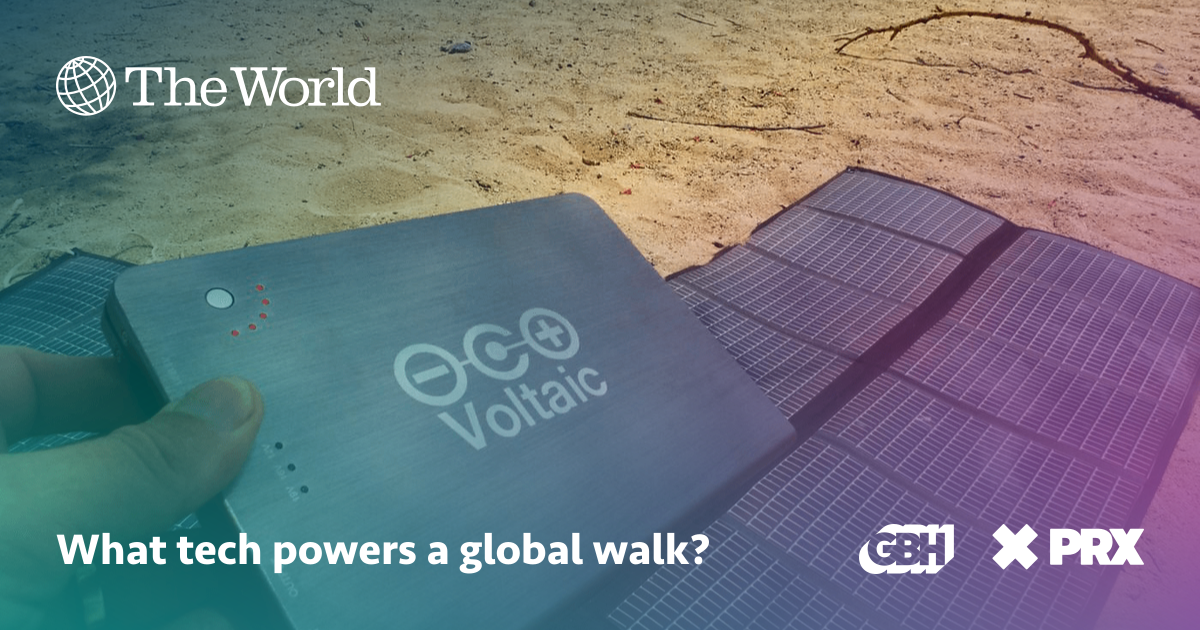
Public radio’s longest-running daily global news program.AboutContactDonateMeet the TeamPrivacyTerms of use©2026 The World from PRXPRX is a 501(c)(3) organization recognized by the IRS: #263347402.What tech powers a global walk?Paul Salopek is a National Geographic Explorer walking from Ethiopia to South America on foot. But it’s also a journalism job. That means conducting interviews, taking photos and videos, and nonstop note-taking and writing. He joins Carolyn Beeler to peel back the curtain on the technology that has kept him connected for the past 13 years, even when he is days of travel away from the nearest outlet or wi-fi signal.7:33Charging up on the trail. Four more precious hours of laptop life.National Geographic Explorer Paul Salopek is a man on a 22,000-mile walk from Ethiopia to the southern tip of South America. He’s documenting it all in a project known as Out of Eden Walk.Walking the huge expanses in between involves a lot of setting up camp in the middle of nowhere. That might sound low-tech, but a job is still a job. Salopek has to write, take photos and communicate with colleagues, including regular check-ins with The World. “Every day I’m recording things. I’m taking photos, I’m recording audio, I’m recording video, I’m jotting notes, I’m doing interviews,” said Salopek. “And then once every week or two, I have to kind of draw all this information together into a story.He joined Host Carolyn Beeler recently to peel back the curtain on the technology that keeps him connected even when he’s far from power outlets and cell towers.“I’m mainly a writer, but they often have, you know, visual elements. So I have to find a way both to record this stuff and to send it, right? From — it could be, you know, a 6,000-meter mountain pass in the Himalayas, or more recently, a desolate coastline in Alaska, where the nearest plug and the nearest Wi-Fi signal might be hundreds of kilometers away. It’s a challenge.”So we’re talking 7 kilograms, or about 15 pounds of stuff. Everything from like a MacBook Air, kind of the smallest available laptop. For satellite technology, I had a beacon. Remember the beacons? They’re the size of a plate. I don’t even know if they still make them, Carolyn, but basically they weighed about as much as a laptop, and you pointed at the sky, and it was expensive. You know, my editors were saying don’t leave it turned on. It was, I think, $7 per megabyte back then. Now, for $50, using Starlink, you can send 100 gigabytes. I carried a satellite phone. I had a digital kind of camera, a great camera, a Canon, but it was like one of those bricks. I had a digital audio recorder, external power banks and solar panels too. And all this stuff used up maybe half of my pack.Today, all these years later, I’m on one platform. I’m on a smartphone, basically. That’s where I do my video, my visuals and my audio. I even take notes on it sometimes. So yeah, it’s gone from 15 pounds down to 6 ounces.For two reasons. One is just riding this wave of miniaturization. God knows by the time I reach Tierra del Fuego, I might have some implant in my eye and just blink and take a picture, right? I won’t do that. But the other thing is, the world is simply getting more and more wired. When I started out walking, getting a cell signal was kind of a rarity that was kind of limited to big cities and highways. Today, there are cell towers everywhere. One example: China. I walked through the hinterlands of China for two and a half years. The time that I had off-grid was one day. It’s just that wired.So today it’s a laptop and a smartphone, and I still do carry a Zoom recorder, and that’s about it.Yes, yes, that’s right. And, and there’s — I’ll add one more kind of anthropological little detail. Imagine when you and I were starting out [as journalists], whenever in our careers, and we had to carry all this equipment, coming up to somebody’s house and just poking all this technology into somebody’s face. It was intimidating for that poor person, right? And you had to kind of prepare them for it. Today, everybody is carrying a smartphone. And so when I’ve reduced my technological burden, literally and kind of figuratively, there’s no barrier anymore because people are recording their lives so much themselves that one skinny guy walking through the landscape and taking pictures with his phone causes no ripples at all, right? That’s one advantage of you kind of simplifying this technology.I’m still an analog guy, in that I carry a notepad with me all the time. I’m addicted to taking handwritten notes. Could be some idea, it could be something I’ve seen. So I know that my kind of narrative biorhythm is, like, once every week or two weeks, I need to produce something. So that tension’s building up as the kilometers roll under my feet, and by the time I know that my editor is waiting for something, I have to sit down and go through my notes, these handwritten notes, and by then, usually I figure out like two or three issues. What is the most interesting one? It could be the portrait of a fascinating individual. It could be something political. It could be something more lyrical, metaphorical. Um, so that’s how it happens. It’s kind of this organic building up.Both. Yeah, both. This is another thing that people may not realize if they haven’t, you know, spent time with reporters is we’re information consumers. So, you know, when I do have a phone signal, I — here’s my practice: I always walk with the phone turned off, you know, kind of regardless. I mean, like, on airplane mode. I’m not looking at social media. I’m not scrolling the news wires. I do that at night, but I still do it, right? And so I could be in a one-man tent on a beautiful bay, a glacial bay in Alaska, and then if there’s a signal, my instinct is to see what’s happening in the news in that part of Alaska, because it might be the source of a story idea.Parts of this convo have been lightly edited for length and clarity.Writer and National Geographic Explorer Paul Salopek has embarked on a 24,000-mile storytelling trek across the world called the “Out of Eden Walk.” The National Geographic Society, committed to illuminating and protecting the wonders of our world, has funded Salopek’s project since 2013. Explore the project here. Follow the journey on X at @PaulSalopek, @outofedenwalk.
What tech powers a global walk? - The World from PRX
Paul Salopek is a National Geographic Explorer walking from Ethiopia to South America on foot. But it’s also a journalism job. That means conducting interviews, taking photos and videos, and nonstop note-taking and writing. He joins Carolyn Beeler to peel back the curtain on the technology that has kept him connected for the past 13 years, even when he is days of travel away from the nearest outlet or wi-fi signal.
1,115 words~5 min read