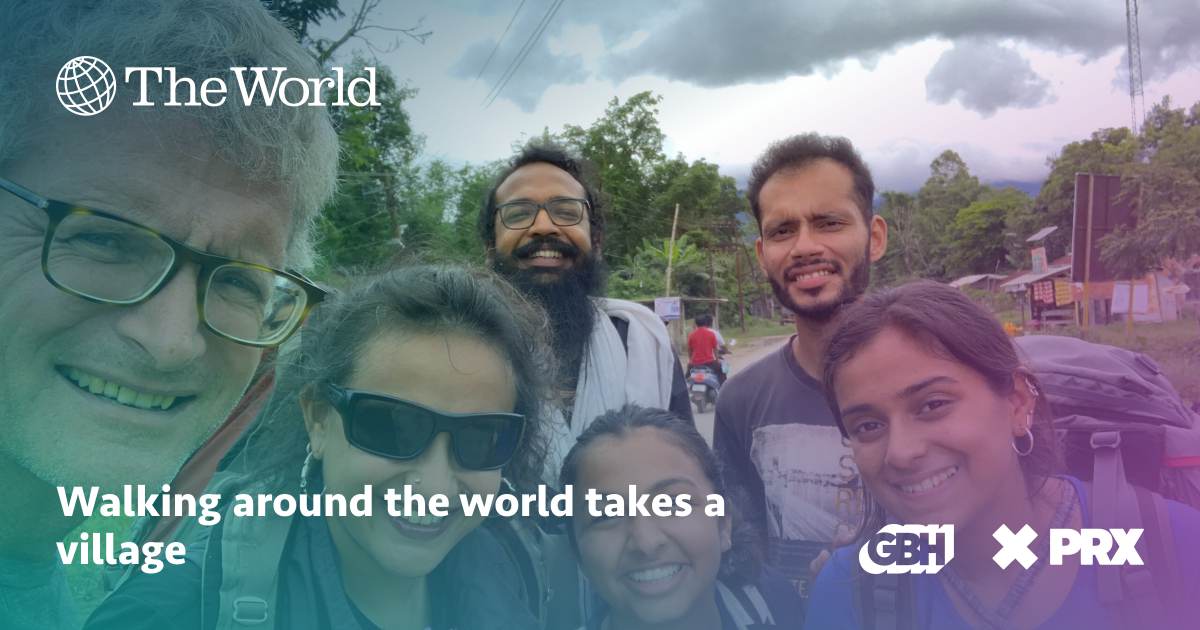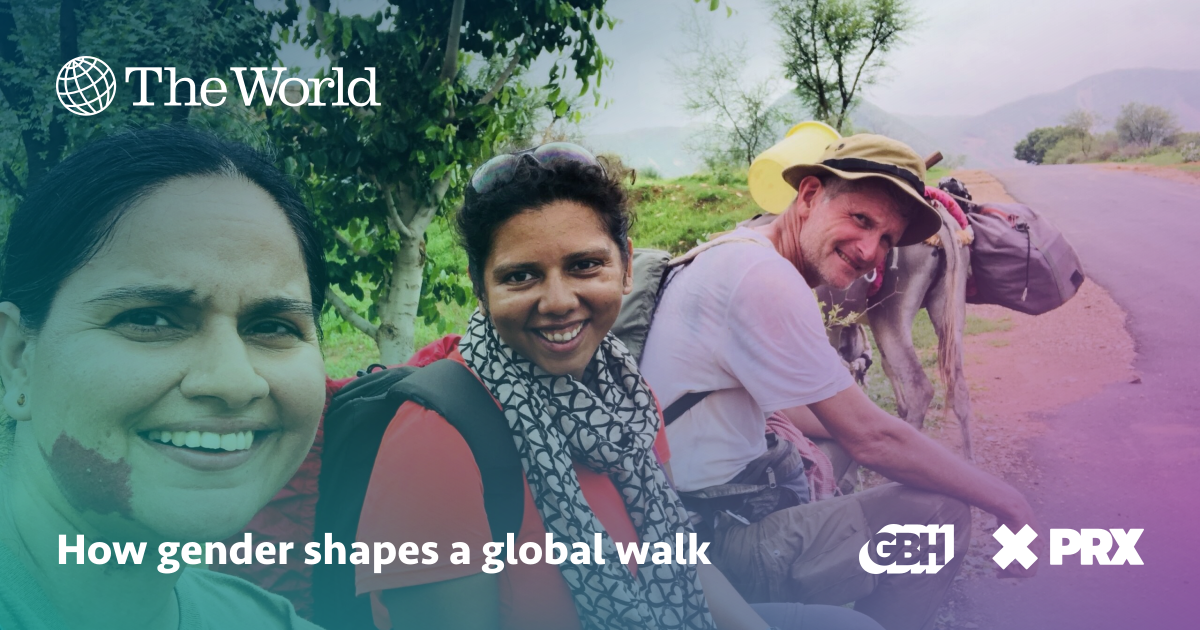
Public radio’s longest-running daily global news program.AboutContactDonateMeet the TeamPrivacyTerms of use©2026 The World from PRXPRX is a 501(c)(3) organization recognized by the IRS: #263347402.How gender shapes a global walkNational Geographic Explorer Paul Salopek has been walking around the globe on foot for over 13 years. One facet of life that he encounters everywhere he goes is gender. He joins Carolyn Beeler to talk about the importance of walking alongside women in his travels and what’s missing from his project when social barriers make speaking to women difficult. Out of Eden WalkJune 12, 2026Updated: June 12, 20268:13Loveleen Mann (left) and Priyanka Borpujari take a break with Paul Salopek on the trail in India.Gender shapes how we experience the world in many different ways. It can dictate where you can or can’t go, where you feel safe and even what you see and experience when you travel.National Geographic Explorer Paul Salopek has been walking across continents for years. He calls it the Out of Eden Walk. The last time The World’s Host Carolyn Beeler caught up with Salopek, he said that walking might sound like a pretty neutral thing, but the project is still shaped by his gender.“The thing that walking did was, basically, reinforce a perception that I’ve carried around for many years, even pre-walk, which is if there’s one kind of social justice issue that’s kind of the most pervasive, it’s gender,” Salopek said. It’s, you know, how women and men, in this case, these two genders, are differentiated; who has power, who doesn’t, in both obvious and subtle ways.”Paul Salopek: I would say it’s approaching half, which sounds great, except that it’s not evenly distributed. This is not a particularly even sample. In rural societies anywhere, and ones that also have religious strictures about mixing genders, it’s really hard to get women walking partners to come walk with a stranger like me. So, I would say the first few years of the walk, almost none, actually one. And then it was made up for in India, China, then the Far East. It became much more, much more balanced.Not just for kinds of statistics, but actually even repertorially. As a journalist, you’ll know this: You miss out on half the world, half the human experience that’s not your gender, or it’s just much more difficult to kind of get access to that world. So, walking with men and women has pluses and minuses for me as, kind of, an aging white dude. But walking with women has, I’ve got to say, even more pluses because I get access to the women’s world through my female walking partners, who, imagine if we were walking into a village and we come in to stay at a farmer’s house or a shepherd’s house, it’s often segregated. The women are kind of behind a wall or behind a curtain. They come out and maybe greet you in the common living space, but I can’t really go back in with them to talk or watch them work. Whereas a woman walking partner can share her learning with me. So, walking with women has many more benefits in that respect.Journalist Bhavita Bhatia is one of 14 women who have joined Paul Salopek on his global storytelling trek. She says that walking through two Indian states known for their conservatism and violence has made her confident that she “could go back and do it” again — alone.Paul Salopek/National Geographic, Out of Eden WalkYeah. And this is something I wish I had my women walking partners on this call, because they would be much better at informing you. But it does raise questions, again, particularly in conservative societies, about, “Hey, what’s your relationship?” You know, speaking to my woman walking partner with this guy … “Is he your partner?” And so, they would have to explain patiently over and over again that we’re colleagues and that we’re in a working relationship. It often puts my women walking partners a bit on the spot, as you can imagine, right? Their intentions are being questioned. Something that a guy probably would not face. This is something that my women walking partners taught me over time, even as a reporter before this project: If I’m in a small village somewhere, country X, and I’m trying to interview a bunch of people on the street, they start talking to me, even though my language skills are not that great, and they ignore my walking partner. And so, I have to kind of stop, especially men, local men, and say, “Whoa, whoa, whoa, wait a minute, talk to my walking partner.” Or vice versa, if I want to talk to a local woman about, say, water issues, she’s doing a lot of the water carrying; she’s lugging water from a well. And when the water table’s dropping, the men start jumping in to talk for her, right? I have to kind of politely but firmly tell the guys, “Hey, I’ll get to you. I’ll get your side of the story, but if you don’t mind, let me talk to this woman about this experience.” Over and over again, this happens.I question my walking partners, men and women, closely about their comfort levels throughout the walk. From day one, even before day one, to kind of get a feel for what their comfort levels are with interacting with people who we don’t know. I’ll say the vast majority of people are always pretty friendly. They’re pretty curious mainly and kind of welcoming. But women walking partners may get more attention, and it could be very subtle things that aren’t communicated verbally, like looks, that I don’t get. And thank heavens we never experienced any kind of overt sign of violence, no physical aggression. There probably were some instances where a woman’s virtue was kind of questioned, maybe indirectly, by walking with me, which is kind of a … it’s a drag. But nothing, no kind of overt harassment that I could detect. And, of course, I’m checking with my women walking partners on a daily basis, many times a day. And so, that didn’t happen.Yeah, I mean, absolutely. There are societies where men kind of have subtle homoerotic relationships. Here’s the thing: I’m getting along in tooth. My hair’s kind of gray and white, so I’m sort of out of the game for better or for worse. But walking through China, there was, until fairly recently, a fairly open LGBTQ kind of community, you know, before there was a crackdown on it. I interviewed a woman who was running a bar, and she finally said she had to close that bar down, simply because the government wouldn’t come out and say, “Hey, we’re cracking down on you because it’s a lesbian bar.” They’re saying, “No, we have trouble with your electricity wiring, we have trouble with your plumbing.” They’re finding kind of picky ways to make it impossible for her to stay open. So, the ways of oppressing people on gender issues is infinite, right? Because you can just go sideways; you can do, you know, straight. But yeah, I did see some of this on the walk across the world.Parts of this interview have been lightly edited for length and clarity.Writer and National Geographic Explorer Paul Salopek has embarked on a 24,000-mile storytelling trek across the world called the “Out of Eden Walk.” The National Geographic Society, committed to illuminating and protecting the wonders of our world, has funded Salopek’s project since 2013. Explore the project here. Follow the journey on X at @PaulSalopek, @outofedenwalk.
How gender shapes a global walk - The World from PRX
National Geographic Explorer Paul Salopek has been walking around the globe on foot for over 13 years. One facet of life that he encounters everywhere he goes is gender. He joins Carolyn Beeler to talk about the importance of walking alongside women in his travels and what’s missing from his project when social barriers make speaking to women difficult.
TL;DRAI
Non rilevante per Warptech Tech News. L'articolo tratta questioni di genere e antropologia del viaggio (progetto Out of Eden Walk di National Geographic), senza connessioni a tech, AI, mercato IT o infrastruttura digitale. Non rientra nel target (manager IT, CTO, responsabili AI). Scarta da newsletter + feed.
1,262 words~6 min read