Google Research has unveiled SensorFM, a foundation model that learns a general representation of human physiology and behavior from wearable sensor data collected from five million people. The model can be applied to 35 different health and behavioral tasks.
Most health features on wearables today are built for a single purpose. One model detects sleep stages, another estimates cardiovascular risk, and yet another analyzes stress or metabolic markers. Google wants to replace these siloed approaches with a shared AI foundation that can make sense of continuous, often gappy sensor data across many health questions, cut the need for expensive labeled training data, and eventually feed personalized context into AI health assistants.
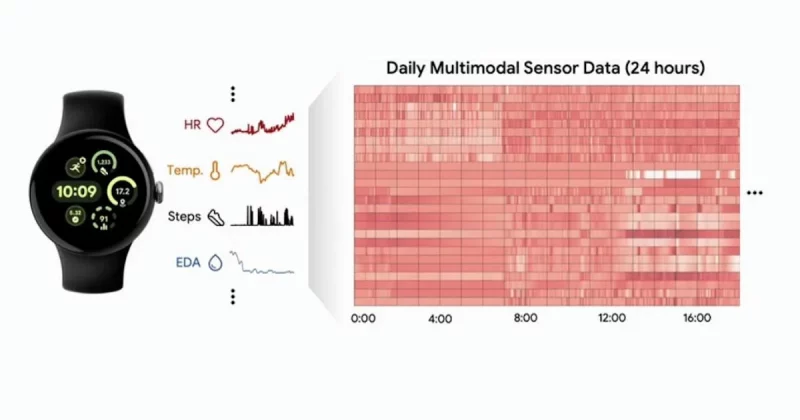
Google Research has now introduced SensorFM in a blog post and an accompanying paper. The foundation model learns a general, reusable representation of physiological and behavioral patterns from large volumes of unlabeled wearable data. The researchers used more than a trillion minutes of multimodal sensor data from five million Fitbit and Pixel Watch users for pretraining. The data came from over 100 countries and was collected with more than 20 different Fitbit and Pixel Watch models. According to the authors, this is the largest and most diverse wearable dataset ever used to train a model of this kind.