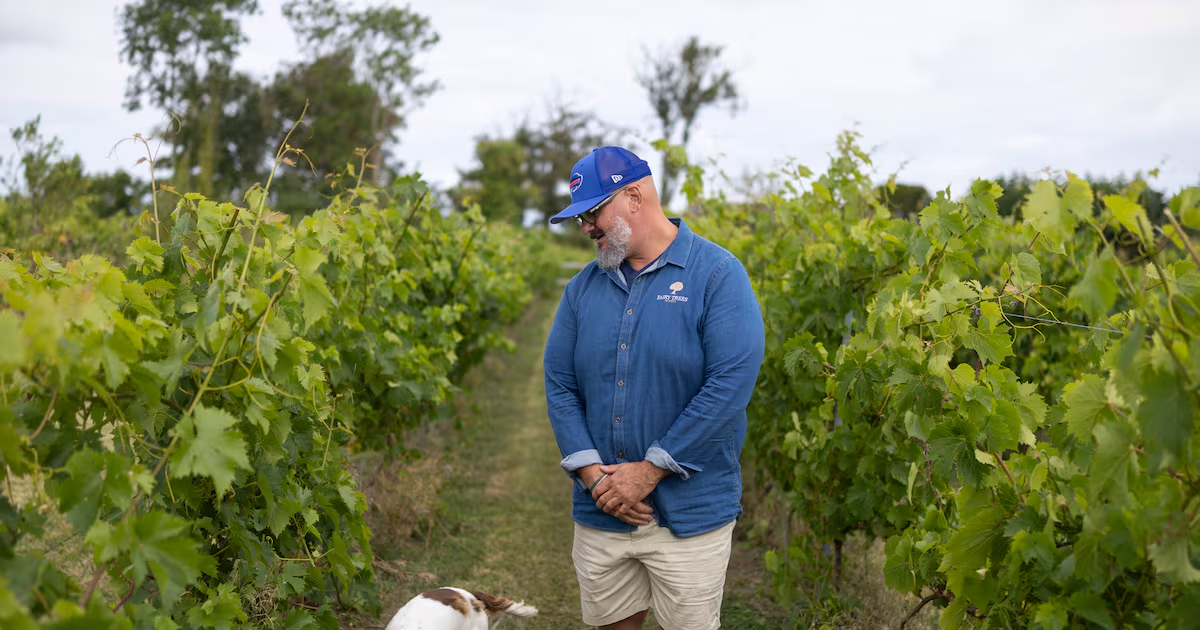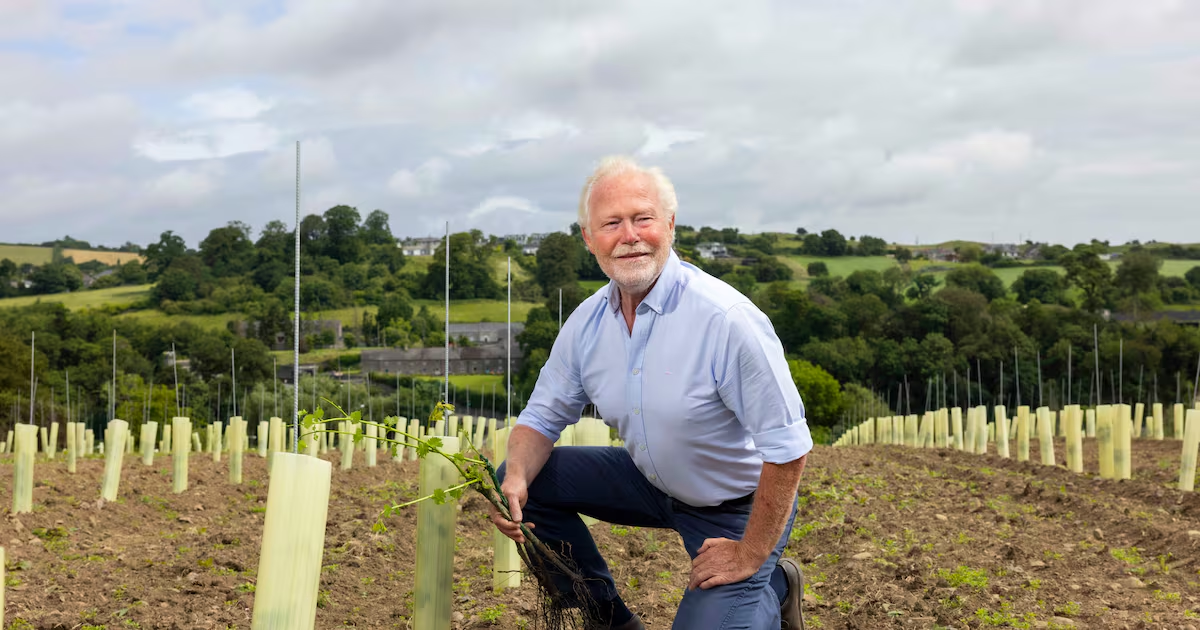
Three times a day since the end of May, Paulus Willem Heemskerk has walked a particular patch of his 100-hectare Fennor House estate in Co Meath.The 72-year-old is walking the same route thrice-daily to check on the progress of the 36,000-plant vineyard he recently laid across 13 hectares on his land beside Slane and the banks of the river Boyne.“Four white varieties, two reds, a sparkling white wine, some rosé, some red wine and some sparkling rosé wine. That’s what we’re hoping to produce,” Heemskerk tells The Irish Times.“Of course, it will take three years before we have the first harvest, which we’re hoping will be at the end October 2029. We think that we can produce around 8,000 kilos per hectare, which will produce around 70,000 litres of wine, so around 90,000 bottles of wine.”Heemskerk has called his venture Herovina, which he says is a Greek-Latin name connected historically to wine and olive oil. The planting phase has cost close to €2 million, but he adds more cash will need to be pumped into the business to tide it over before first harvest.“I think the total investment will be between €3 million and €4 million because you have to cover the three to four years when there is no income. “The winery itself is expensive. We could buy second-hand machinery, but we want to invest in this properly to produce the best grape. “We have to invest in the tourism part of the business too, which could be very interesting for us where the farm is situated on the Boyne and near Newgrange. They say there are about 200,000 people visiting Newgrange every year. We have Slane Castle nearby, too. So I see that as part of the income in future.” Heemskerk, who is from the Netherlands and spent most of his career in Portugal, is no blow in. He has a six-decade-long relationship with Slane.His parents bought Fennor House in 1965, and while he grew up in his homeland, Heemskerk spent his summer holidays in Meath. He also made the occasional trip to the Gaeltacht in An Spidéal, Co Galway, with local friends.In 1974, when he was 20, Heemskerk gravitated towards Portugal as opposed to Ireland, where he had a tillage farming business, imported black-and-white Friesian heifers and sheep from mainland Europe into Portugal, and also exported livestock into Egypt, Syria and Morocco.“My business was based on human relationships, because there was no computer or mobile phones. You had to get on a plane and travel to do business. Around the beginning of the 2000s, things changed. It became a different world. Everything went online, and that’s not my world.”Paulus Willem Heemskerk has planted 36,000 vines at the Fennor estate in Slane, which will produce close to 90,000 bottles. Photograph: Chris Bellew/Fennell Photography At the turn of the millennium, Heemskerk spotted a new opportunity in olive oil processing, where he made the millions of euro now being invested into his Slane-based vineyard.“When the Spanish were planting big olive groves in Portugal, we saw an opportunity. We knew they would need new olive mills to transform the olives into oil, but then we thought, ‘The waste from those mills has to go somewhere’.”In 2007, he founded an olive biomass processing plant in Ferreira do Alentejo, almost an hour-and-a-half drive from Lisbon. The €25 million facility called Casa Alta scaled up to process 400,000 tonnes of waste a year from olive oil production.[ Ireland’s vineyards win global recognitionOpens in new window ]Heemskerk sold his interest in Casa Alta two years ago. He was coy to confirm how much he made from the sale. “Enough to go ahead with this vineyard project,” he says.His exit from the Portuguese business gave Heemskerk time to ponder what to do with his Irish property. In 2018, the manager of the Fennor estate had left after 26 years.“He did a really good job with the suckler herd and sheep we had here, but he decided to start his new life at his family’s farm. “We decided to reorganise things to find a new future for the farm. It has so many positives going for it. It has the best soil, situated along the Boyne, and the area has a rich heritage. We wanted to do something that brought something new to the area.”Heemskerk consulted climate and soil experts in Ireland about the land and spoke to contacts in Portugal with experience of the wine sector, who convinced him a vineyard could work on the banks of the Boyne. He says he has received no external finance for the project. Now he has a long wait to see the fruits of his investment, but he feels the time will fly by.“A year nowadays, it’s passing by so fast, especially when you get older, but there is a lot of yearly investment we need to do buying specific equipment to pre-prune with the vineyard itself.”Paulus Willem Heemskerk's Fennor estate spans more than 100 hectares on the banks of the river Boyne. Photograph: Chris Bellew/Fennell Photography He plans to use machinery to do the picking, which he says would take 40 people to do manually.“We decided you can’t pick grapes manually. You can’t find the pickers, and especially in October with the rain, it’s not a nice job like going to France to pick grapes in August.”Heemskerk has staff coming from Portugal, including his friend Pedro José Hipólito Reis as winemaker, for the harvesting and pruning works. “I can’t find people here with that experience. Perhaps we can teach some local people here in the area.”The 36,000 vines Heemskerk planted have been in the ground only since the final week of May, but between each walkabout Heemskerk feels he can see some progress.“You can imagine how the plants are growing at the moment, so fast. It’s optimum conditions, of course. “We were so lucky with the timing when we planted the last week of May. We had a few dry days and then the day after finishing it started raining. For the first 10 days we had some rain every day, so the plants have been flying out of the guards.”Few have tried a vineyard of this scale in Ireland before. Heemskerk claims it is Ireland’s first commercial-scale vineyard, and is “convinced things will work out well”. [ Did you know there are more than a dozen vineyards in Ireland?Opens in new window ]Some of the feedback he is hearing from friends in continental Europe’s wine business are contributing to his confidence. “I had my Portuguese adviser on the phone yesterday, and he told me it was 44 degrees in his vineyard. Plants will grow up to 27 degrees. At 44, the climate stress and the water stress is unbelievable.”He adds that 30 years ago, plants would live 100 years, but now live only 15 to 20 years due to environmental pressures. “Climate change is a reality nowadays. Everybody knows and experiences this difference. We are going in the right direction in Ireland, and over there they’re going in the wrong direction. “If you see what happened in England from 2000 onward, they planted 4,000 hectares of plants and produced top wines. Their type of climate gives a stable growing season, unlike the extremes in Spain and Portugal and even in France at the moment. Ireland doesn’t have those extremes either.”
‘We’re aiming for 90,000 bottles by 2029’: Meet the Dutchman betting €4m on Slane vineyard
Paulus Willem Heemskerk has planted 36,000 vines in recent weeks on his estate at Fennor House in Meath
1,223 words~6 min read