Story audio is generated using AI
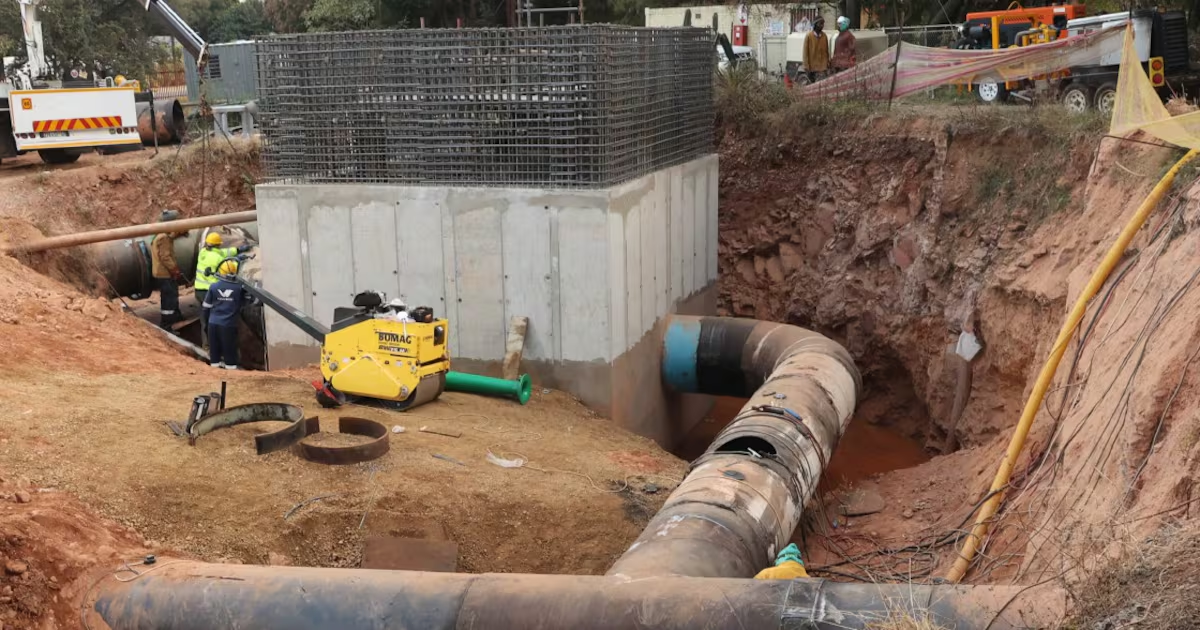
South Africa’s growth constraint lies not in its finances but in an insufficient pipeline of viable infrastructure projects, President Cyril Ramaphosa’s adviser says.Presidential economic policy adviser Kenneth Creamer says structural reforms are key to unlocking investment as fixed capital formation remains well below historical levels.South Africa’s deep and sophisticated financial sector has ample capacity to finance economic growth, but years of underinvestment have left the country without a sufficient pipeline of viable infrastructure projects, according to Creamer, a member of the presidential economic advisory council.Creamer said the country’s financial system is not the main obstacle to faster growth despite years of debate over how to unlock investment in Africa’s most industrialised economy. He made the comment during an economic conference at the weekend hosted by the African Development Bank, the UN Development Programme and the Organisation for Economic Co-operation and Development (OECD).“The financial system is sizeable, globally integrated, stable and well-regulated. The real constraints to South Africa’s economic growth and development do not lie inside the financial sector,” Creamer said.Kenneth Creamer. Picture: SUPPLIED Fixed investment in South Africa has fallen to about 15% of GDP from nearly 25% in the early 2000s, reflecting years of underinvestment in electricity, ports and rail infrastructure that have increased the cost of doing business and weakened the economy’s competitiveness, Creamer said.National Treasury’s latest forecasts suggest investment is recovering only gradually. Gross fixed-capital formation is projected to expand by 2.2% in real terms in 2026 after contracting 2% in 2025 and 3.9% in 2024, highlighting the challenge of lifting investment despite ongoing structural reforms.The prolonged weakness has fuelled a longstanding debate over whether pension funds should be required to allocate part of their assets to infrastructure projects.“It is not so much a lack of finance that is constraining investment in South Africa but a lack of infrastructure projects,” he said.“The project pipeline has been inadequate due to corruption, poor state capacity and regulations that, in certain cases, have granted monopoly power to public entities that lack the balance sheets to drive the necessary investment programmes.”Those constraints have prompted the government to focus on structural reforms through Operation Vulindlela, a joint initiative of the presidency and National Treasury that has now entered its second phase.Expanding the electricity transmission network has become one of the programme’s key priorities. Creamer said financing is being mobilised through a combination of privately financed independent transmission projects, investment by the state-owned National Transmission Company South Africa, and international climate finance through the Just Energy Transition Fund.The investment programme could also stimulate demand in industries including steel, cement, and engineering, provided the transmission grid is opened to more generators to create a more competitive electricity market.“Success in large-scale investment projects is about project design, policy certainty, and consistency. Political leadership capable of resolving contested reforms in the national interest is often decisive in determining whether such programmes succeed,” Creamer said.Business Day’s coverage of the African Economic Conference was made possible by the African Development Bank.