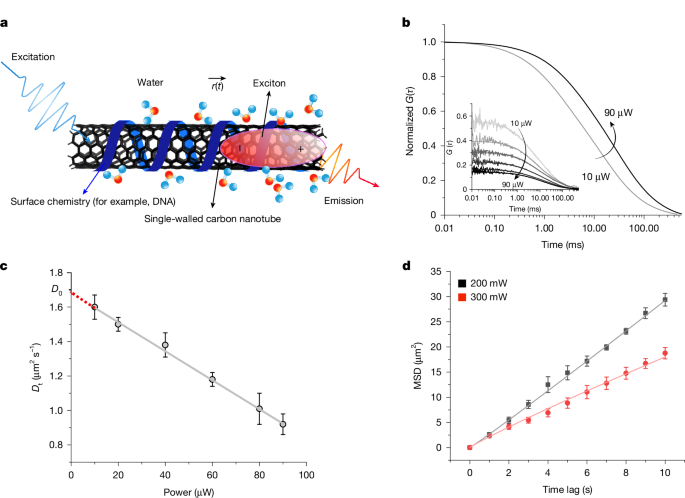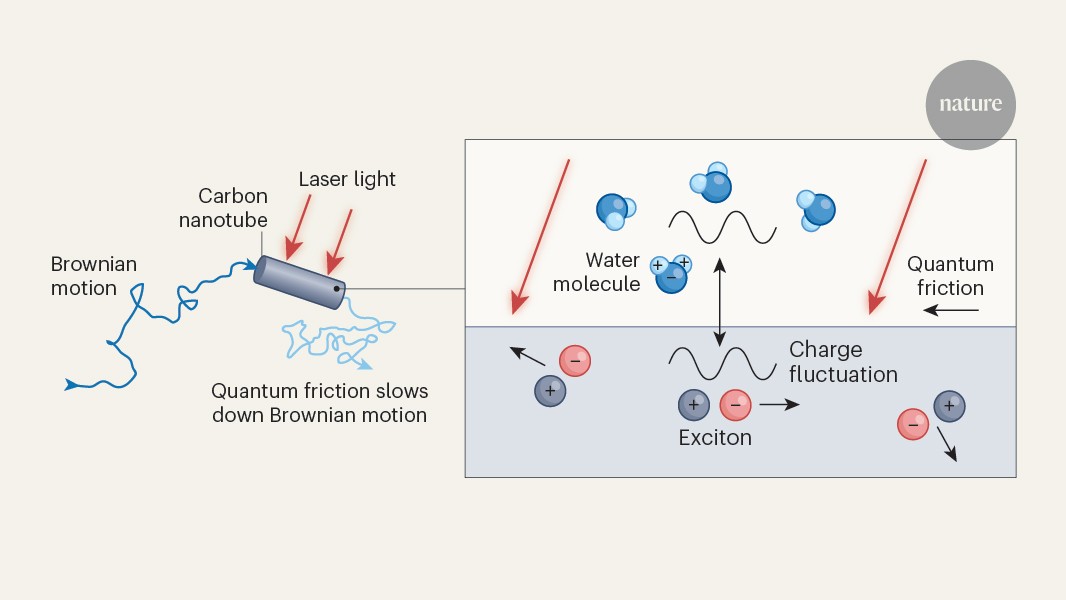
The fundamentals of light continue to fascinate scientists and reveal new secrets – including how its effects can be counterintuitive.Conventional wisdom suggests that light adds energy to heat up particles or set them in motion. But scientists just caught light doing the opposite: acting as an invisible brake at scales almost too small to imagine.In a new study published in Nature, researchers led by a team from Ruhr-University Bochum in Germany found that fluorescent carbon-mesh nanotubes move much more slowly when irradiated with light in an aqueous solution. How the experiment was set up. (Kistwal et al., Nature, 2026)The brighter the light, the slower the movement, or specifically, the lower the diffusion constant, a measure of how freely a particle moves through a liquid.This is at least partly due to 'quantum friction', the researchers determined. Quantum friction is a recently discovered phenomenon, and scientists are only just beginning to understand what it can do."This discovery of light-induced quantum friction fundamentally changes our understanding of interfacial processes," says physical chemist Sebastian Kruss, from Ruhr-University Bochum."Our experiments show that the diffusion decreases when we increase the light intensity."
Light Can Act as a Quantum Brake to Slow Movement in The Nanoworld, Scientists Discover
The fundamentals of light continue to fascinate scientists and reveal new secrets – including how its effects can be counterintuitive.
664 words~3 min read