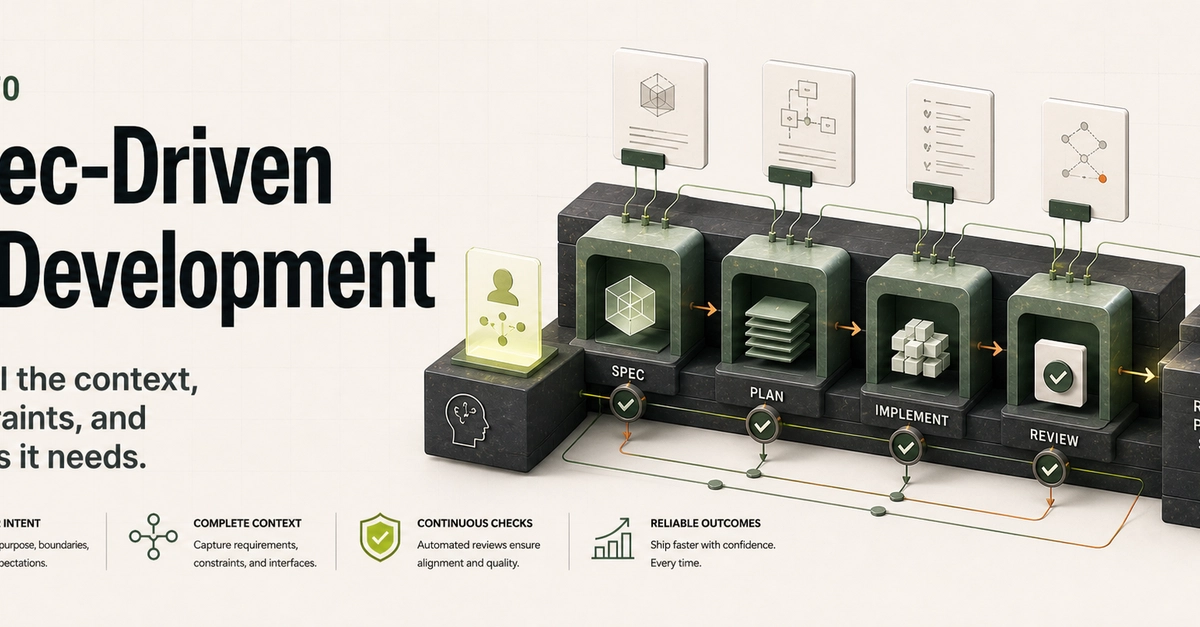
AI can generate an endpoint, a test fixture or a deployment manifest in seconds. That speed is useful, but it does not solve the expensive part of software delivery: deciding what the system should do, proving that the implementation matches that intent and controlling change across architecture, security and operations. In an AI-assisted SDLC, you need a stronger source of truth than a backlog item or a chat transcript. Spec-driven development gives you that control plane. You express behaviour, contracts, constraints and acceptance criteria in durable specifications, then let engineers and AI agents derive code, tests, documentation and delivery checks from them.
The specification becomes the delivery control plane
Traditional delivery often treats specifications as temporary input. A product owner writes a story, an engineer interprets it, and the details disperse into code, tests, pull-request comments and operational knowledge. AI amplifies the weakness of that model. A model will confidently fill gaps, choose defaults and optimise locally unless you provide explicit boundaries. The resulting code may compile while violating business rules, security assumptions or integration contracts.