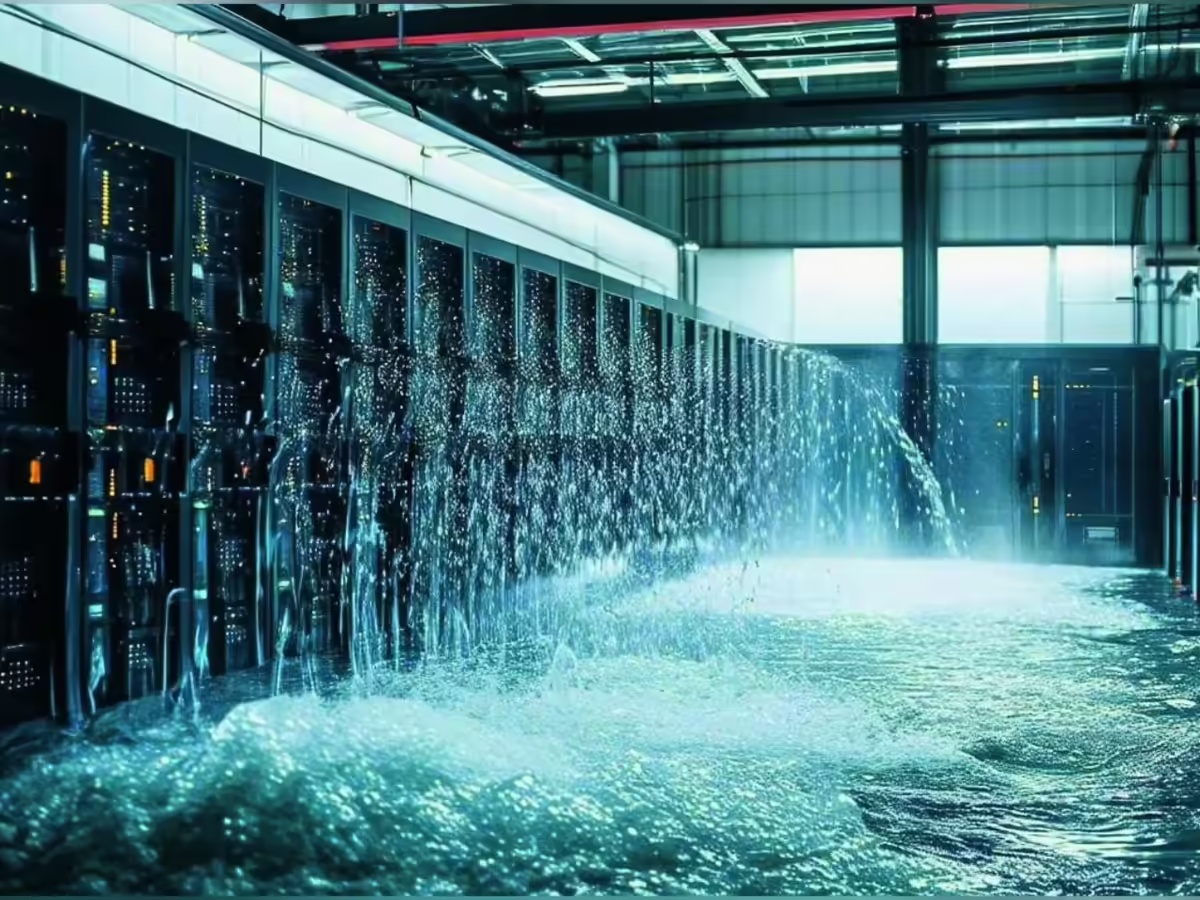
Water demand varies significantly across data centres, depending on how facilities are designed, cooled, and located.
| Photo Credit:
iStockphoto
Artificial intelligence is often described as weightless: software, algorithms, cloud infrastructure. But the systems powering it are profoundly physical. Data centres require land, electricity and, in many cases, significant volumes of water for cooling. As countries race to secure a place in the AI economy, an uncomfortable question is beginning to emerge: what are the hidden resource costs of becoming an AI hub?India is making an increasingly ambitious bet on digital infrastructure. India’s installed data centre capacity, estimated at 1.3-1.5 GW today, is projected to expand to between 5 GW and 8 GW by 2030, driven by demand for cloud services, AI workloads, and data localisation requirements. Large industrial groups, including Adani and Reliance, are investing aggressively in hyperscale infrastructure, while several States are competing to become digital hubs. According to Jefferies and Bernstein estimates, the scale-up could involve tens of billions of dollars in investment over the decade.This ambition is economically rational because data centres support cloud computing, enterprise digitisation and, increasingly, AI-enabled productivity. They attract capital, create high-skilled employment, and may strengthen India’s strategic position in a technology ecosystem currently dominated by the US and China.Resource allocationBut digital infrastructure also raises a resource allocation problem that India is uniquely vulnerable to i.e., water. India is already the world’s largest user of groundwater, accounting for roughly a quarter of global extraction. In many regions, withdrawals exceed natural recharge rates, particularly in urban and industrial centres. Bengaluru, Chennai, Hyderabad, and Delhi have all faced recurring concerns around water stress, while the World Economic Forum’s Global Risks Report 2025 identified water supply shortages as India’s most severe environmental risk over the coming two years.Against this backdrop, the expansion of data centre infrastructure deserves closer scrutiny.Water demand varies significantly across data centres, depending on how facilities are designed, cooled, and located. Some newer facilities rely on closed-loop systems, liquid cooling, wastewater reuse, or hybrid approaches that significantly reduce freshwater dependence. Others may be located near coasts, allowing access to non-potable cooling alternatives. Yet even under more efficient designs, infrastructure at gigawatt scale creates a significant resource demand, especially when concentrated in already stressed regions.A good portion of India’s planned data centre expansion is concentrated in States such as Maharashtra, Tamil Nadu, and Telangana, regions that are simultaneously major digital hubs and periodically exposed to water stress. Maharashtra alone accounts for a significant share of India’s upcoming data centre pipeline, with Mumbai emerging as the dominant cluster. Yet India’s data centre expansion is concentrated in these States. These regions offer strong digital infrastructure, reliable connectivity, enterprise demand, and access to power, making them natural locations for large-scale facilities.Key policy questionThis raises an important policy question. As India builds the infrastructure needed for an AI-driven economy, how should it weigh economic priorities against environmental constraints?Countries like Ireland and Mexico have already gone down this path. In Ireland, data centres accounted for 21 per cent of total metered electricity consumption in 2023, eventually prompting restrictions on new grid connections around Dublin as infrastructure struggled to keep pace. In Mexico’s Querétaro region, rapid data centre expansion has heightened concerns about water availability during periods of prolonged drought.The underlying challenge for the future India is same as what Ireland and Mexico are facing today i.e., how can governments expand digital infrastructure without putting excessive strain on already constrained resources?Several policy interventions are available and already visible in different parts of the world.First, regulators could prioritise treated wastewater, recycled water, or harvested rainwater over freshwater withdrawals for industrial cooling wherever feasible. Second, environmental approvals could incorporate more rigorous water impact assessments, especially in regions already classified as water-stressed. Third, policymakers could create stronger incentives for coastal siting and seawater cooling for hyperscale facilities where geography permits. Finally, greater disclosure requirements around data centre energy and water intensity would improve transparency in a sector where reporting remains uneven. This matters because current environmental accounting remains incomplete. Most companies report at the data-centre level rather than distinguishing AI-specific workloads, making precise estimates of AI’s environmental footprint difficult. Policymakers are therefore making long-term infrastructure decisions amid meaningful uncertainty.The debate over AI infrastructure is often framed as a choice between innovation and sustainability. In practice, successful industrial policy will require both. India’s opportunity is substantial, but so are its constraints.AI may be digital, but its costs are profoundly physical. India’s challenge is not whether to build for the AI economy, but whether it can do so without exhausting the very resources that sustain growth.Mehta is a leading international consultant in the field of market entry, innovation, and public policy, Nagpal is an MBA graduate of the Darden School of Business at the University of VirginiaPublished on July 12, 2026