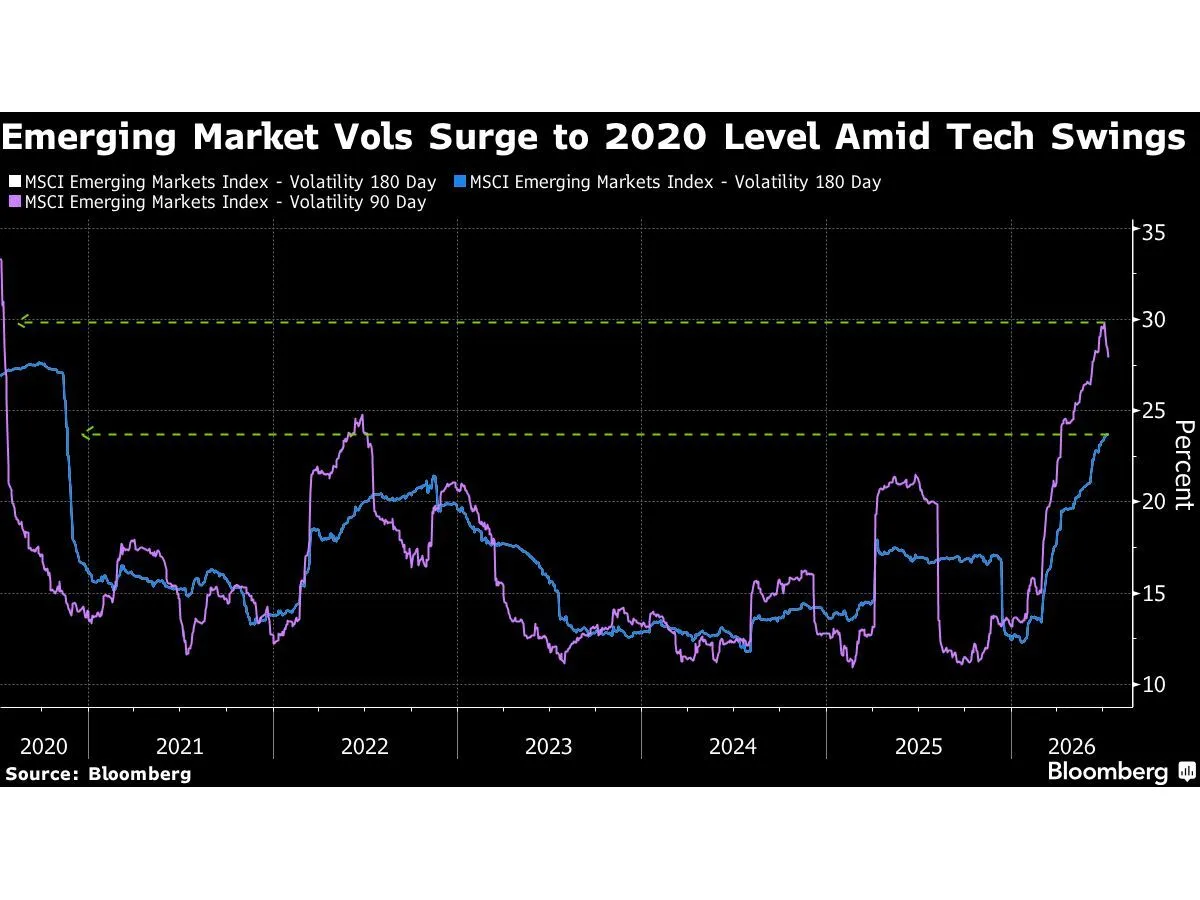
Skip to Content News Archives Economy Energy Oil & Gas Renewables Electric Vehicles Mining Commodities Agriculture Real Estate Mortgages Mortgage Rates Finance Banking Insurance Fintech Cryptocurrency Work Wealth Smart Money Wealth Management Investor Personal Finance Family Finance Retirement Taxes High Net Worth FP Comment Executive Women Puzzmo Newsletters Financial Times Business Essentials More Innovation Information Technology FP500 Podcasts Small Business Lives Told Tails Told Shopping Financial Post Store Obituaries Place a Notice Advertising Advertising With Us Advertising Solutions Postmedia Ad Manager Sponsorship Requests Classifieds Place a Classifieds ad Working Profile Settings My Subscriptions Saved Articles My Offers Newsletters Customer Service FAQ News Economy Energy Mining Real Estate Finance Work Wealth Investor FP Comment Executive Women Puzzmo Newsletters Financial Times Business Essentials HomePMN BusinessFunds Fret Over $4.4 Trillion AI Trio's Grip on Emerging MarketsInvestors are rotating beyond AI winners in emerging markets, where just three technology stocks worth $4.4 trillion drive an outsized share of returns.Author of the article: You can save this article by registering for free here. Or sign-in if you have an account.aq(n8wrzu3wf4[9pmrgxv2)e_media_dl_1.png Bloomberg(Bloomberg) — Investors are rotating beyond AI winners in emerging markets, where just three technology stocks worth $4.4 trillion drive an outsized share of returns.Subscribe now to read the latest news in your city and across Canada.Exclusive articles from Barbara Shecter, Joe O'Connor, Gabriel Friedman, and others.Daily content from Financial Times, the world's leading global business publication.Unlimited online access to read articles from Financial Post, National Post and 15 news sites across Canada with one account.National Post ePaper, an electronic replica of the print edition to view on any device, share and comment on.Daily puzzles, including the New York Times Crossword.Subscribe now to read the latest news in your city and across Canada.Exclusive articles from Barbara Shecter, Joe O'Connor, Gabriel Friedman and others.Daily content from Financial Times, the world's leading global business publication.Unlimited online access to read articles from Financial Post, National Post and 15 news sites across Canada with one account.National Post ePaper, an electronic replica of the print edition to view on any device, share and comment on.Daily puzzles, including the New York Times Crossword.Create an account or sign in to continue with your reading experience.Access articles from across Canada with one account.Share your thoughts and join the conversation in the comments.Enjoy additional articles per month.Get email updates from your favourite authors.Create an account or sign in to continue with your reading experience.Access articles from across Canada with one accountShare your thoughts and join the conversation in the commentsEnjoy additional articles per monthGet email updates from your favourite authorsSign In or Create an AccountorFunds including JPMorgan Asset Management and Grantham Mayo Van Otterloo & Co. are turning to bets on the broader economy — such as gaming, energy, and even a Vietnamese milk company. JPMorgan AM is looking at India and China for diversification away from the giant tech companies, one of them in Taiwan and two in South Korea.“This type of concentration is never easy for a portfolio manager, it’s always difficult,” said Warren Chiang, portfolio manager for systematic equity at GMO in Berkeley, California. “The point here is to look for opportunity in as many places you can, but the absolute risk will be there no matter what.”Get the latest headlines, breaking news and columns.By signing up you consent to receive the above newsletter from Postmedia Network Inc.A welcome email is on its way. If you don't see it, please check your junk folder.The next issue of Top Stories will soon be in your inbox.We encountered an issue signing you up. Please try againTaiwan Semiconductor Manufacturing Co., Samsung Electronics Co., and SK Hynix Inc. now make up more than 30% of the MSCI Emerging Markets Index — as much as the exposure of the “Mag 7” in the S&P 500. Overall, technology accounts for 45% of the emerging market index.Swings in those three stocks drag or lift the entire emerging market gauge along with them, with investors being roiled by volatility that’s at a six-year high.Chipmaking stocks are faltering amid questions over whether cloud providers have overbuilt AI infrastructure. Samsung Electronics’ blowout earnings failed to spark a rally last week, while signs that AI developers are set to flood the market with their own chips deepened concerns that AI investment could outpace demand.South Korea’s Kospi has slid 20% from its June record, with waves of selling repeatedly triggering exchange circuit breakers to temporarily halt trading.Worries that valuations are getting too frothy — and tech exposures too heavy — led William Lam, co-head of Asia and EM equities at Invesco, to pare back Samsung Electronics in one of the firm’s Asian equity funds by more than 60% since the start of the year. He said he redeployed the proceeds into other Korean companies that are not tied to tech.“We think it’s important to safeguard clients’ capital from over-concentration,” Lam said. “History suggests that competition, capacity expansion and normal industry dynamics are likely to erode returns over time.” Despite efforts to diversify, SK Hynix is simultaneously one of the largest underweights in GMO’s $1.9 billion Emerging Markets Equity Strategy fund — and one of its top holdings, according to Chiang. The $1 trillion company maker of memory chips has seen a 13-fold surge in its share price since the start of 2025 — more than fundamentals justify, in Chiang’s view. “You’re not going to get around having a big position in TSMC, Samsung, SK Hynix, but your active position, that could be diversified at the stock level, country level and industry level,” he said. SK Hynix American depositary receipts started trading on the Nasdaq Global Select Market in the US on Friday, surging 14% above their offering price, after the chipmaker raised $26.5 billion in the largest-ever US listing by a foreign company.As long as there is increased development and spending on AI by hyperscalers in the US, the positive trends in the Asian supply chain will continue, according to Alison Shimada, head of total emerging markets equity at Allspring Global Investments. Retail flows show enduring confidence. The $25.4 billion Avantis Emerging Markets Equity ETF — the largest actively-managed exchange-traded fund tracking emerging equities — just posted its biggest weekly inflow in four months. BlackRock Inc. is seeking to balance tech exposure with investments in industries poised to benefit from developments in artificial intelligence — including energy, materials, power infrastructure and utilities. It’s a way to cushion the volatility of pure AI plays, said Egon Vavrek, head of the emerging markets and Asia core team.A top pick for Brandes Investment Partners’ roughly $1.3 billion Emerging Markets Value Fund is NetEase Inc., China’s second-largest gaming company.China tech stocks are also attracting interest. US export controls have forced the nation to create a separate technology ecosystem centered on domestic companies such as SMIC and Huawei. That makes them a good way to get exposure to AI while also diversifying away from global chip leaders, according to Mark Davids, head of emerging markets and Asia Pacific equities at JPMorgan AM.“Chinese technology companies are the survivors of a fierce evolutionary race,” said Oliver Shale, investment specialist at Ruffer, a $25 billion global macro absolute return manager. “They have strong business models, healthy balance sheets and a captive domestic customer base.”What to WatchNigeria, Malaysia and India will report consumer price inflation data for JuneChina’s second-quarter GDP report is likely to show growth slidingBank of Korea looks to kick off a tightening cycle with a 25-basis-point rate hikeIn Brazil, May activity data will help shape expectations for second-quarter GDP growth, while Peru’s May activity likely declined as temporary supply socks and high oil prices weighed on growthArgentina’s inflation may show a slowdown in June, reflecting reduced pressure from regulated prices after their previous oil-driven surge—With assistance from Margaryta Kirakosian. Join the Conversation This website uses cookies to personalize your content (including ads), and allows us to analyze our traffic. Read more about cookies here. By continuing to use our site, you agree to our Terms of Use and Privacy Policy.
Funds Fret Over $4.4 Trillion AI Trio's Grip on Emerging Markets
Investors are rotating beyond AI winners in emerging markets, where just three technology stocks worth $4.4 trillion drive an outsized share of returns.
1,331 words~6 min read