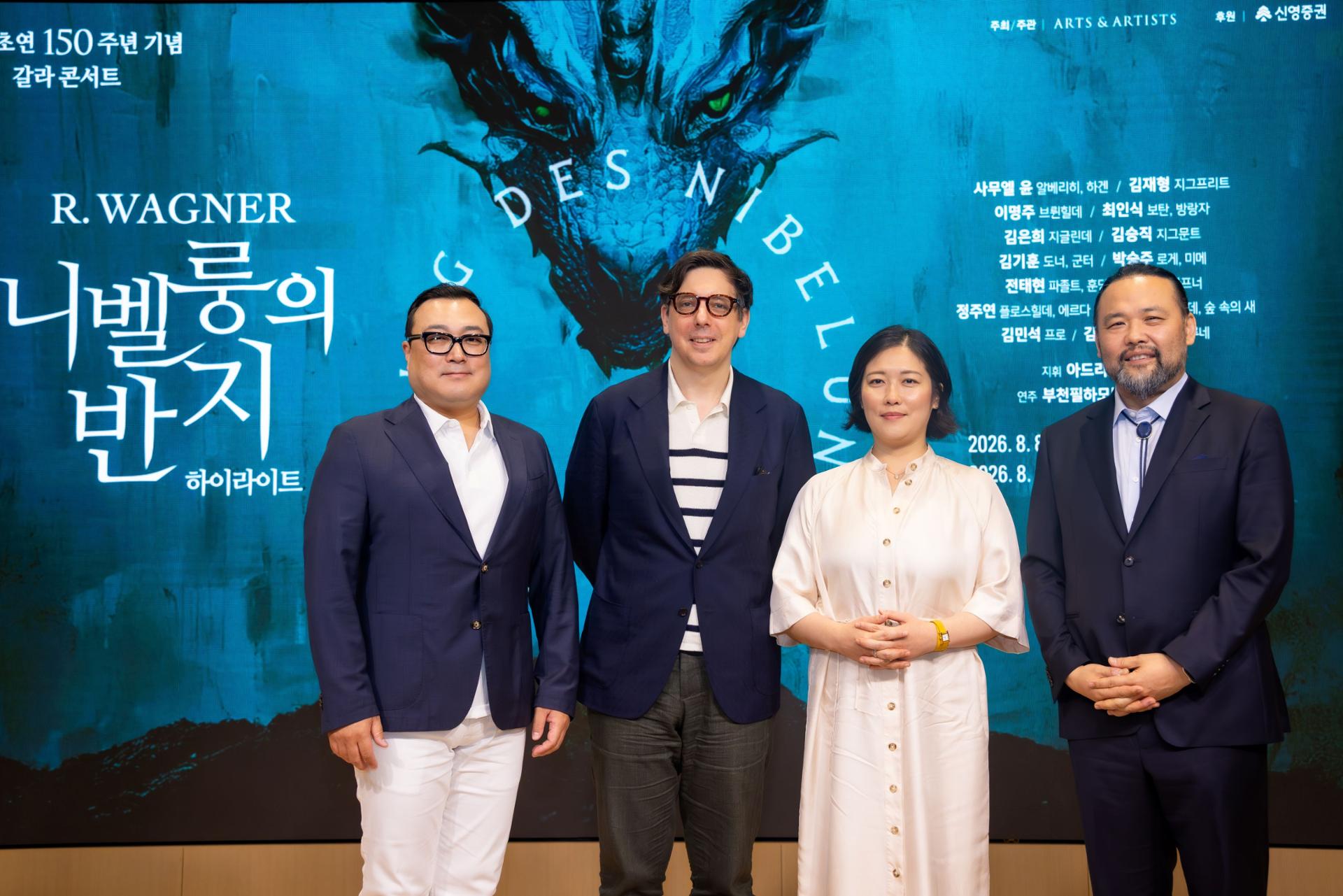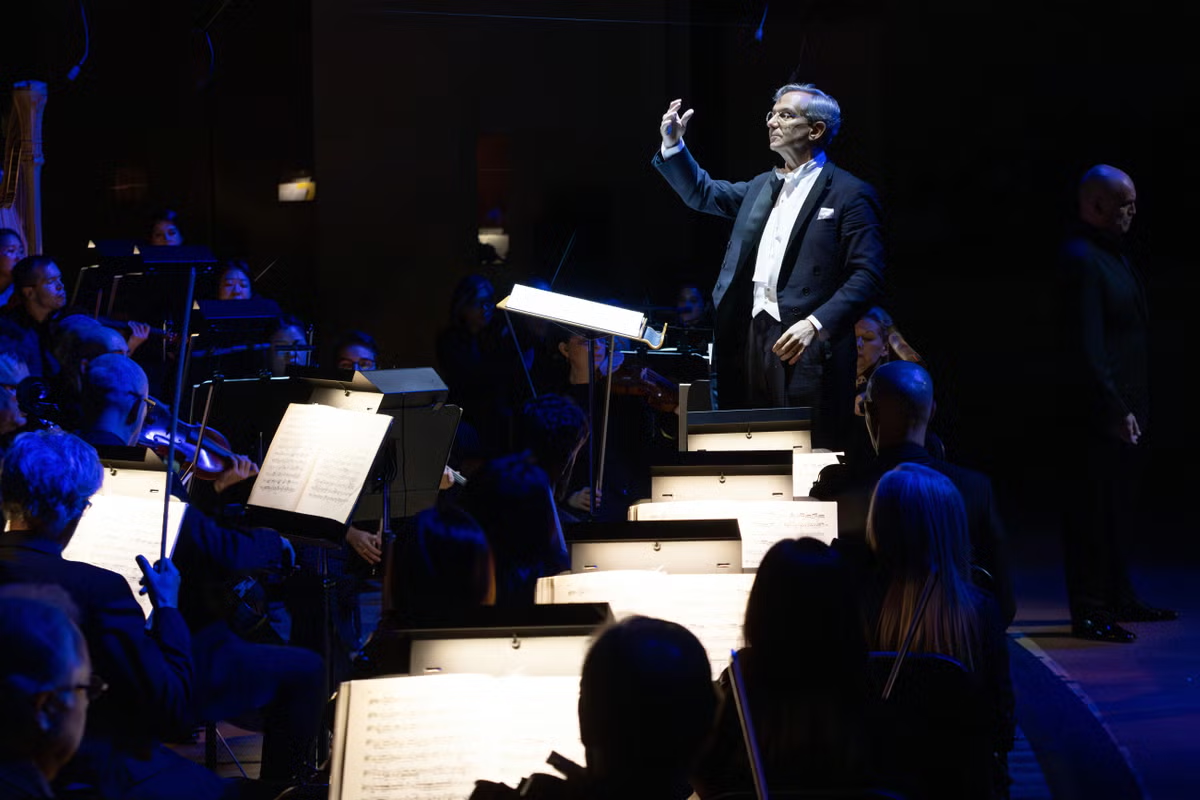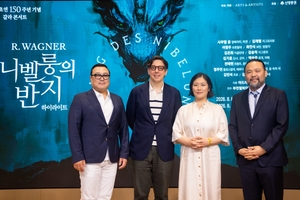
Top opera singers and Bucheon Philharminic offer 'The Ring of the Nibelung' in one night From left: Tenor Alfred Kim, conductor Adrien Perruchon, soprano Lee Myung-joo and bass-baritone Samuel Youn pose for photos during a press conference in Seoul. (Arts&Artists) “Der Ring des Nibelungen” or “The Ring of the Nibelung” in English, is opera at its most colossal: a four-evening cycle spanning fifteen to sixteen hours, written entirely by Richard Wagner himself over twenty-six years.Drawing on Norse myth and the medieval Nibelungenlied, it traces a world's rise and ruin through a cursed ring of power, sung over an orchestra of nearly a hundred players and stitched together by some two hundred leitmotifs. Wagner even built his own theater at Bayreuth to house it, where the cycle premiered in 1876 — 150 years ago this year.That anniversary is what brings the Ring to Korea next month, in a highlights version that condenses all four operas into roughly three hours and 40 minutes of music, performed in a single evening.A project of this scale in Korea only happens when every condition falls into place — and this time, they all did. The 150th anniversary supplied the moment. Samuel Youn, who had long carried the Ring as an unfinished ambition, supplied the will. And the three roles without which no Ring is possible — Wotan, Siegfried, Brunnhilde — were all secured.Choi In-sik, a Wotan seasoned on European stages, joined the cast alongside tenor Kim Jae-hyung, also known as Alfred Kim, in his first Siegfried, and soprano Lee Myung-joo in her first Brunnhilde. Youn, a Wagner specialist of twenty-five years, sings both Alberich and Hagen — father and son, two villains in one voice."Without a Siegfried and a Brunnhilde, this simply cannot be done, and truly, not without a Wotan," Youn explained. "All the pieces had to align: not just the singers' capabilities, but the orchestra too, and a conductor who genuinely wants to do it."The Bucheon Philharmonic, led by Adrien Perruchon, embraced the production as its biggest project of the year — "pouring everything into it," as Youn puts it — committing a 99-player orchestra and weeks of rehearsal.Presented in concert format, it keeps the story in strict chronological order, preserves the key leitmotifs and each opera's distinct sound world, and flows as one continuous narrative, with subtitles and explanatory videos bridging the cuts.The organizers said the production will feature the cycle's most celebrated music, from the "Ride of the Valkyries" to "Siegfried's Funeral Music." Korean subtitles will run throughout, and video commentary before the performance and during intermission will bridge the cut passages. The organizers and artists both said they hope the concert will serve, in part, as a "primer" for those new to Wagner."Just open your heart and see what you feel," said Kim. "At some moment, you won't even know why, but this music will bring tears to your eyes."Asked what might make Wagner resonate with Korean audiences, Perruchon reached for an unexpected parallel. Around the time of the Cannes Film Festival, he recalls, he was reading an article analyzing why Korean films have been so successful worldwide."One element was that Korean film directors are essentially conceptual artists: they write the story, choose the characters, film it, create the visuals," he said. "And as I was reading it, I thought: but that's exactly Wagner. He is the one unique example in music history of the total work of art made by a single man. In a way, he's the model of what the great Korean visual artists are today. And that's why the Ring is such a universal legacy."The performances take place on Saturday, Aug. 8, at 5 p.m. at the Seoul Arts Center Concert Hall, and on Friday, Aug. 14, at 7 p.m. at the Bucheon Arts Center Concert Hall.
Wagner's Ring comes to Korea, condensed
“Der Ring des Nibelungen” or “The Ring of the Nibelung” in English, is opera at its most colossal: a four-evening cycle spanning fifteen to sixteen hours, writt
632 words~3 min read