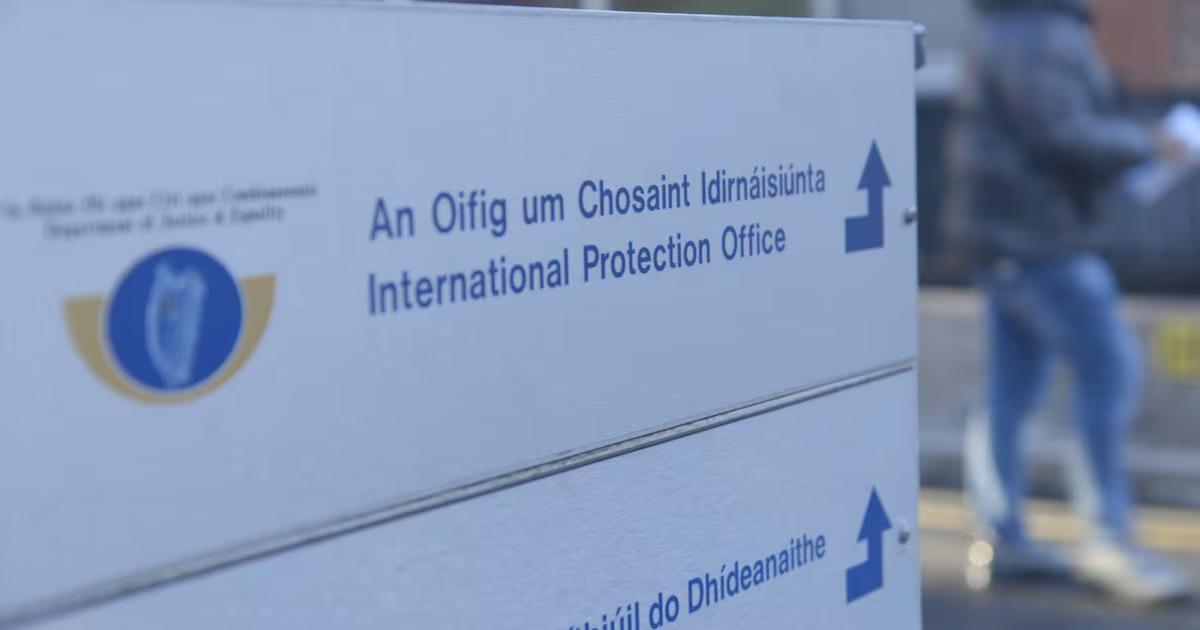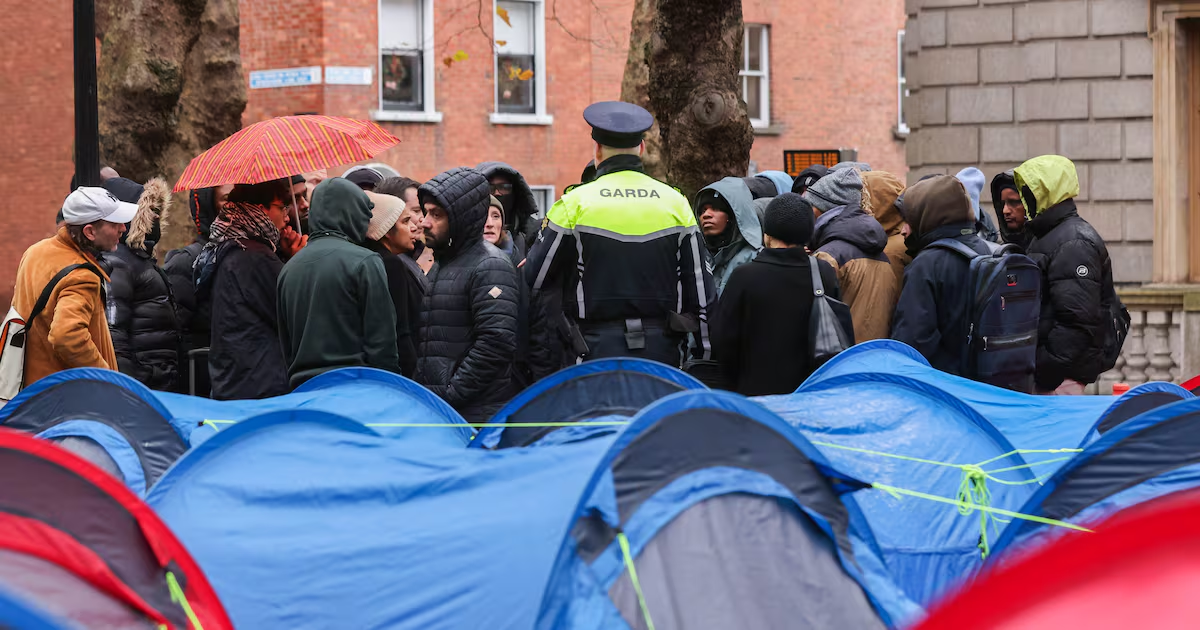
The effort by the Government to reduce inward migration to Ireland is well under way. But it seems to be mostly focused on the smallest cohort of the people who arrive here – asylum seekers. They also happen to be the easiest target.A new streamlined system for assessing the claims of people who arrive in Ireland to seek asylum is doing exactly what it was intended to do – it is turning down most of the people who apply. As Jack Power reported in Monday’s Irish Times, nine out of 10 asylum seekers whose requests for international protection were assessed using a fast-track procedure now being rolled out on a permanent basis had their claims rejected.This was described in internal Department of Justice briefings, which reported on the trial operation of the accelerated system, as “very encouraging”. Under the new EU migration pact, that fast-track system is now being rolled out generally. It will decide quickly that most asylum seekers do not qualify, hear their appeals quickly, turn most of them down, and then seek to ensure they leave the country. Court actions may challenge a final refusal, but they are getting harder to do.The tougher regime on asylum, or international protection, will not just mean more people are turned down and compelled to leave Ireland. It will mean, almost certainly, that fewer people come here in the first place, preferring to take their chances elsewhere. That is just the way the system works – flows of people respond to incentives, and to disincentives.Ireland’s previously lax system led to a big upsurge in asylum seeker numbers after the pandemic, and while the numbers – 20,000 or so a year – wasn’t large by comparison with other EU countries, it overwhelmed the system here and led, among other things, to tents on the streets and pressure for emergency accommodation for asylum seekers. That, in turn, provoked a negative reaction among some elements of the public. For the first time, immigration became a substantial issue in Irish politics. Politicians have reacted accordingly.The fact is that public opinion in Ireland has toughened on migration, as it has all over Europe. Some of this is in response to agitation by the far right and their online amplifiers (which include, as the Sunday Times reported last weekend, Russia-aligned actors seeking to politically destabilise the West).But it is also in response to concerns in communities about facilities for asylum seekers being opened without notice or consultation. Some people are fine with this, and experience tends to show that openness and dialogue with communities leads to much better outcomes. But some people are not fine with this.Repeated polls show two things – one, that Irish people appreciate the contribution made by immigrants here, and two, they have concerns about the levels of immigration.Irish politics is nothing if not responsive to the whims of voters. The Government parties and some of the Opposition – looking at you, Sinn Féin – have shunted themselves to the right on immigration. In other words, politicians have done what politicians do and accommodated themselves to the changing public mood. That has manifested itself as a toughening of Ireland’s asylum regime in the last couple of years, and the further recent adoption of the stricter EU regime.It’s not so much that the EU migration pact has resulted in a tighter system – it’s that the EU migration pact was adopted in order to have a tighter system.My strong suspicion is that public tolerance for the idea of offering asylum and protection to people fleeing war or persecution – a fine and noble idea, a mark of a civilised country – is contingent on the numbers of people who actually show up to avail of it. The more people who come, the flakier public consent becomes.[ Lesson of Swiss vote may be that Ireland can’t avoid immigration issue foreverOpens in new window ]It is reasonable for a country to take account of the levels of inward migration and adjust its rules accordingly. It is clear that many asylum seekers are really economic migrants. In some cases, they tell a story about how they came to be in Ireland that is of questionable veracity. Some asylum seekers will tell the authorities whatever they think will result in them being allowed to stay. Wouldn’t you? I would. I spoke to a person involved in this process some time ago and the person acknowledged that there was widespread awareness of this in the system. But now the system is becoming tougher on it.A more rigorous system is fair enough. But focusing all concerns about migration on asylum seekers is not.And it’s hard to avoid the suspicion that asylum seekers are being squeezed because the State is obliged to provide them with accommodation, whereas other immigrants fend for themselves.[ Michael McDowell: Decent Irish people have concerns about migration. If we don’t listen, populists willOpens in new window ]Asylum seekers are a small part of overall immigration. About 13,000 people or fewer will come here to seek asylum this year. Meanwhile, the State continues to grant about 30,000 to 40,000 work permits for non-EU workers every year. In addition, there is also a substantial sector teaching English to foreign students, who are also entitled to work while they are studying. I suspect for some of them, the balance between their devotion to their studies and their jobs might be questioned. Total student visas – including non-EU students who come to study full-time at university here – are about 60,000 a year.But those coming on work permits and the student workers are deemed essential to the economy. So the asylum seekers are in the firing line.
As public opinion toughens on migration, politicians have shifted to the right
New system for assessing the claims of people who arrive here to claim asylum is doing what was intended - turning down most of those who apply
946 words~4 min read