The industry is currently obsessed with letting Large Language Models (LLMs) output entire microservices, infrastructure layouts, and functional code in seconds. It's fast, it's powerful, and it is completely redefining how software is built.
Because modern LLMs can navigate both code syntax and standard architectural design patterns with ease, the role of the software engineer is rapidly evolving. The true value is no longer in manually writing out implementation details, but in orchestrating macro system topology, setting deterministic boundaries, and enforcing zero-trust constraints.
Welcome to the era of the Agentic Engineer.
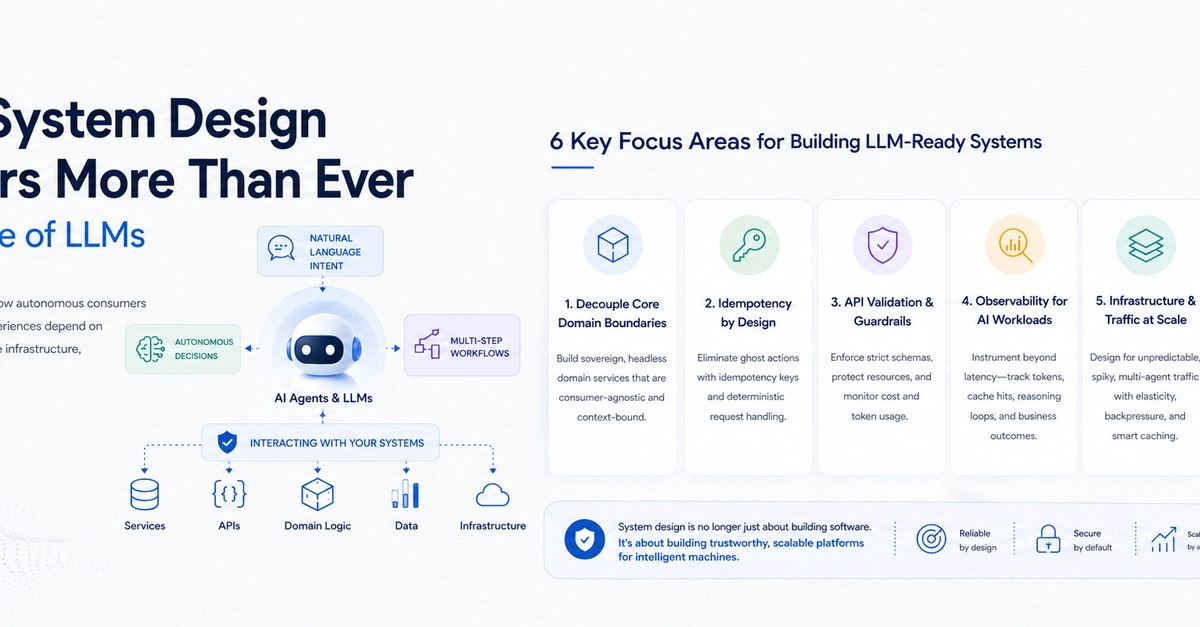
When your consumers are no longer just human eyes looking at a browser, but autonomous AI agents executing multi-step workflows, your system design cannot afford to be loose. AI operates strictly within the structural constraints we provide; if asked to build inside a tightly-coupled system, it will generate highly sophisticated code that inadvertently scales that complexity at warp speed. To build for an AI-driven ecosystem, we must treat system architecture as the ultimate governance tool.
1. Decoupling the Core: Designing Sovereign Domain Boundaries