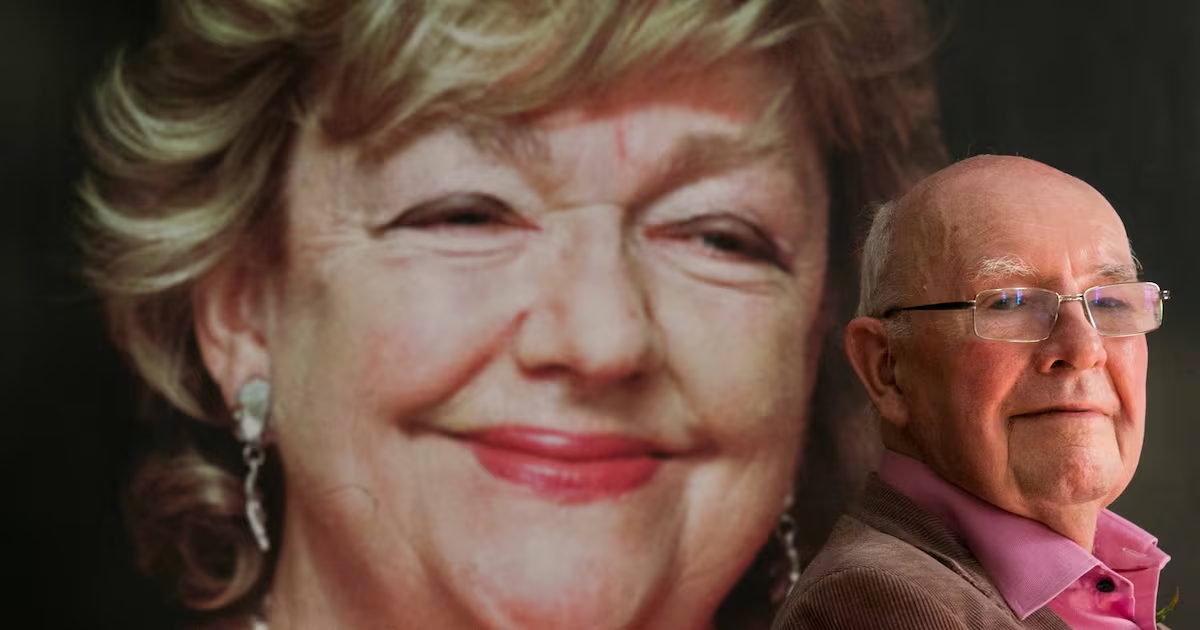
Words, I’ve often thought, let you down just when you need them most. When Gordon Snell, my friend of 12 years, died in April, his family asked if I would be one of the speakers at his funeral. Yes, of course, I said, it would be an honour. But almost immediately I began to worry: how could I sum up a friendship? The words that immediately came to me to describe Gordon were quite likely the same ones everyone who knew him would use: clever, generous, witty, kind. Yet each of his friends had their own relationship with him, and no two were the same. I wrote a eulogy, but the evening before his funeral, ripped it up and started again. Where I had gone wrong, I realised, was that I had written the “what” of our friendship rather than the “why”. And friendships, whether in real life or fictional, are predicated on “why”. I first met Gordon in May 2014 when he presented me with the inaugural Maeve Binchy Travel Award, which, two years after her death, had been established in her honour at UCD. All he had to do was to shake hands, smile for a picture, hand over the fancy certificate. In other words, to be pleasant to a stranger for an hour. That was the opening “what” of our friendship. The reason why we became friends is because he had an enormous capacity for friendship. His heart was big and open, and his compassionate curiosity about other people’s lives was genuine (a quality he and Maeve both had in spades, and one which seems to be rapidly diminishing in the world; empathy is a well which self-replenishes when used, but dries up when ignored). When Gordon died, so many people contacted me to say, sorry, I saw your friend died, that I found myself thinking how much I must have talked about him. But perhaps it wasn’t just the 40-year age gap that made the friendship distinctive, but the fact that making new friends as one ages becomes increasingly difficult. Cathal O’Gara’s recent feature about using the Bumble BFF app to find new pals opened with the words: “It’s easier to get a mortgage in Ireland than it is to make a friend in your 30s.” He’s not wrong; the pressures of being an adult can become a sieve, ruthlessly sifting people out of our daily lives in a way that would have been unthinkable to our teenage selves.On television, friendship is treated as the preserve of the young, something people sooner or later leave behind in favour of romantic relationships. When the final season of Friends ran in 2004, the characters were all in their mid to late 30s. Joey, Rachel, Monica, Ross, Rachel and Chandler had spent the previous 10 years behaving as if they were six eggs in a box until the realities of adulthood finally caught up with them. One of the many noteworthy elements of this summer’s Disney+ drama Alice & Steve is that the titular characters are fiftysomethings who have been platonic best mates for decades. In an early scene, Alice (played by Nicola Walker) tells Steve (Jemaine Clement) that she loves him so much that if he were drowning, she’d hollow out her own mother’s body and use it as a canoe. Alice and Steve’s relationship is shattered when Steve falls for Alice’s 26-year-old daughter. This icky plotline soon becomes subsumed into a story about navigating decades-long friendships, and the shifting sands of the generational gulf between parents and their newly adult children. The cast of Friends. Photograph: Getty Images My novel The Woman in the Water, inspired by the Daphne du Maurier gothic classic Rebecca, is a story of a toxic friendship which turns murderous. The dedication on the opening page which reads “For my friends” is not me being sarcastic. The book is a character study of an intense relationship between two women, childhood friends whose adult relationship explodes under the pressure of privilege, excess and bitter jealousy. The dedication exists because thinking about the meaning of friendship while writing the book made me appreciate my own friends anew. It’s not as though friendship is an unusual topic for writers. Thousands of years before Mark Twain created Tom Sawyer and Huckleberry Finn, the Epic of Gilgamesh tackled the theme. Dating to around 2100 BCE, the Epic of Gilgamesh is the oldest surviving piece of epic literature. Gilgamesh is a tyrannical demigod king who befriends a wild man, Enkidu. As children, naturally and openly curious and imaginative, friends help us define our sense of self. Peer friendships in children’s books are often more important than relationships with parents. From Winnie the Pooh knocking about with Piglet to Lucy Kennedy’s Friendship Fairies series, Judy Blume or Oliver Jeffers, adventures are the glue that bind friends together. To a child, a new friend can seem as close as one’s own reflection in the mirror, and simultaneously a creature from a different world (for that is what other households, with their unfamiliar rules, can feel like).Spin the characters on a few decades, and the picture has changed. Of course there are always exceptions, but so much of adult fiction centres on family or romantic relationships, relegating platonic friendships to the subplot (unless it falls into that classic literary trope, friends-to-lovers). The ups and downs of generations of family life and the chaos, sexual thrills and roller coaster of romance have long been considered more fertile ground than stories about plodding-along friends. Us fiction writers have been missing a trick I think; Alice & Steve shows us that characters who push back against the supposed rules of friendship, who show that friendships struggle and age and rip and need mending, can be as messy and difficult as romantic relationships – and as fascinating. Rónán Hession wrote Leonard and Hungry Paul in 2017 in the evenings when his children were in bed. Photograph: Tom Honan/The Irish Times Just ask Richard Osman, whose Thursday Murder Club novels, centring on the exploits of four friends in a retirement village, have sold over 15 million copies. Rónán Hession’s bestselling 2019 debut Leonard and Hungry Paul is a heartfelt celebration of friendship seen through the lives of two single men in their 30s. Leonard and Paul are unremarkable men, yet make for memorable and poignant characters. As Maeve Binchy said, “no one is ordinary if you know where to look”. Some of the most famous literary relationships may appear to be friendships, yet aren’t; despite their affection for each other, Jeeves and Wooster are servant and master, and for all that Sherlock Holmes and Dr Watson are depicted as pals, they’ve always struck me as two characters trapped on the see-saw of their co-dependency, neither willing to jump off the seat. Within the classifications of literary and crime fiction, bad friendships, those which break down or wreak havoc, tend to feature far more than positive ones.The outsider narrator of Donna Tartt’s The Secret History is so painfully fixated on an elite group of students that he will do anything – no matter how ill-judged or illegal – to be considered their friend. In Patricia Highsmith’s The Talented Mr Ripley, Tom’s obsession with everything his friend Dickie Greenleaf has, and everything Dickie is, cannot be assuaged. When Tom realises their relationship can never be that of equals, he consumes his friend’s identity. The dark tensions lurking within supposedly sunny friendships are fuel to crime and domestic noir thriller authors; if we are wrong to trust our dearest friends, such novels warn us, what other fundamentals might we be mistaken about?The commercial women’s fiction genre, which for years laboured under the unfair, demeaning and sexist label chick-lit, is often regarded as the preserve of friendships, as though only women of a certain age care or understand what it is to have – or be – a good friend. The shelves are brimming over with excellent examples of novels in which women stand by other women. (Does the publishing world’s genre-codification assist or confuse readers? I think we can make up our own minds what a book is without it being labelled for us.) Author Elizabeth Strout writes about the power of friendship Elizabeth Strout, classified as a writer of literary fiction, writes novels which often examine how friendships can become a vital source of comfort in an increasingly troubled and troubling world. Take, for example, the gloriously unexpected friendship which develops between characters Lucy Barton and Olive Kitteridge in Strout’s recent novel Tell Me Everything. Not only do they come to love and appreciate each other, they change each other’s lives.[ Fashion ‘Irish people love colour’: The Clare designer admired by Beyoncé, Tilda Swinton and Florence PughOpens in new window ]Gordon Snell wrote a book of poems for children called The Thursday Club, about a motley group of animals who meet weekly to regale each other with stories. The last lines of both The Thursday Club and its follow-up, The Wonderful Thursday Club are “Storytelling never ends/ So till next Thursday, farewell friends”. From her debut Light a Penny Candle, to Circle of Friends (the clue is in the title) and her last novel, A Week in Winter, friendships were the lifeblood of Maeve Binchy’s novels. The theme of friendship has always been important to Echoes, the Maeve Binchy Literary Festival, which takes place in Gordon and Maeve’s home place of Dalkey every October. The programme for this year’s festival features, among others, author John Boyne in conversation with Ryan Tubridy about Boyne’s new book The Weight of Angels, and acclaimed Scottish television presenter Lorraine Kelly in conversation with Miriam O’Callaghan about her career and latest novel, The Island Secret. Speaking at the festival a couple of years ago, Olivia O’Leary said that Echoes felt so appropriate to Maeve’s memory because the conversations at the festival prove that “friendship overcomes everything”.I think Gordon would agree. Henrietta McKervey is an author. Her latest book, The Woman in the Water, is published by Hachette
It’s hard to make new friends as you age - Gordon Snell showed me why it’s worth trying
On television, friendship is treated as the preserve of the young, something people sooner or later leave behind in favour of romantic relationships, writes Henrietta McKervey.
1,673 words~8 min read