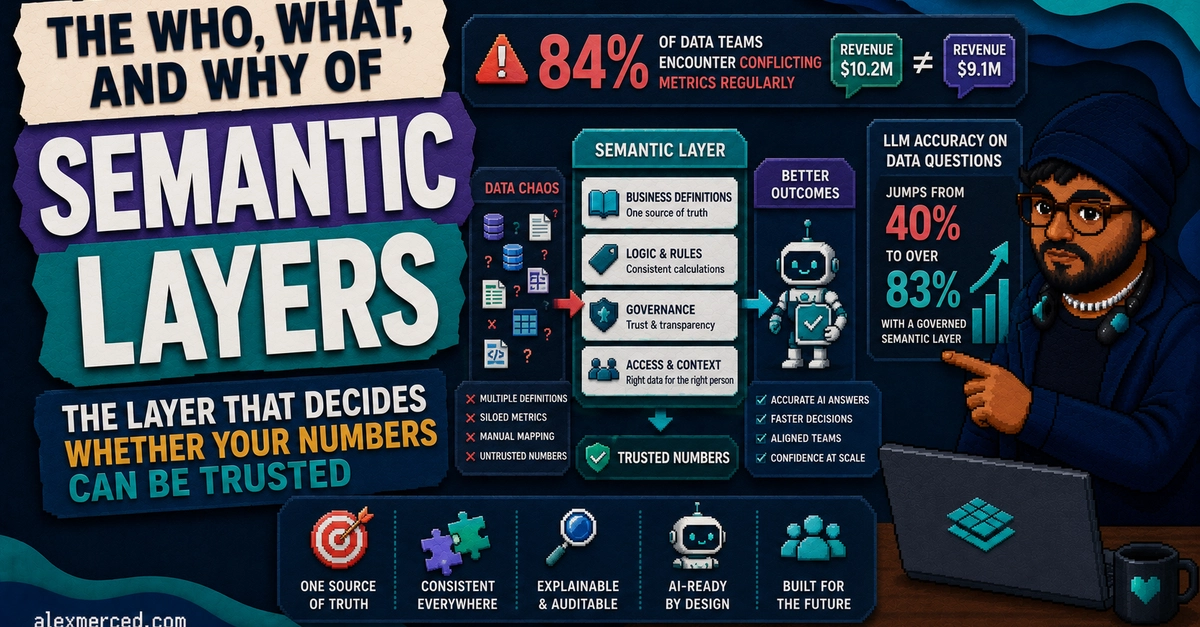
There is a survey statistic making the rounds this year that I cannot stop quoting: 84 percent of data teams report regularly encountering conflicting versions of the same metric. Not occasionally. Regularly. As in, most reporting cycles include an argument about whether revenue means gross or net, whether churn counts seats or accounts, whether this week's number can be compared to last week's at all.
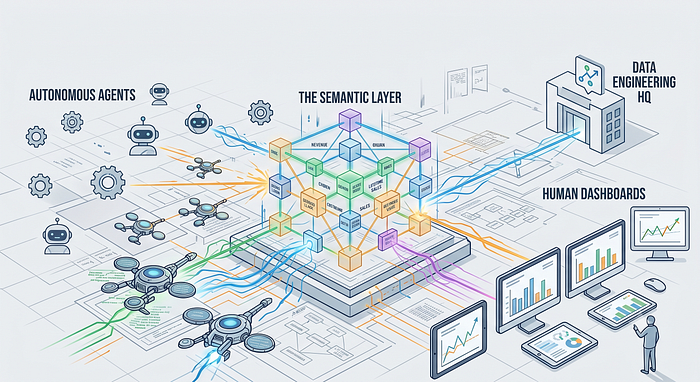
For thirty years, the industry's answer to that problem has carried one name: the semantic layer. And for most of those thirty years, semantic layers were a somewhat sleepy corner of the stack, the thing inside your BI tool that a few modelers maintained and everyone else ignored. That era ended abruptly. The rise of AI agents querying data on behalf of humans turned the semantic layer from a nice-to-have into the deciding factor between agents that produce trustworthy answers and agents that produce confident guesses. One frequently cited finding puts the stakes in a single pair of numbers: large language model accuracy on data questions jumps from roughly 40 percent to over 83 percent when the model is grounded in a governed semantic layer rather than raw tables.
So this article is the full treatment: the who, the what, and the why of semantic layers in 2026. What a semantic layer actually is, in plain language. Why every serious data platform now ships or integrates one. Who builds them, who owns them, and who consumes them, with an honest tour across the whole market, dbt, Cube, AtScale, Looker, the warehouse-native layers from Snowflake and Databricks, and yes, Dremio's approach, where I work and where I will declare my colors before praising anything. By the end, you should be able to explain the category to your CFO, evaluate the tools like a practitioner, and understand why I keep saying this layer is where the AI era gets won or lost.