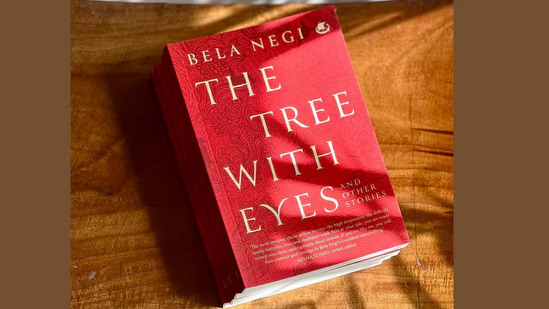
If you think life in the mountains is all peace and romance, this book might change your mind. Bela Negi’s The Tree With Eyes and Other Short Stories is a collection of nine short stories that capture the breathtaking beauty of the mountains without overlooking its darker realities.Cover of Bela Negi's new book, The Tree With Eyes and Other Stories that offers an honest portrait of the hills and of those who call these their home.Remaining rooted in the essence of Nature, in the collection, the mountains bring with them an all-encompassing presence and indirectly shape the destinies of those who call them their home. Gulab, the shepherd and medicine man in Where the Road Ends was content living up in the mountains, but his life succumbs to a darker fate after descending to the foothills. Despite acknowledging Nature’s destructive force like Shekhar’s deserted village in A Long Way From Home, where the entire settlement is abandoned because of floods, the people of the mountains fail to find a sense of belonging anywhere else. For them, the mountains and Nature remain their true home. This is evident in Shekhar’s search for his ancestral home in the deserted village, despite having left at age nine. The longing for home in Shekhar was so profound that he willingly assumed the identity of a man from the lower cast, simply for the chance to call someone Ija (mother).Negi’s characters are flawed yet human. Rather than presenting idealised protagonists, she creates individuals whose weaknesses, prejudices, and contradictions make them feel authentic. In The Monkey Chaser, Ganesh is lethargic, entitled, and unwilling to work. Believing that his family is the original owner of the land brought by wealthy outsiders from the city, he assumes he deserves employment without effort or qualifications. Similarly, Amma in Amma’s Keys defies the conventional image of a wise, nurturing grandmother. She drinks heavily, impulsively accepts a ride on a stranger’s scooter, and ultimately spends the night sleeping in a ditch. Yet, she remains the life of the party and the reason her grandson Laxman has his tea stall running.Presenting a range of interconnected issues that move beyond mere romanticisation of the hills, Negi highlights women’s plight in her stories. A sense of dual marginalisation emerges when women not only bear the burden of physical labour on the fields but also endure gender-based oppression. In Crazy Love, Gayatri is prevented from beginning a new life with her husband because she is expected to remain behind and labour in her brothers’ fields while they live in the city. Similarly, in The Three With Eyes, Lata is exploited by her father-in-law and abandoned to deal with the trauma of an abortion on her own while her mother-in-law, Savitri Devi, remains a silent and indifferent observer. Across these stories, women are portrayed as vulnerable and helpless, constrained by rigid social expectations. However, departing from this pattern, in Hishalu, 12-year-old Dimpy refuses to remain a victim of the circumstances created by her irresponsible father, and she exploits his ego to trick him into marrying the responsible Khushboo.The collection offers an authentic portrayal of life in the higher slopes, capturing its hardships and the slow identity crisis due to its ecological transformation.Title: The Tree With Eyes and Other StoriesAuthor: Bela NegiPublisher: Westland BooksPrice: ₹499For more, follow HT City Delhi Junction
Book Review | Tales that trade the romanticised mountain life for honest human encounters
Author Bela Negi’s The Tree With Eyes explores mountain life beyond its usual image, revealing changing realities through flawed yet deeply human characters.
554 words~3 min read