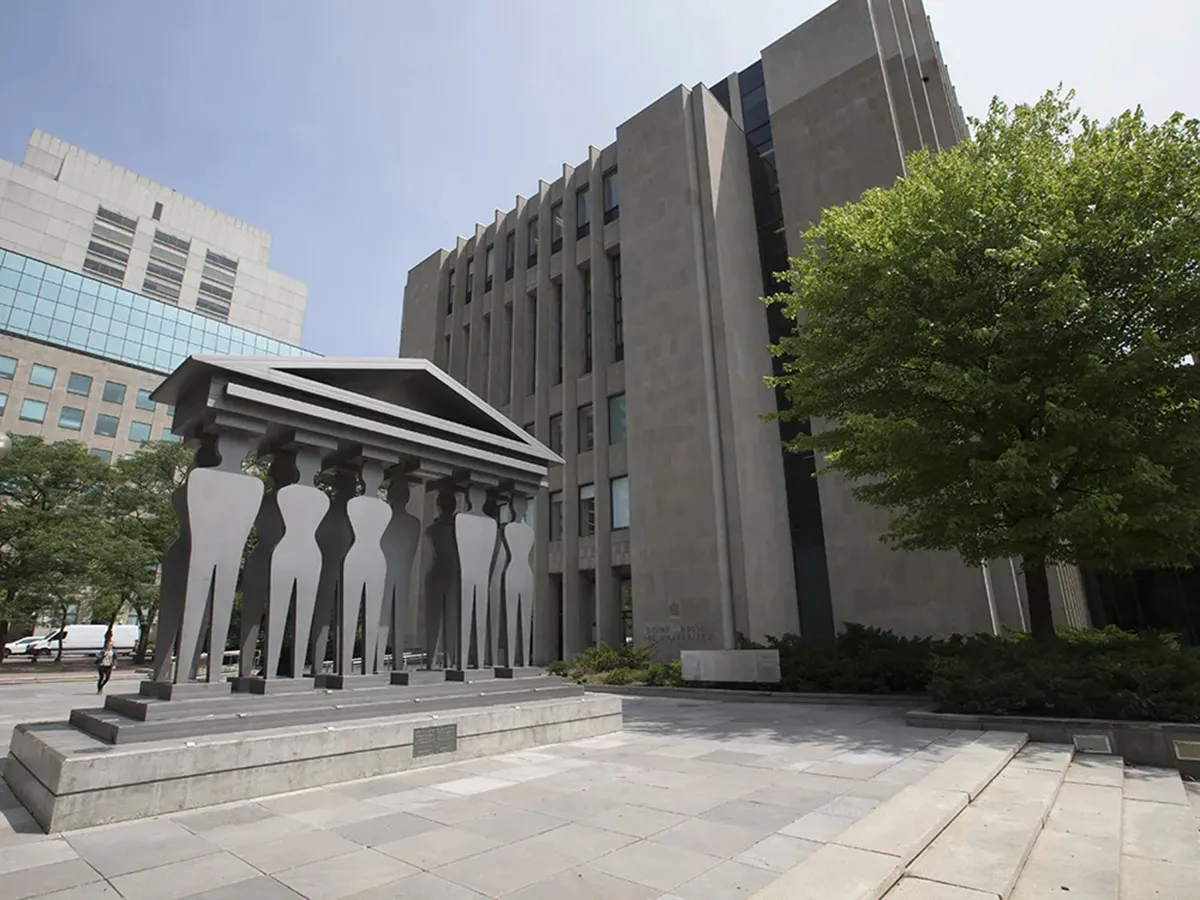
Skip to Content Subscribe Our Offers My Account Manage My Subscriptions FAQ Newsletters Canada Canadian True Crime Canadian Politics Health World Israel & Middle East Financial Post NP Comment Longreads Puzzmo Diversions Comics NP News Quiz New York Times Crossword Horoscopes Life Eating & Drinking Style Sponsored Play for Ontario Travel Travel Canada Travel USA Travel International Cruises Travel Essentials Culture Books Celebrity Movies Music Theatre Television Business Essentials Advice Lives Told Tails Told Shopping Buy Canadian Home Living Outdoor Living Kitchen & Dining Tech Style & Beauty Personal Care Entertainment & Hobbies Gift Guide Travel Guide Amazon Prime Day Deals Savings National Post Store More Sports Hockey Baseball Basketball Football Soccer Golf Tennis Driving Vehicle Research Reviews News Gear Guide Obituaries Place an Obituary Place an In Memoriam Classifieds Place an Ad Celebrations Working Business Ads Archives Healthing Epaper Manage Print Subscription Profile Settings My Subscriptions Saved Articles My Offers Newsletters Customer Service FAQ Newsletters Canada World Financial Post NP Comment Longreads Puzzmo Diversions Life Shopping Epaper Manage Print Subscription HomeNP CommentNP View: Excessive leniency for the mentally disabled robs society of justiceThe courts are failing to protect societyLast updated 11 minutes ago You can save this article by registering for free here. Or sign-in if you have an account.An Ontario Superior Court of Justice courthouse in Toronto. Photo by Stan Behal/PostmediaCanadian courts have become so soft on the mentally disabled that they can no longer be trusted to protect Canadians.Enjoy the latest local, national and international news.Exclusive articles by Conrad Black, Barbara Kay and others. Plus, special edition NP Platformed and First Reading newsletters and virtual events.Unlimited online access to National Post.National Post ePaper, an electronic replica of the print edition to view on any device, share and comment on.Daily puzzles including the New York Times Crossword.Support local journalism.Enjoy the latest local, national and international news.Exclusive articles by Conrad Black, Barbara Kay and others. Plus, special edition NP Platformed and First Reading newsletters and virtual events.Unlimited online access to National Post.National Post ePaper, an electronic replica of the print edition to view on any device, share and comment on.Daily puzzles including the New York Times Crossword.Support local journalism.Create an account or sign in to continue with your reading experience.Access articles from across Canada with one account.Share your thoughts and join the conversation in the comments.Enjoy additional articles per month.Get email updates from your favourite authors.Create an account or sign in to continue with your reading experience.Access articles from across Canada with one accountShare your thoughts and join the conversation in the commentsEnjoy additional articles per monthGet email updates from your favourite authorsSign In or Create an AccountorTake the case of an autistic and intellectually disabled Ontario man: when his little sister was 12, and he was 16, he began sexually assaulting her. It went on for four years — and when he was finally convicted for it, his judge gave him a sentence under half the length required in the Criminal Code, and ordered that it be served at his grandmother’s house instead of prison.He would go into his sister’s bedroom to do it, and sometimes ambushed her at the family cabin. He would watch porn and emulate it on her. He would tell her that it was for her own good, that it was preparation for marriage. He would reward her sometimes with money or candy. It ended in May 2022, when she made an audio recording of her brother sexually assaulting her at a friend’s suggestion, and reported the long-term abuse to her high school guidance counsellor. This newsletter from NP Comment tackles the topics you care about. (Subscriber-exclusive edition on Fridays)By signing up you consent to receive the above newsletter from Postmedia Network Inc.We encountered an issue signing you up. Please try againThe ensuing charges, two counts of incest and one count of sexual assault, should have landed the man in jail for at least five years. That’s the mandatory minimum for incest with a person under the age of 16, the bare standard settled upon by Parliament. But Justice Anne Molloy of the Ontario Superior Court said that such a sentence would constitute “cruel and unusual punishment,” and arrived at two years less a day of house arrest with grandma instead. It could have been worse: the man’s defence lawyers, Boris Bytensky and Kathryn Doyle, tried to argue that the Youth Criminal Justice Act should apply not only to people who are literally minors, but also to people whose intellectual age is below that of an 18-year-old. Because the man had the mental capacity of a child between the ages of nine and 12, they argued, his Charter rights required him to be treated as if he were that age. At very least, the judge shot this absurd proposal by defence down — had she agreed, it would have been a disaster for justice.That said, the sentence discount was still appalling in its own right. He sexually enslaved his sister. He knew it was wrong because he took steps to prevent pregnancy or discovery, and he’d stop if it sounded like their parents had come home. He was able to graduate from high school, get a driver’s license, and work a forklift job (albeit at his dad’s workplace), without depending on welfare; he lives with a degree of agency. A prison sentence that respects the moral code Canadians literally signed into law shouldn’t be out of the question just because the man would have a hard time of it — prison is tough for everybody, and the sad reality is that many of those incarcerated have a personal background of disadvantage.Sadly, this lenient treatment isn’t an anomaly. Courts across the country resort to the same logic to give convicted and suspected sexual predators a pass. In 2023, an intellectually disabled man was given the same sentence as in this more recent case — two years less a day on house arrest — for impregnating his intellectually disabled daughter who was 31 years his junior. And over in Alberta, just last week, the Court of Appeal ruled that there was no constitutionally compliant way to prosecute or detain a deaf man who never learned to communicate for multiple sex crime charges involving children. The judges backed themselves into a paradox that rendered Kendall Longclaws ungovernable by the criminal law, claiming that his lack of linguistic capability makes it impossible to examine whether he’s fit to stand trial — even though it’s clear that his lack of communicative ability has stunted his mind and has left him unable to function in society. At very least, these men were both found guilty; in the case of Longclaws, the court refused to assess the claims of his three alleged victims.When it comes to mental illness, meanwhile, it’s a regular fact of life to see even killers released back into the general public. Just in the last few months, a migrant who stabbed a firefighter to death in Toronto in 2013 in a schizophrenic rage was allowed to live in an apartment in an area frequented by the victim’s wife — to her utmost horror. A Toronto woman who knew she was schizophrenic but decided to stop taking her medication anyway and in doing so fatally stabbed a woman browsing a Shoppers Drug Mart was recently granted an absolute discharge after being released in 2021. Releases like this happen all the time even when — as in the case of George Veerman, a much-convicted, 71-year-old schizophrenic man who brutally strangled a cellmate — they remain a “significant threat to the safety of the public.”The ultimate purpose of the criminal justice system is to separate dangerous people from the law-abiding masses, and rehabilitate where possible. Having a mental deficit shouldn’t entitle a person to a completely different, lenient set of standards that allows them to wreak havoc on society. This is a problem, and for the sake of Canadians’ safety, it needs to be solved.National Post Join the Conversation This website uses cookies to personalize your content (including ads), and allows us to analyze our traffic. Read more about cookies here. By continuing to use our site, you agree to our Terms of Use and Privacy Policy.
NP View: Excessive leniency for the mentally disabled robs society of justice
The courts are failing to protect society
1,367 words~6 min read