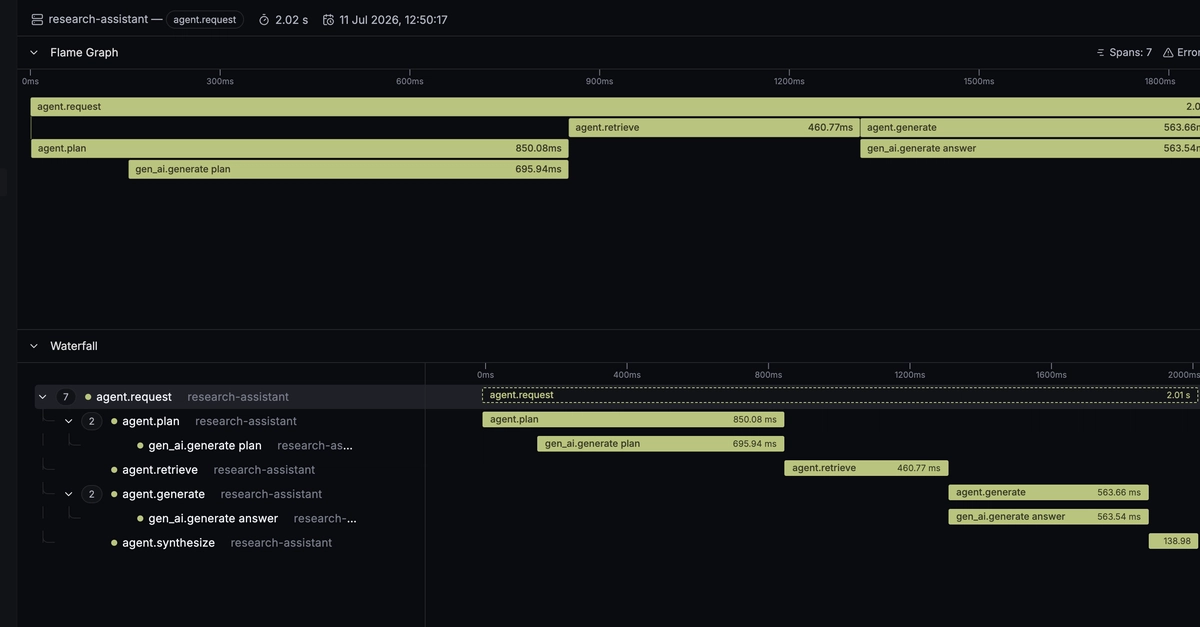
Multi-step LLM agents fail in a way normal backends don't. Nothing crashes. The pipeline "works", the answer is just bad, slow or three times more expensive than yesterday. print() debugging tells you nothing, because the interesting question is never "did step 3 run". It is "what did step 3 see, which model actually answered and what did it cost".
So I self-hosted SigNoz and pointed a simulated agent pipeline at it: a four-step research assistant (plan, retrieve, generate, synthesize) instrumented with OpenTelemetry, emitting traces, metrics and logs, with GenAI semantic-convention attributes (gen_ai.request.model, gen_ai.usage.input_tokens and friends) on every LLM call.
This post is about the feature that turned out to be the most useful. It was not the one I expected.
Setup: one CLI, eight lines of YAML
Self-hosting used to mean wrangling a long docker-compose file. SigNoz now ships Foundry, a small CLI that casts the whole stack: