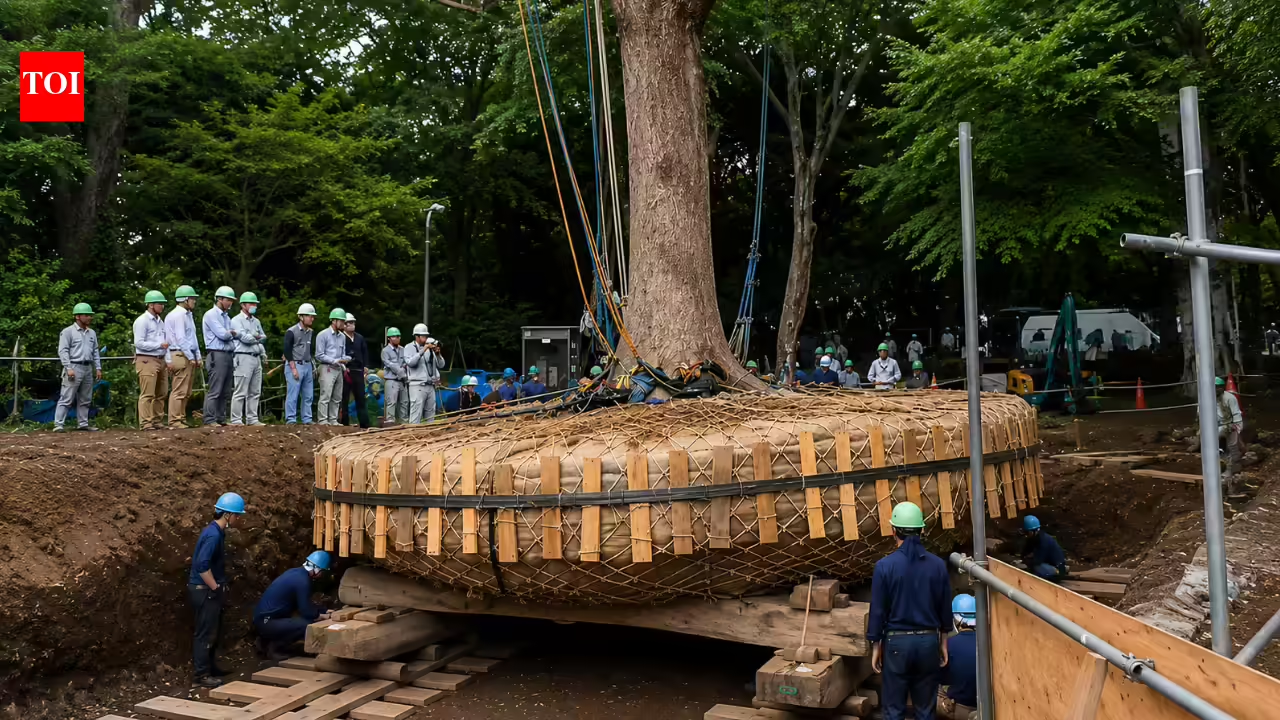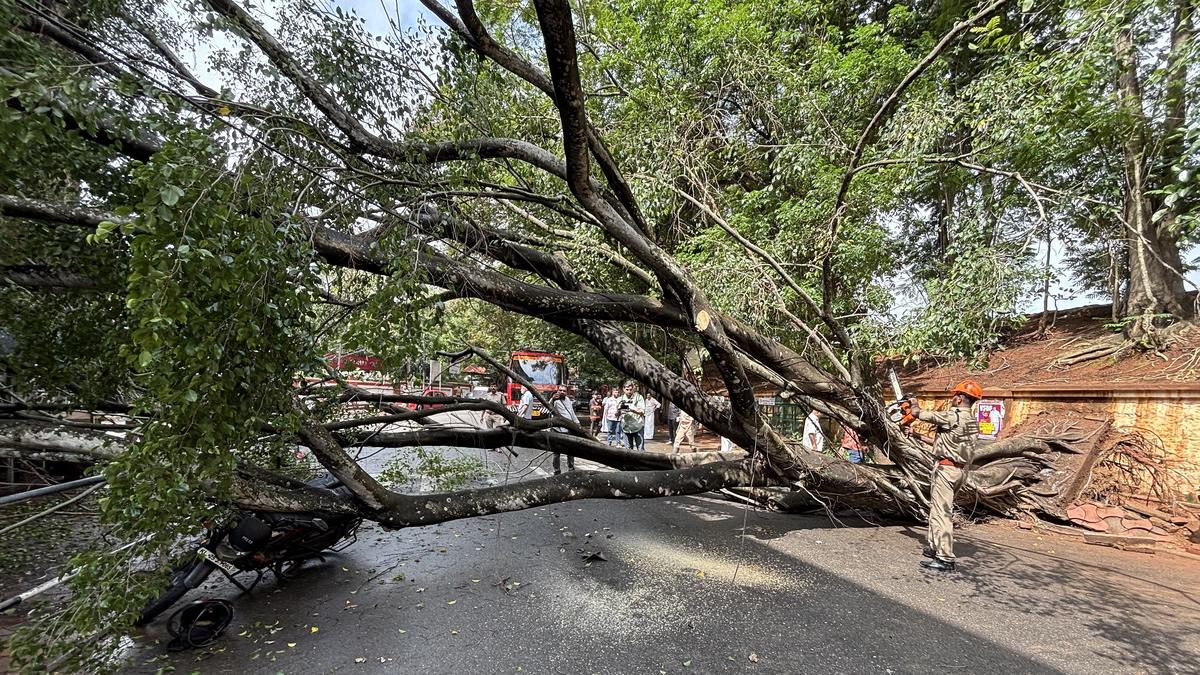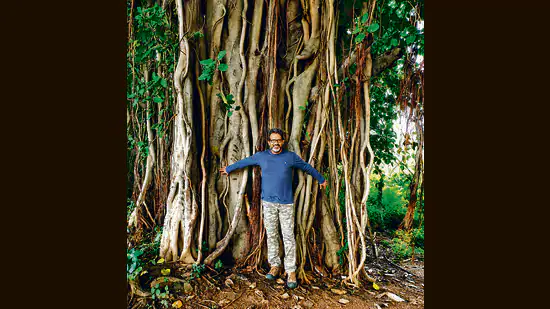
We have developed a kind of “tree blindness”, says Uday Krishna Peddireddi.Peddireddi and his Vata Foundation operate mainly in Telangana and Maharashtra. The thing about translocation is it takes time, he says. ‘It takes about 21 days: trim branches, isolate roots, allow fresh leaves and roots to sprout. Then move the tree.’One day, a caller may report that a decades-old banyan is set to have a road built around it. Another day, he receives news that a row of tamarind trees is set to make way for a flyover. Or a local homeowner may text him, complaining about an old imli shooting roots through his compound wall. “Can you do something or should I chop it down? I have to save the wall.”He first noticed the effects as a young man in Hyderabad. “When I was a teenager, I didn’t have to go far to get to a banyan tree,” he says. “As the years passed, I now have to go further and further.”Never a complainer, he decided, as soon as he could, to act.In 2010, his company Walkways secured a government contract to build foot-overbridges in Hyderabad (in exchange for exclusive rights to sell advertising space on these structures).For one such bridge, the project was granted permission to fell 16 trees.“There was a lane nearby that had no trees, and we already had heavy machinery at hand, so I thought, why not try to move them instead. After speaking to local residents, we moved them all. We saw 13 survive. Nine still stand. The rest were eventually cut down for another civic project.”When he realised it could really be that simple, he says, he couldn’t help but think: Why aren’t we all doing more of it?That question haunted him and, by 2015, Peddireddi had delegated most of business responsibilities to others and launched Vata Foundation, with a simple motto: Trees that stand for decades should not fall in seconds. (Vata is Sanskrit for wind.)He uses part of his income to fund his work, “which really isn’t that expensive,” he says. In some cases, people requesting a tree relocation supply the equipment, which reduces the cost. He has meanwhile acquired a 10-tonne crane and 40-ft trailer truck, so he doesn’t have to keep leasing them by the hour.“Scale can really help reduce the cost as well,” says Peddireddi, 56. “When I moved about 100 average-sized trees a distance of 25 km, the average per tree was just ₹3,000. On the other hand, moving two large banyan trees 75 km cost almost ₹1 lakh. Translocation doesn’t stop at the replanting either. For at least two years, the trees have to be monitored and watered regularly. This can involve a cost too.”Always looking for ways to further the cause, he sometimes offers free consultation too.His biggest project so far has been one where he served as consultant: an effort by the Indian Navy to translocate over 7,800 trees within the Damagundam jungle in Vikarabad, Telangana, to make way for a communications facility. The foundation was approached to help plan, execute and supervise the work last year.“We have translocated over 7800 trees of various species… at various locations within the Damagundam forest,” the Project Amber concluding report stated in October. Vata Foundation also planted 25,000 saplings of native varieties in the area, the report states.So, how does it all work?Transplanted trees famously have an abysmal survival rate, ranging in India from 5% to a best-case average of 33%. Peddireddi’s stated survival rate is a significantly higher 75%.Which is possible, says botanist Shrikant Ingalhalikar, who is on the advisory committee for Pune’s municipal tree planting and riverfront development project, if a tree’s health and age, as well as the soil and water content of the recipient environment are all taken into account carefully. The method is what makes the difference. “Transplantation is simply movement of a tree facilitated using hydraulic tree spades. Translocation salvages a mature tree along with its entire root system by uprooting the whole using heavy machinery and replanting it in a conducive environment.”Peddireddi has translocated trees to graveyards, school grounds, homes and private farms, across mainly Telangana and Maharashtra, collaborating with owners of plots, companies and gram panchayats. He likes to pick private plots as relocation sites because permission is much easier to secure. “Many, many homes are happy to take a fully grown tree,” he says.One thing he has become wary of is picking a location where there might be plans for new infrastructure. It is heart-breaking, he says, to see a tree take root again, and then have it torn down.OUT ON A LIMBAll this is far from ideal, Peddireddi adds.The best-case scenario would be a developmental plan that doesn’t disturb the trees, but the most realistic one, he adds, is translocation.“Theoretically, 21 days are required to translocate a tree. One must trim the branches, isolate the roots and allow fresh leaves and roots to sprout, after which the tree can be moved.” Rush it, he says, and the success rate falls.This means the plan for a new flyover or bridge, office complex or Metro station, even a plan for a new construction project (and there are so many thousands of these dotting each city), must take the trees into account from the start.“When governments treat translocation as a quick fix, floating tenders to private contractors who act in haste, that is when they see low success rates here too,” Ingalhalikar says.Meanwhile, trees that should be translocated are left to wither by the side of the road, their roots choked in concrete that doesn’t breathe. Already this monsoon, lives have been lost in Indian cities as giants, unable to stand on diminished root systems, crashed to the ground.It’s not really hard to do this better, Peddireddi says. “Trees make our world liveable; we do ourselves a favour when we protect them.” That’s the motto that guides him now. “I don’t do this to change the world,” he says. “I do this to make my corner of the world a little better.”
Re-rooting...: Meet the man saving trees by the thousands, with a simple formula
When he hears of one set to be axed, businessman UK Peddireddi digs it up with roots intact, and translocates it to a private plot. It’s not that hard, he says.
1,003 words~5 min read