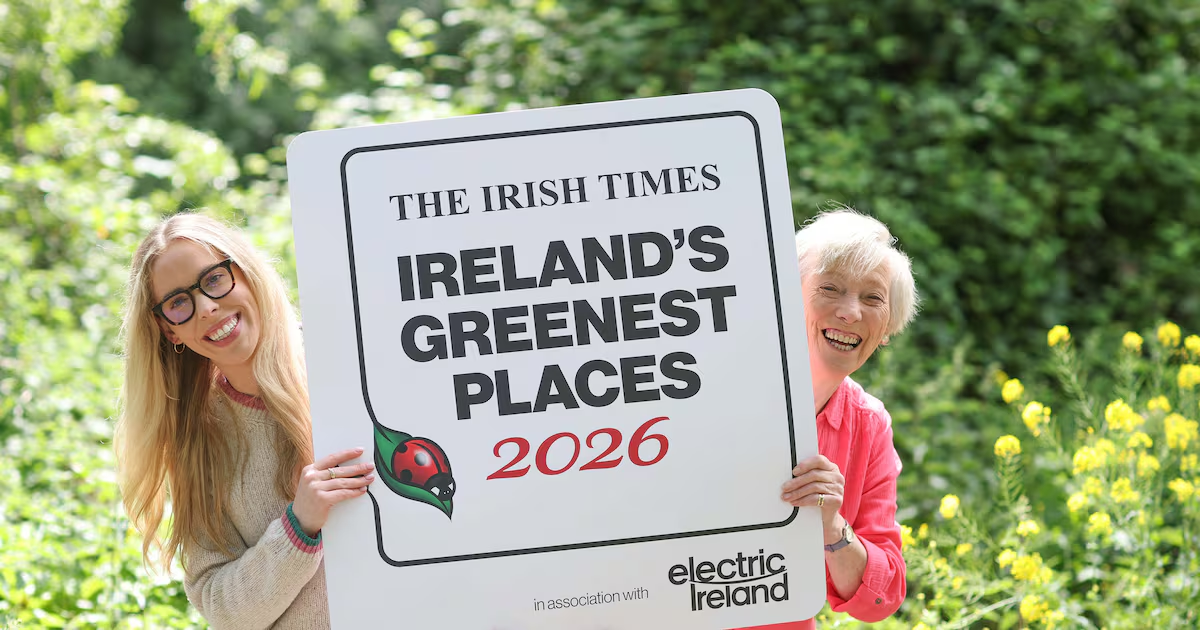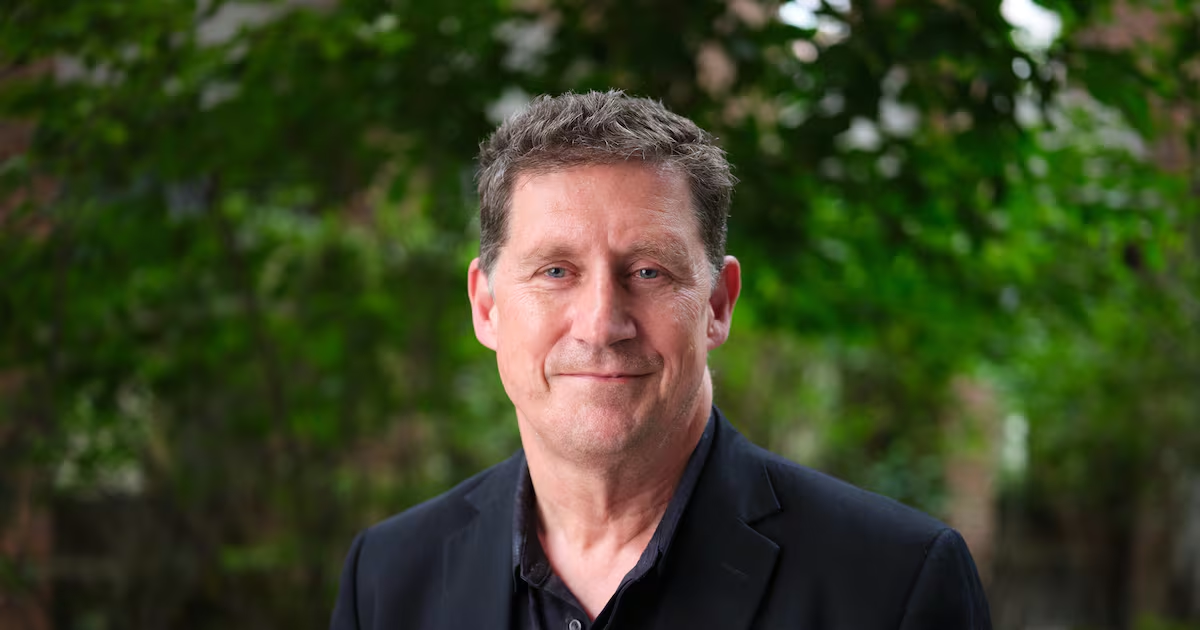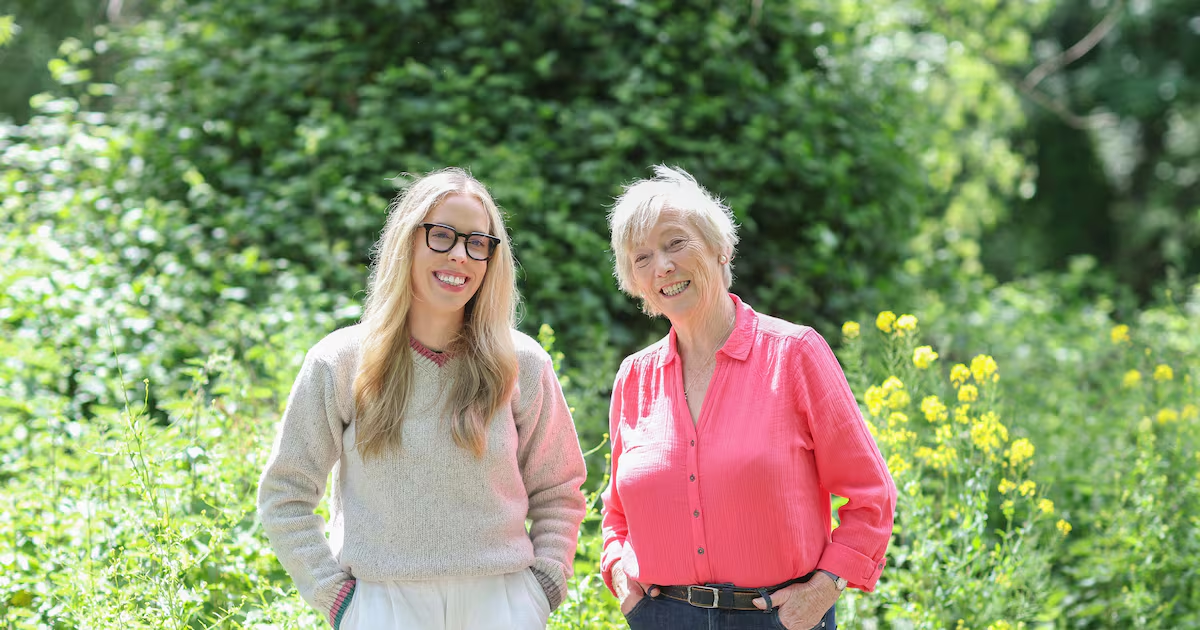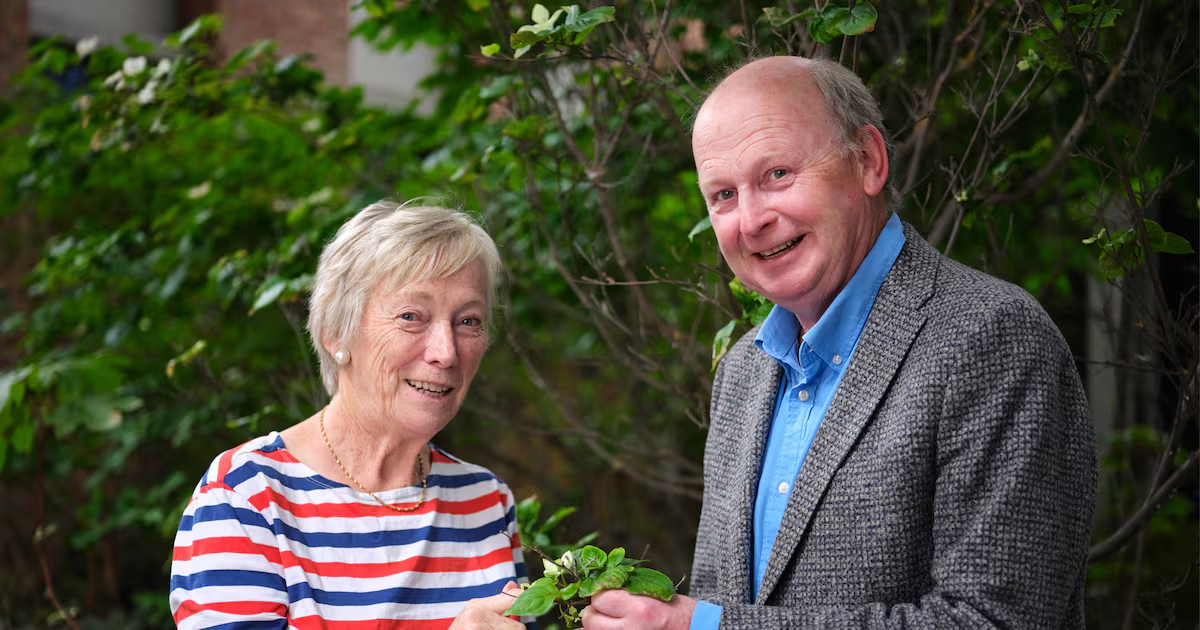
We are three weeks away from the closing date for entries to Ireland’s Greenest Places, a competition run by The Irish Times in association with Electric Ireland.By August 1st, we are asking readers to suggest places and people that are deserving of the spotlight for their commitments to a greener world. This year, as well as selecting winners for Ireland’s greenest town or village, community, and suburb, the judging panel will be considering submissions for a new category.[ Where are Ireland’s Greenest Places 2026? Cast your vote hereOpens in new window ]The Net Zero Hero category is aimed at a singular individual whose climate action is making a real impact. Included below are some examples of the sorts of profiles that could excel in this category, but bear in mind that a Net Zero Hero can operate at a very local level. If you see inspiring climate action unfolding around you, please do not hesitate to submit an entry.Environmental consultant and former Irish Times environment editor Kevin O’Sullivan, who is returning to the judging panel for Ireland’s Greenest Places, explains that the term “net zero” is more important than ever. “There is an increasingly loud and growing movement calling for climate action to be rowed back,” he says, “while insisting its advocates are not in the deniers’ camp... their ranks include some multinationals, governments and prominent politicians, airlines and, of course, fossil fuel companies who claim to be still embracing renewables.”The narrative being touted, O’Sullivan says, is that climate targets are well-meaning but overambitious and too demanding. “Invariably, they are united in detesting the global commitment to achieve net-zero emissions by 2050, as if it was some nebulous notion plucked out of the sky,” O’Sullivan says. “This runs counter to reality.”Net zero means achieving a balance between greenhouse gases put into the atmosphere, and it is dictated by science, O’Sullivan adds. “It is essential to making the world a safer place, to avoiding irreversible climate breakdown and to cooling the planet.” “As a counter to all of this, those who through their actions, especially at community level, bring us a step closer to net zero by mid-century need to be highlighted as the small catalysts that will help build to transformational collective action. That is why the Ireland’s Greenest Places Awards want to salute such individuals.”Eamon Ryan, former Green Party leader and ex-minister for the environment and climate, is back on the judging panel for Ireland’s Greenest Places 2026. Photograph: Mark Henderson Alongside O’Sullivan, former Green Party leader and ex-minister for the environment Eamon Ryan is back on the judging panel, as well as Irish Times senior features writer Rosita Boland and Lisa Browne, head of marketing and customer insights at ESB.They are joined by biologist, author, presenter and environmental consultant Éanna Ní Lamhna, and sustainability consultant and “de-influencer” Shannen Healy, known as @_greengal on Instagram and other platforms.Now, to examples of potential Net Zero Heroes. Jacinta BarrinsTeaching climate activism Jacinta Barrins Through a six-week course that has, to date, served 14 counties, Jacinta Barrins fosters an older generation of climate activists in Ireland. Having spent close to two decades working in the Department of Hydrology at University of Galway (UG), Barrins left to focus on water-related projects in a host of African countries, and finished out her professional career with 15 years as a residence co-ordinator with the United Nations, where one of her main roles was facilitating the Paris Agreement.“When I retired, I wasn’t ready to put my feet up,” Barrins explains. She returned to UG to complete a climate-based MsC and “it became obvious to me, in Ireland, that my age group – we weren’t really understanding what is this thing called climate change”.That was when the idea for the 60+ Climate Drive Programme arrived. Working with Galway City Council, Barrins designed a course aiming to help older people relate to the climate and related issues. She imparts the science, she says, but in “the most friendly, easy way”. The first session explains the link between a cup of tea and climate change, focusing on consumption first and confronting participants with the impact of their own behaviour. [ Ireland’s Greenest Places: Community is the catalyst that can create changeOpens in new window ]The participants develop an understanding of emissions beyond impersonal statistics, analysing their own carbon footprints and committing to achievable goals. Anyone signing up for the climate drive knows they have to take action in one of four areas: housing, transport, food or waste. On top of effecting personal change, participants are asked to reach out to members of their community, sharing the information they have taken in. The course is bolstered by additional speakers. Experts in local biodiversity explain, for instance, what and what not to grow; nutritionists teach about meat alternatives; representatives of councils and the Sustainable Energy Authority of Ireland (SEAI) detail the grants and incentives available to people who make green commitments. It also prepares participants to avail of Community Climate Action Funds if they so choose, giving them a sense of how to access the schemes, but, perhaps more importantly, explaining why they exist. “If the climate fund is focusing on pennies in the pocket without people appreciating the net zero part, getting the greenhouse gases down and the why of why you want to do that, then we’ll have missed this opportunity with this fund,” Barrins says. “I have found people who would not have understood their behaviour,” she adds. “People begin to see why they should do it… If you show the opportunities that are out there and the potential that is out there, it is surprising the number who do come on board.”Joe DevineBog restoration South of Bangor Erris, in rural Co Mayo, sits an 1,800-acre blanket bog ideally suited to capturing carbon, but which has for long been emitting greenhouse gases instead as a result of draining in the 1980s. Joe Devine, co-founder of private investment company Ion Equity, first encountered the bog in 2017 while trekking along the Bangor Trail. It was for sale at the time, though it was 2021 before he began considering it for purchase, analysing the site’s capacity for different projects including forestry, wind farming, tourism, and carbon trading. “I thought, well look, land values aren’t going down in Ireland, so why don’t we just buy it?” Devine says. “Worst case, the grandkids can figure out what grandad was doing in about 30 years’ time.” Having entered the process with no background knowledge of bogs, he became fascinated by them. He set about rewetting and rewilding the land, aided by Bord na Móna, which conducted a baseline survey and helped designed a bog restoration plan. Forestry and wind farms were ruled out as possibilities, and carbon became Devine’s central focus. Since the draining for industrial extraction, the bog was leaking “between 1,000 and 2,000 tonnes of greenhouse gas emissions”, so he zoned in on reversing that damage. “We blocked the drains,” Devine says. “Rather than filling them all in [individually], which would have been a very expensive exercise, there were dams made of peat from the bog which were filled into the drains in order for the water to accumulate. It’s all about water table management.”‘The family has gotten involved and the kids and grandkids have all been to the bog, and they’re all fascinated by it’— Joe Devine, Ion EquityAs the water table rises, life returns to a drained bog, reversing the leakage of emissions and instead storing carbon. The baseline survey that was conducted gave a precise summary of the state of Devine’s bog, enabling tracking of its progress as it improves. Early indications suggest the process is working, but the first official measurement will take place in 2029, and subsequently once every five years for the next four decades. [ Revealed: Ireland’s Greenest Places 2025 long listOpens in new window ]“Part of the bog is already a sink,” he says. “It wouldn’t have been drained at all in the ’80s for a whole variety of reasons, so we have demonstrable evidence that [the whole thing] can be remediated and turned into a sink.”As that process continues, the biodiversity, flora and fauna on the site will benefit. Habitat development organisation Breeding Waders EIP has identified the site as a useful location for flocks of birds to nest. Returning mosses are a driver for the removal of dissolved organic carbon from the water, and for controlling the flow of that water into the sea. “I’m fascinated by the whole thing,” Devine says. “It’s a whole new area for me since 2021. The family has gotten involved and the kids and grandkids have all been to the bog, and they’re all fascinated by it and so on. For me, it underlines that, as a state, we need to be doing more of this work rather than less of this work.”Pamela O’ConnorFacilitating home energy upgrades“She’s incredible,” Anne O’Reilly says of Pamela O’Connor, whose green efforts in Wexford have hinged, in the main, on being well-known, well-regarded and highly trusted in her community. In 2021, O’Reilly was one of the co-founders of Wexford Town Sustainable Energy Community (SEC), a voluntary group aiming to address climate change and promote a just transition to sustainable energy use. When the Net Zero Hero category was explained to her, O’Connor was the first person who came to mind. A couple of years ago, the SEC had been trying to promote fully funded grants for home energy upgrades offered by the SEAI under its Warmer Homes Scheme. They identified Southend, an area in Wexford with high levels of disadvantage, as a good fit for the programme, and carried out a survey among its residents. Responses were good, but sceptical. People weren’t sure about the scheme, and meetings were organised to try to explain it to them. O’Connor sat in on those meetings and took an interest in the topic.“Pamela learned what it entailed herself, checked the application forms and discovered that she could help people fill out their applications if they needed help,” O’Reilly says. “There were a lot of older people in the area who wouldn’t be able to do stuff online.”‘You had people from outside the community contacting her for information, advice and for help’— Anne O’Reilly, Wexford Town Sustainable Energy CommunityWhen upgrading of houses first began, O’Reilly said a “flood” of requests to speak with O’Connor arrived. Nowadays, O’Reilly speaks with people in the area who have benefitted from the scheme, and they tell her their health has improved thanks to O’Connor’s work. “Between the jigs and the reels, she helped to fill out forms for over 100 people, maybe 150, who all made their submissions and who were approved for the grant,” O’Reilly says. “This started in 2022 or 2023, and since then, 30 to 40 houses have been completed, and it’s ongoing up there in that area.” The SEC was set up by Patrick Rochford, its chairman, alongside O’Reilly and a couple of others. They made an early decision to concentrate on upgrading houses, reducing the use of fossil fuels in home energy, and on a just transition “to make sure nobody was going to be left behind”. That philosophy is epitomised by O’Connor. Her work highlights the power of local engagement, and her legacy is clear in the upgraded infrastructure.“We didn’t think it was going to turn out anything like it did,” O’Reilly says. “But Pamela is just incredible. People just take to her. You had people from outside the community contacting her for information, advice and for help.”
Ireland’s Greenest Places: Why we want to salute Net Zero Heroes
As the deadline to nominate people and places in the second Ireland’s Greenest Places competition approaches, we take a look at some of those already in the running
1,926 words~9 min read