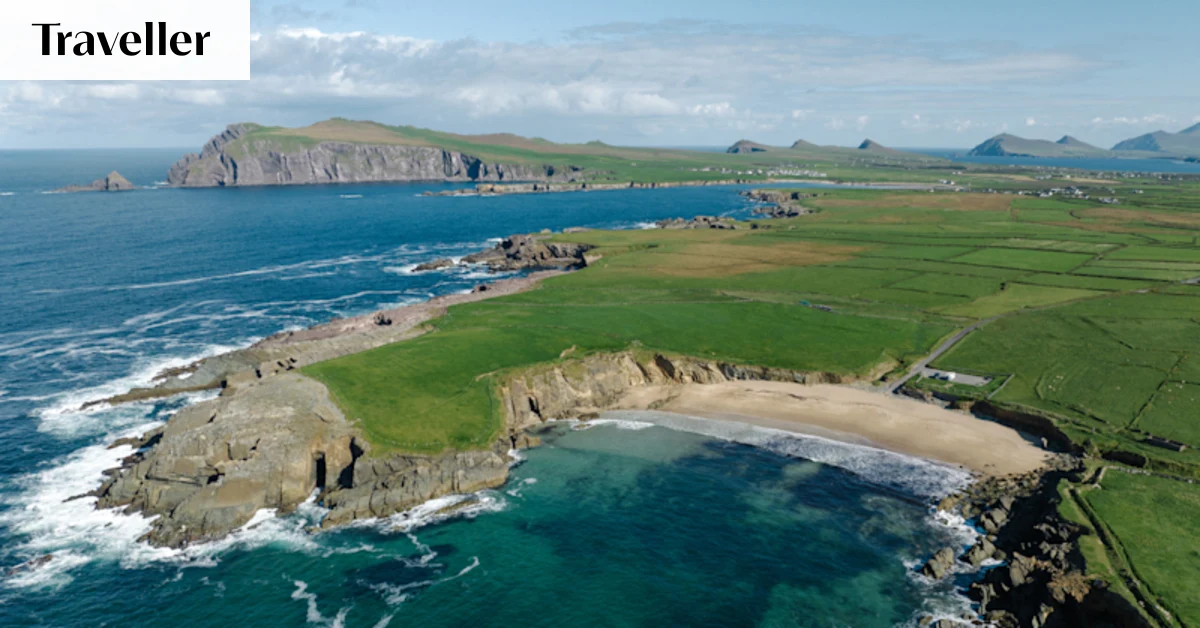
Welcome to Dingle – Ireland’s Greenest Place 2025. That’s the sign Deirdre de Bhailís envisages standing proud on the road to the Co Kerry peninsula. She’s negotiating with Kerry County Council on the proposal because, she says, the accolade “should be up in lights and banners”. But even if the physical signpost isn’t there yet, the experience of winning has left its imprint on the community. Dingle won the inaugural Ireland’s Greenest Places competition run by The Irish Times in association with Electric Ireland last year after bowling over the judges with the area’s locally led and community-based initiatives that strive for a greener way of living. The peninsula has organisations, associations and networks giving their time to protect nature, prevent coastal erosion and roll out renewable energy in many different settings. There are groups showcasing local produce, staging zero-waste festivals, planting trees, sharing seeds, developing pollinator corridors and digging ponds for biodiversity. The area supports LocalLink buses, runs EV charger share groups, hosts swapshops, promotes slow tourism and takes sustainability from a slogan to a way of doing business. And that’s only a sample of what’s going on there. De Bhailís, manager of the Dingle Hub, was one of the people who nominated Dingle for the competition and was at pains to convey in her submission just how abundant and diverse the efforts were.Ireland’s Greenest Places 2025: Máire Uí Mhurchú, Val Behan, Fionna Sheehy, Catríona Fallon, Ann Ní Chiobhán, Dinny Galvin, Tommy Reidy, Martin Bealin, Martha Farrell, Grainne Kelliher and Deirdre de Bhailís at the newly created pond for biodiversity at Dinny Galvin's farm. Photograph: Valerie O'Sullivan “One lovely comment we got afterwards was how unifying Ireland’s Greenest Place was,” she says. “It’s a big area and people were working away north of the peninsula, south of the peninsula, in Dingle itself. “A big driver for us in entering the competition was the pulling together of, and the recognition of, so many different groups.” That spirit of individual and collective effort working in tandem ran through many of the entries in the all-island competition and was very evident in the category winners too. Dún Laoghaire in Co Dublin, named Ireland’s Greenest Suburb, had a big challenge on its hands – how to take crowded, car-congested, urban throughways and turn them into ‘living streets’ for active travel. The idea was to prioritise space for people – not just to get from A to B but to meet, browse, chat and feel part of a neighbourhood. [ Ireland’s Greenest Places winners: The five locations our judges lovedOpens in new window ]The area has always had popular walks – the pier at the harbour and the lovely People’s Park among them. But rather than compartmentalising amenities, the vision was one of interconnectedness with walking and cycling routes complementing public transport and allowing ease of movement – as well as precious opportunities for simply sitting down. Ireland’s Greenest Town, Skerries, had a different kind of challenge. So often considered a seaside escape for city dwellers or a commuter town to feed Dublin with workers, the vision was to reinforce its own identity and re-energise its residents by enhancing its natural beauty. Inagh in Co Clare, Ireland’s Greenest Village, was one of the smallest places to enter, but the village of fewer than 200 people made a big impact. Its wide array of projects focused partly on creating a better local environment right now – by developing a riverside walk, building a community playground and creating a sensory garden. But they also had a firm eye on the future, planting an apple orchard and nut trees with dreams of opening a local nut buttery when the trees mature. James Carton and David Fay of the Dysart River Project at Lough Ennell in Co Westmeath. Photograph: Bryan O’Brien The Ireland’s Greenest Community award went to the Dysart River Project in Co Westmeath, which showed a community can be created by a shared ideal as much as by geography. The project brought a community of swimmers, anglers, farmers and landowners together to clean up the Dysart and, in doing so, return to health Lough Ennell which had been the repository for the river’s polluted waters. Now the search is beginning for the 2026 Greenest Places. The format is similar to last year but with a slight change to the categories. Awards will be made to Ireland’s Greenest Community; Greenest Suburb; Greenest Town or Village; Overall Winner and, a new one this year, Ireland’s Net Zero Hero. The Net Zero Hero award will go to someone who stands out for their exemplary work in driving a particular project, in inspiring others to act, in co-ordinating community efforts – or all of the above. Their work will be in the spirit of the Net Zero ambition – aiming to reduce greenhouse gas emissions and increase natural carbon capture, replenishing the land and nature so that whatever is taken from it is repaid with interest, or helping build climate resilience. In a cynical world at a time when it can be hard to distinguish the fake from the genuine, it may almost be hard to believe that such people and communities exist in any number.But Pete Lunn, head of the Behavioural Research Unit at the Economic and Social Research Institute, is not at all surprised. “The first thing to understand is that the large majority of the population are worried about the environment and particularly climate change,” he says. “We know that from multiple research sources. The overwhelming majority will describe themselves as either worried or very worried, so there is a basic motivation there. “We also know that they tend to underestimate the degree to which the rest of the population is as worried as they are. “Unfortunately academics give this a really annoying name – pluralistic ignorance – but it essentially means people don’t realise the extent to which everyone else is as worried as they are. “We’ve measured that in our own work and it’s known internationally.” It’s not just the science that backs Lunn up – recent events tell a similar story. National Biodiversity Week took place last month and the countrywide calendar was filled with hundreds of events hosted by environmental NGOs and local groups to celebrate and share what remains of the natural world around them. While we may not be fully insulated from the crisis, I do get a sense that we are not powerless— Deirdre de BhailísBefore that, the results of the wide-reaching consultation on the Nature Restoration Plan were published, revealing a deep concern, and even grief, among the hundreds who turned up at public discussions on the decline of their natural environment. Again, Lunn is not surprised. “People have a really strong sense of loss and worry about the state of the environment,” he says. [ How coastal community is modelling a new way for rural Ireland to thriveOpens in new window ]“The way we connect with nature is something we don’t fully understand, but we do know that when people connect more with nature it makes them happier and gives them a sense of wellbeing, so it shouldn’t be a huge surprise that when they see nature being damaged that they experience a sense of loss.” People also connect with people, says Lunn, echoing that sense of unity de Bhailís spoke of. “People instinctively know it’s a collective problem,” he says of the climate and biodiversity crisis. “In other words, how everybody behaves is what determines the outcome – not how individuals behave. “We know a lot about how people approach those kinds of collective action problems, which is to say that it’s much more likely that people will act if there’s a strong group identity – and particularly if they see that other people are acting too. “Most people are conditional co-operators. They will volunteer and put the effort in if they perceive that other people around them are doing it too. “They want to play their part and feel good about what it’s doing and achieving.” Ireland's Greenest Places: Judge Éanna Ní Lamhna with young nature enthusiasts Joey Ricketts (4) and Emily Tofan (6) So we know now what generally motivates people to care about the kind of projects Ireland’s Greenest Places 2026 wants to recognise and we know what gets them involved and sustains their enthusiasm. Now the judges want to hear the details. We are asking readers to nominate the places, projects and people they believe are Ireland’s Greenest. At the end of this article you will find a form to enter some basic details and make a case in a short written piece of up to 300 words as to why your nominees are deserving of recognition. All the entries will be assessed by a panel of judges and researchers before a longlist is compiled and the team take to the roads to see the nominated places for themselves. You don’t have to be part of the initiatives contributing to a better environment in the place you nominate. You don’t even have to live there. But if you’ve been impressed, heartened and inspired by what’s being achieved there, let us know. Over the summer, the longlist will be whittled down to a shortlist before the winners are announced in September, and The Irish Times will carry updates on each stage of the competition. Most of the judging panel have returned for the second year. They include former Green Party leader and ex-minister for the environment and climate Eamon Ryan, environmental consultant and former Irish Times environment editor Kevin O’Sullivan, Irish Times senior features writer Rosita Boland, and Lisa Browne, head of marketing and customer insights at ESB. Ireland's Greenest Places: New to the judging panel is Shannen Healy of Green Gal Joining them for the first time are biologist, environmental consultant, author and radio presenter Éanna Ní Lamhna, and Shannen Healy, sustainability consultant known as @_greengal on Instagram and other platforms, she brings sustainability issues and tips for greener living to social media. There’s a little bit of work involved in writing a good pitch for your nominated place, so don’t delay. Please don’t use AI.Preparing an entry is a rewarding exercise in itself, de Bhailís says. “Just to reach out to different groups in an area and see what is happening and collect all that in one place is worthwhile,” she says. “Often times people don’t know what’s going on in their area, but recognition inspires more action so for groups that are trying to get started on the journey to a greener place, compiling what’s happening is really valuable.” Deirdre de Bhailís, manager of the Dingle Hub on the Dingle peninsula. Photograph: Domnick Walsh There can be other rewards too. “We got some great feedback from our tourism network because they can leverage the kind of recognition that winning the award brings,” de Bhailís says.“Even with State bodies, if you’re approach them about new projects or investment, an award like this gives you clout. “Networking gets stronger too. People reached out to us immediately afterwards with invitations to conferences and events to hear more about what we do. “There was an increase in volunteerism too. It added to the momentum because people were able to look at what we were doing as a collective across the peninsula and take pride in their success. “Success breeds success, so if you have exhausted volunteers out there, this is a wonderful way of getting new people on board to help. And that’s what we need because it’s all shoulders to the wheel.” There have been difficult times since the award ceremony last September, with global instability and the cost-of-living crisis, but de Bhailís says it has not proved a distraction. “It’s the opposite. When you see our dependence on imports for fuel and food, it focuses the mind even more on what we’re trying to achieve,” she says.“We’ve been taking action all along – on agriculture and travel and energy – and while we may not be fully insulated from the crisis, I do get a sense that we are not powerless, that we can do this.”
The search for Ireland’s Greenest Places begins, with two new judges on board
Following the success of last year’s competition, we are once again asking readers to nominate the places across Ireland that deserve to be recognised
2,023 words~9 min read