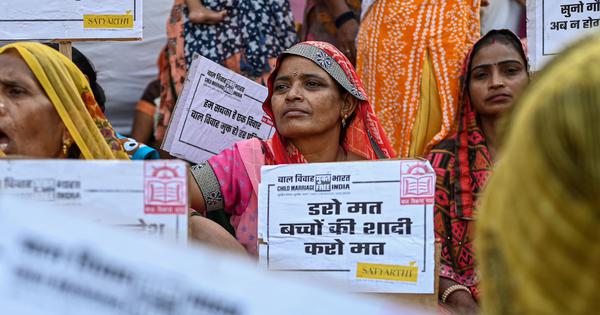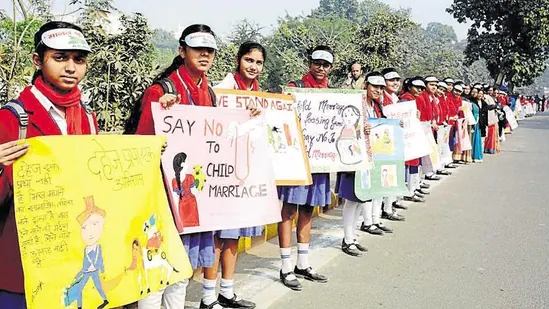
India has implemented multiple strategies to address early marriage and high fertility, primarily through two policy approaches. The first approach has focused on increasing girls’ participation in education. Initiatives such as the Sarva Shiksha Abhiyan (2001) targeted universal elementary education, while the Right to Education Act (2009) established schooling as a fundamental right for all children aged 6 to 14. The Mid-Day Meal Scheme provided nutritional incentives to encourage school attendance. More recent programmes, including Beti Bachao Beti Padhao, Sukanya Samriddhi Yojana, and West Bengal’s Kanyashree Prakalpa, have further promoted girls’ education and delayed marriage. The second policy approach has addressed family size and the institution of marriage directly. India introduced the world’s first national family planning programme in 1952. The Prohibition of Child Marriage Act, 2006, established the minimum legal age of marriage for women at 18, with a subsequent proposal in 2021 to increase this to 21.Both policy streams are based on the premise that education, marriage, and family size are interrelated, forming a ‘virtuous cycle’ in which increased education delays marriage, reduces fertility, and enhances women’s empowerment, while lower fertility enables greater investment in each child’s education. The latest round of the National Family Health Survey, NFHS-6 (2023-24) in comparison with the previous round, NFHS-5 (2019-21), provides an opportunity to evaluate this relationship using recent State-level data.Growth in schoolingBetween the two surveys, women’s schooling continued to rise almost everywhere. The share of women with 10 or more years of education increased in 33 of 35 States and Union Territories. And in 27 of the 35, the two indicators moved exactly as the virtuous cycle story predicts: schooling up, early marriage down. Across States, the correlation between changes in women’s schooling and early marriage is −0.40, a statistically significant association (p = 0.018). States where girls stayed in school longer are, on average, the States where early marriage fell fastest.
Where education still moves the needle: marriage, not family size
Explore how education impacts marriage age and fertility rates in India, emphasizing the importance of delaying early marriages.
1,011 words~5 min read