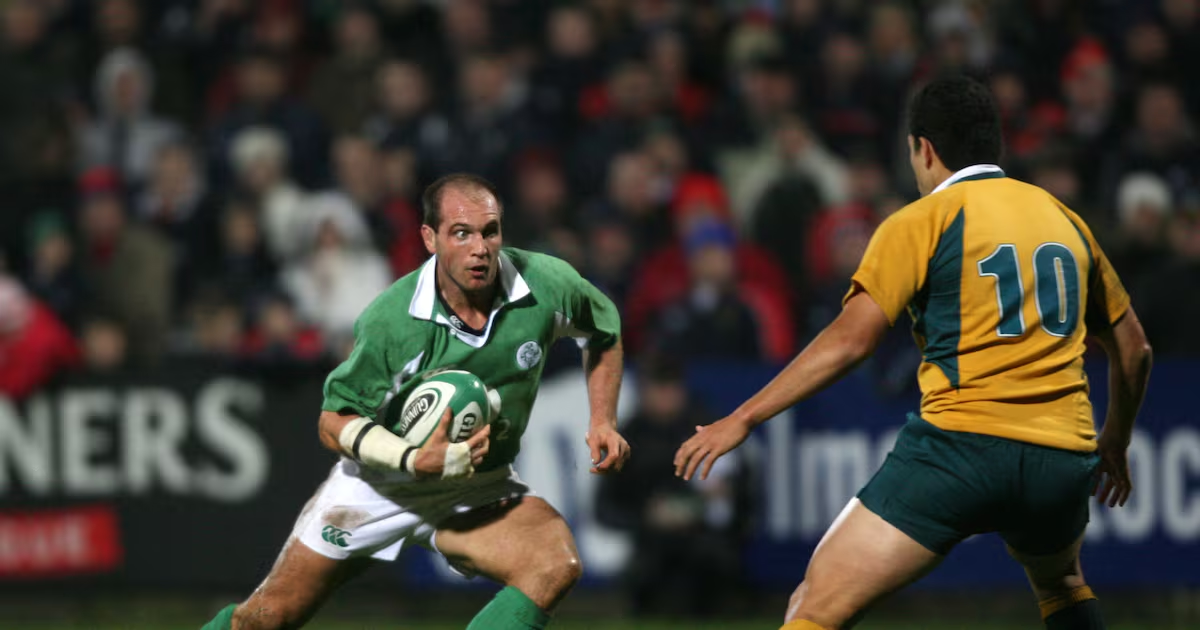
The former Ireland player, who was reared in Sydney, discusses his concerns about the future of professional rugby in Australia and the ‘very special’ Andy FarrellKeith Gleeson in action for Ireland in 2006. Photograph: Billy Stickland/Inpho Sat Jul 11 2026 - 06:00 • 6 MIN READKeith Gleeson was born in Dublin and reared in Sydney. He’s been back living here since 2008, yet there’s no doubting his allegiance this week, last week or any other week. When it comes to rugby, he’s Irish. Always will be.It was for rugby reasons that Gleeson moved to Ireland in 2001 and joined Leinster for sevens seasons, bookended by a memorable inaugural Celtic League final in Lansdowne Road and a Magners League title. He earned 27 caps for Ireland, winning three Triple Crowns and playing in the 2003 World Cup. His Irish father Tony and Australian mum Diane decided their family would have better prospects Down Under than in early 1980s Ireland, and last year they celebrated their 57th wedding anniversary. Gleeson also met his wife Fiona while living in Dublin. Their oldest son Lucas (17) was born there and remains affiliated to Ireland and a rugby fan. But as Gleeson reveals with a wry shrug, their younger boy Dylan (15), born in Australia, has no great affection for either.Last month Gleeson turned 50 and last week he and Fiona celebrated their 20th wedding anniversary with a mid-term family break in Queensland, and by sitting in to cheer on Ireland in their 33-31 win over the Wallabies last Saturday.The Wallabies are his second team, but he is concerned. “I fear for professional rugby out here, because there’s great interest in the international matches, but Super Rugby is broadcast to middle upper/class Australia, for the most part, and the product is really poor.”Gleeson stresses that schools rugby and club rugby are healthy.“But Super Rugby games are still played late in the evenings, which is not family-friendly time, and the fear is Super Rugby will fall in a few years and all players will play overseas, and like soccer fly back for internationals.“And if they get to that point then there’s no recovery for the game. It’ll be an absolute disaster, and it’ll be a disaster for New Zealand rugby as well.“In the last week Rugby League has signed an Aus$5 billion deal [€3.03 billion] over seven years for television rights, equivalent to about $800 million [almost €500 million] a year in television rights. I think rugby union gets about $35 million [€21.23 million] a year in television rights, so how do you compete?”A general view during the round six Super Rugby Pacific match between NSW Waratahs and ACT Brumbies at Allianz Stadium, on March 22nd, 2025, in Sydney, Australia. Photograph: Darrian Traynor/Getty Images Rugby League clubs can offer rugby union-playing boys €80-90,000 straight out of school, with the carrot of about €600,000 per year for a professional career.“Rugby union can only pay that wage to its 25 international players. If you’re just playing Super Rugby you’re probably not getting paid more than $150 to $250,000 a year [€90,000 to €150,000]. You can’t do that for 10 years.”Many Australian players thus head to Japan and Europe – enough, Gleeson reckons, to fill two Super Rugby teams. So it is that Tom Staniforth is on the French bench in Brisbane against the Wallabies and Mack Hansen starred against them last November.The Lions’ tour filled a gaping hole in Rugby Australia’s finances and next year’s World Cup will help, but Gleeson fears it may just be plaster tape.Of the 17 clubs in the NRL, nine are from the greater Sydney area, meaning derbies galore, whereas the Waratahs are the sole professional union team in Sydney. Even their rivalry with the Reds has been diluted and utterly dwarfed by the league’s State of Origin, which the Blues won in a deciding Game Three by beating the Maroons 30-12 last Wednesday – just the third time in 40 years that NSW won a decider in Suncorp Stadium, dubbed “Suncorpse” in one back page. The Sydney community is “more connected” to league than union, says Gleeson.“You see [league] players more regularly. I don’t think I’ve ever seen a Waratahs player walking around the streets, whereas in Dublin kids who idolise rugby players would see their Irish internationals like Dan Sheehan walking up to the supermarket in Tescos in Donnybrook. You just don’t get that here.”Add in the cost of travelling and the only solution Gleeson can envisage is for private capital and Rugby Australia to lure players home and “form six to eight east coast Australian-based teams that play six New Zealand teams” to create more localised and travel-friendly rivalries.“But it would take a good chunk of money and I don’t know whether Rugby Australia has that at the moment. I’m not sure what their vision is for the game, but if they don’t sort out Super Rugby, Super Rugby as a product is going to die and that would be an absolute tragedy for the game here.”He also believes the various schools competitions, namely the GPS (Great Public Schools), CAS (Combined Associated Schools) and the ISA (Independent Association Schools) should be merged into one and tiered.“To create an exceptional schools rugby competition that again would start to garner a lot more support.”Gleeson himself attended St Aloysius College, more an academic school than a sporting one, but was part of a very good team. He progressed through the ranks with the Waratahs before his career stalled and might have petered out but for a call from Matt Williams to join Leinster at the age of 24.“I asked Steve Tuynman, a former number ‘8’ for the Wallabies who was one of my coaches at the Waratahs. He said, and excuse my language: ‘You’d be f**king mad if you didn’t go. What’s the worst that can happen? If you don’t go, you’ll never know, and you’ll always wonder whether you should have’.”He flew to Dublin the day before the second Lions’ Test in 2001 and what followed was “a wonderful time of my life”. He made friends for life such as Peter Smyth, Victor Costello and Reggie Corrigan among others.Leinster's Brian O'Driscoll, Keith Gleeson and Rob Kearney celebrate in 2008. Photograph: Billy Stickland/Inpho He was en route to Limerick for an AIL game with St Mary’s when he received a call saying Eric Miller was sick and returned to Dublin to make his Ireland debut off the bench against Wales at the old Lansdowne Road in February 2002.“My parents couldn’t make the game because of the last-minute notice. But my grandfather James Gleeson was there and lots of my Irish family, my first cousins Ciaran and John.” They own the award-winning Gleesons Pub. “The Booterstown clan looked after me exceptionally well.”As well as that 2001 win with 14 men in the final against Munster (“mainly because I’d been there long enough to understand the fierce rivalry between the two provinces”) and the ’08 league win, highlights included the European quarter-final win away to Toulouse in 2006.The World Cup in 2003 in Australia meant “playing for Ireland in front of family and friends that didn’t have much chance to see me play prior to that. And it’s hard to go past a World Cup experience. I enjoyed that thoroughly.”Partly due to his allegiances, Gleeson remains an avid fan of European rugby, although not of the way the Springboks “bludgeon” opponents. He laments Ireland’s quarter-final loss to New Zealand three years ago, for he believes that team was good enough to go all the way. Gleeson is also enthused by the developments in Connacht and citing the success of Rod Macqueen moving Stephen Larkham from fullback to outhalf, is intrigued by Ciarán Frawley starting there against Japan.“Andy Farrell seems to have a great way of connecting with his players and getting the best out of them, because the results are there. The players seem to thoroughly enjoy playing for him, playing for Ireland. “There must be something very special about him. They’re a joy to watch. Yes, we have our frustrations because 20 years ago it was a low bar and now we expect them to win the Six Nations every year and win a World Cup. But when you look at how they play the game, it’s what you want to see out of them.”IN THIS SECTION
Keith Gleeson: ‘The fear is Super Rugby will fall in a few years’
The former Ireland player, who was reared in Sydney, discusses his concerns about the future of professional rugby in Australia and the ‘very special’ Andy Farrell
1,393 words~6 min read