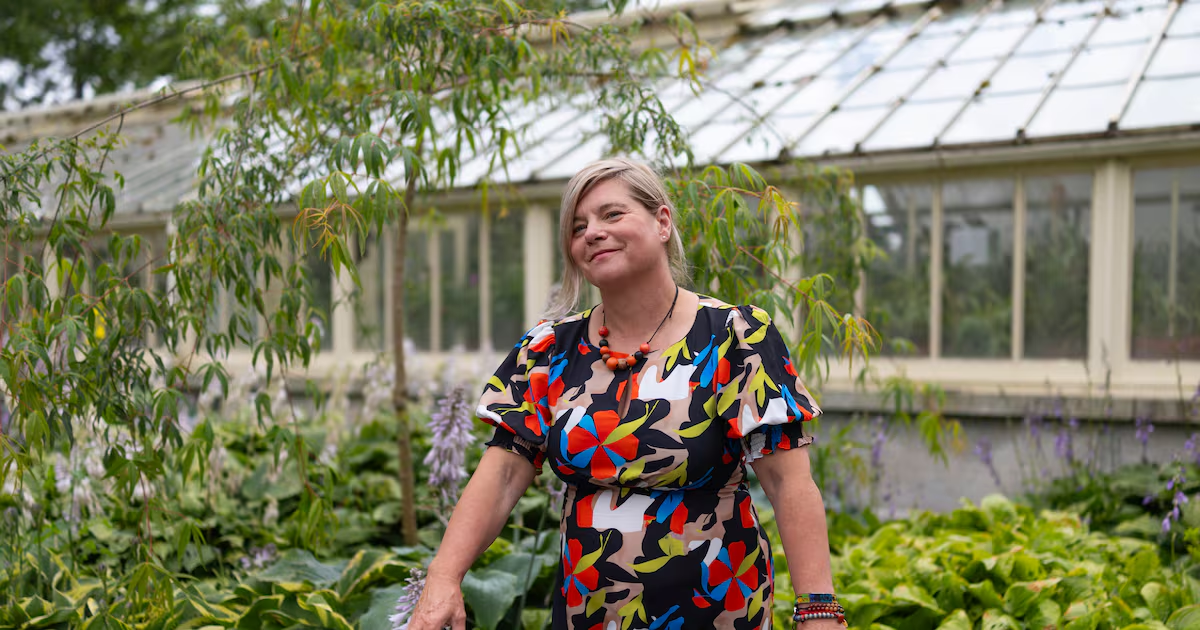
I doubt Noeleen Smyth, newly appointed director of the National Botanic Gardens of Ireland, has ever bothered to count the number of letters after her name. But having done it on her behalf, I can confirm that it comes to an impressive tally of 17, and includes three diplomas (one in Amenity Horticulture from Glasnevin, one in Horticulture from the Royal Horticultural Society, one in Statistics from Trinity College), plus a BA in Botany from Trinity, and a PhD.As well as becoming 12th in a long and illustrious line of directors of the gardens stretching right back to the early 1800s, this former native of Kildare has also, rather wonderfully, recently made history by becoming the very first female director of the “Bots”, heralding a cultural shift that’s been a long time coming.In doing so, Smyth joins the ranks of a small elite making waves in the international world of horticulture, many of them women of a similar age who are similarly new to their jobs.That list includes Julia Knights, appointed Regius keeper of Scotland’s Royal Botanic Gardens in Edinburgh in January of this year; Lucy Sutherland, appointed director of the National Botanic Garden of Wales in 2022; Barbara Gravendeel, appointed scientific director of Hortus Botanicus in the Netherlands in 2025; Lúcia Lohmann, president of Missouri Botanical Garden since 2025; Susan Pell, appointed director of the United States Botanical Garden in Washington in 2022; and Donna McGinnis, appointed chief executive of Denver Botanic Gardens this year. In fact, searching online for other female directors or heads of similar botanic gardens and institutions, I came across just one woman – Beverley Glover, director of Cambridge University Botanic Garden – who had been appointed to their post before 2022, a measure of both how recent and how significant the sea change has been.Noeleen Smyth: 'What we’re witnessing now is the wild and the cultivated coming together in a way that just didn’t happen before.' Photograph: Chris Maddaloni “I think what we’re finally seeing is a lot of women who’ve come up through the system and have now got all the qualifications and experience necessary to qualify for these kinds of jobs. But that process takes a long time,” Smyth says.Her new role marks a welcome return to the same gardens where she first trained as a rookie gardener more than 30 years ago. This time she’ll be residing right in the heart of the “Bots” with her young daughter, Holly. “She’s already loving the idea,” laughs Smyth.Other women gardeners, she agrees, have played an important role in her own career arc. As a freshly qualified graduate of the “Bots”, for example, her very first job took her in 1991 to the walled gardens of Malahide Castle in Co Dublin, former home of the plant-hunter and collector Lord Talbot.[ The Botanic Gardens and me: Conor Pope traces his family tree through the Gardens’ historyOpens in new window ]The garden was being sensitively restored by Fingal County Council under the watchful eye of the brilliant Irish horticulturist Ann James, another formidable female gardener famed for her encyclopaedic knowledge of plants, as well as for being an absolute stickler for botanical correctness. God help any horticultural student sent there on work experience if James were to discover that they were incapable of precisely identifying plants by using a system of “botanical keys” to evaluate numerous small but important differences in the shapes of their leaves, flowers, stems, fruit and seed.“Ann was amazing,” remembers Smyth. “Women were surprisingly few and far between in the world of professional Irish horticulture back then, so to come across someone like that was genuinely inspirational.”Members of the public investigate different species at the National Botanic Gardens. Photograph: Leon Farrell/Photocall Ireland Visitors take in the sights at the National Botanic Gardens, Glasnevin, Dublin. Photograph: Dara Mac Dónaill Another was Edel McDonald, who oversaw the management of the nursery at the National Botanic Gardens until her retirement in 2016. “I think Edel was the only other woman gardener at the Bots when I first started working there in 1994. We’d always have a laugh together when it came to the standard PPE issued to staff, all of which was designed for men, so it would be swimming on us. “The late Maura Scannell, former botanist who worked in Glasnevin’s herbarium, was another remarkable woman and an important figure in my own evolution as a horticulturalist and botanist. She took me under her wing and encouraged me from the start.”Low-hanging fruit: a picture of relaxation at the National Botanic Gardens, Dublin. Photograph: Tom Honan As someone who’s worked in the overlapping fields of horticulture and botany for more than three decades, Smyth is especially well-positioned to observe the many ways in which these two worlds have radically changed. “It’s dramatically different. What we’re witnessing now is the wild and the cultivated coming together in a way that just didn’t happen before. “That includes a huge shift in focus towards issues such as sustainability, biodiversity and conservation, as well as the ways in which our gardens and green spaces help support our health and wellbeing – all key aspects of the role of a modern botanic garden.” [ A potted history of plants at Dublin’s National Botanic GardensOpens in new window ]Smyth’s own life experiences and travels around the world have given her a deep-rooted respect for these issues as well as the importance of plant conservation.Travelling with the National Botanic Gardens’ former orchid expert and horticulturist Brendan Sayers, her first botanising trips were to Belize in the mid-1990s.She was also one of a tight-knit group of gardeners handpicked by the late Seamus O’Brien, former head gardener of Kilmacurragh, to accompany him on his 2002 plant-hunting expedition to China, shortly before the Three Gorges dam project that saw hundreds of hectares of species-rich land submerged by flooding.Subsequent research trips have also brought her to Uganda, Guyana and Jordan, as well as to Pitcairn Island in the south Pacific.A male mandarin duck at the National Botanic Gardens. Photograph: Dara Mac Dónaill One of her particular interests is the control of invasive species, a hot topic in the international world of horticulture where the seemingly insatiable demand for new plants sometimes results in their inappropriate introduction into regions where they pose a threat to native species.The latter is something Smyth is similarly passionate about, having just finished co-authoring a book on the subject, Growing Native, with Edwina Cole of the Botanical Society of Britain & Ireland.“So much of the job of a modern botanic garden is educating people about the importance of the plant kingdom and its role. Because there would be no life on Earth without it. We need to keep reminding ourselves of that.”This week in the gardenTry to refrain from mowing lawns in the hottest part of the day, especially if they’re already showing signs of heat stress, including patchy growth and brown patches. Instead, raise the blades, mow less frequently, and only in the cool of the evening.Revive thirsty pots and containers by temporarily placing them up to their waists in a wheelbarrow filled with tepid water and leaving them to soak overnight.Dates for your diaryCarlow Garden Festival: Saturday, July 25th to Sunday, August 2nd. With an outstanding line-up of guest speakers including Joe Swift, James Alexander-Sinclair, Arit Anderson, Chris Beardshaw, Bunny Guinness, Tom Coward, Fiann O’Nualláin, Colm O’Driscoll, Jimi Blake, Oliver Schurmann, Helen Begadon, Daphne Shackleton and Mary Keenan. Pre-booking essential, see carlowgardentrail.com and carlowtourism.com.
‘There would be no life on Earth without plants ... We need to keep reminding ourselves of that’
Noeleen Smyth is the first female director of the National Botanic Gardens of Ireland
1,244 words~6 min read