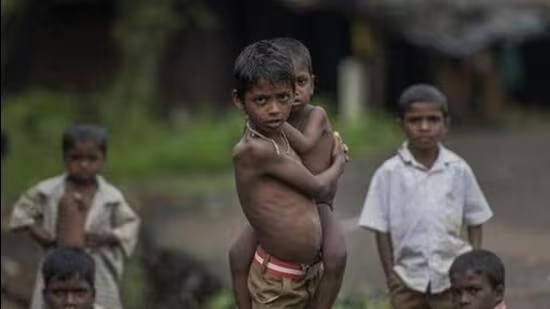
Among eight union territories, Chandigarh has recorded the highest increase in the prevalence of underweight children below the age of five years, according to the national family health survey (NFHS) 2023-24, released recently by the Union ministry of health and family welfare.Along with underweight, the prevalence of malnourished children under the age of five has also increased, shows the data of national family health survey 2023-24.In the 2019-20 survey, prevalence of underweight children in Chandigarh was 20.6%, which increased to 31.6% in the 2023-24 data. In overall prevalence rate of underweight children below five, Dadra and Nagar Haveli and Daman and Diu ranks first at 41.3%, followed by Chandigarh on the second number with 31.6%. In the UT that has a fully literate urban population, the increased prevalence rate does not point to any one particular reason though it does point to hindrance in child’s growth and making them more prone to infections.Along with underweight, the prevalence of malnourished children under the age of five has also increased. The percentage of children falling in the wasted category, i.e. moderate acute malnutrition, increased from 8.4% to 19.5%. In severely waste or acute malnutrition, it increased from 2.3% to 3.3%. Severe acute malnutrition or severely wasted indicator refers to a child who is extremely underweight for his/her height and at high risk of illness and death. Some UTs, including Jammu and Kashmir and Ladakh, have improved the prevalence rate of underweight children.A health official looking into the central government’s reproductive and child health programme in Chandigarh said the nutritional status of a child reflects the mother’s health as well. “If the mother is anaemic or having a high risk pregnancy, hypertension, diabetes, thyroid, etc., the health of the child is bound to get affected, resulting in underweight and other conditions. We are also inspecting the cause of the increase in prevalence rate of underweight children,” the official said.Dr Sadbhavna Pandit, acting director of UT’s health and family welfare department, and head of the paediatrics department in Government Multi-Specialty Hospital, Sector 16, said there are multiple reasons, such as premature birth, high risk pregnancies, mothers being anaemic and malnourishment, responsible for underweight children. The socio-economic factor also plays a role with a large number of the population in Chandigarh being migrant and belonging to other states. The implications of malnourishment and underweight in children include hindered growth, weakened immunity, a higher risk of infections, delayed cognitive development, etc.Dr Inusha Panigrahi, professor in paediatric medicine department, Post Graduate Institute of Medical Education and Research (PGIMER), attributed the increased number of underweight children to changing food habits of people with fast food making its way to the plate more often that does not have necessary nutrients required for child’s growth. The infection rate in underweight children is likely to be high compared with a child of appropriate weight for his or her heightIn parameters reflecting vaccination among children that comes under the health department, results have improved compared with the previous surveyThe social welfare and women and child development department is responsible for executing central schemes for mother and child health, including National Nutrition Mission, to provide supplementary nutrition to children below 6 years of age, pregnant women and lactating mothers. Despite repeated efforts, social welfare and women and child development secretary Anuradha Chagti and director Naveen Rattu remained unavailable for comments.
Among UTs, Chandigarh sees highest rise in underweight kids
Prevalence rises from 20.6% in the 2019-20 survey to 31.6% in the 2023-24 data; premature birth, high risk pregnancies, anaemia and malnourishment are among the factors responsible for underweight children, say experts
557 words~3 min read