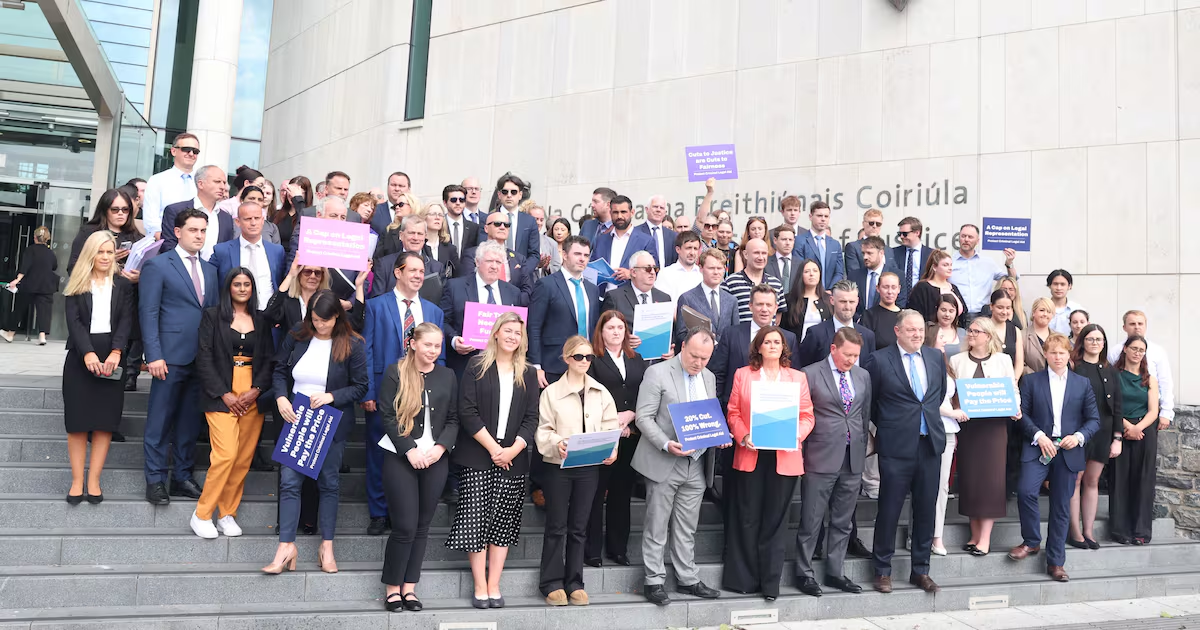
A woman who was left without legal representation in the District Court due to a dispute over the new legal aid payment model has been released from custody on bail after she challenged her imprisonment in the High Court. Ceiligh McCormack (29), of Railway Street, Dublin 1, was unrepresented when she appeared before Dublin District Court this week due to many solicitors ongoing refusal to work under the revised scheme. The scheme provides for a once-off legal aid fee of €520 irrespective of how many appearances solicitors make to represent a client in the District Court. Previously, solicitors were paid per appearance.McCormack, who appeared in the District Court on a charge of robbery, was remanded in custody after gardaí objected to bail. At the High Court on Friday, lawyers for McCormack submitted to Judge Mary Rose Gearty that arising from her being unable to secure representation McCormack did not have a fair hearing at the District Court.Michael Lynn, counsel for McCormack, appearing with Keith Spencer, moved a habeas corpus application under article 40 of the Constitution, challenging to the legality of McCormack’s detention. Gearty agreed to open an inquiry into the lawfulness of McCormack’s detention. Following discussions between legal teams for McCormack and the Director of Public Prosecutions, bail terms for McCormack were agreed. Lynn said there was agreement that “contested issues” in the case could be dealt with next week.In a sworn statement, Donal Quigley, a solicitor acting for McCormack, submits that McCormack was denied her constitutional right to a fair hearing in the District Court and her constitutional right to legal aid and representation. Quigley further submits that the new legal aid payment model impacted on McCormack’s constitutional rights. “By implementing a new system that has been rejected wholesale by lawyers, the State has failed to ensure that [McCormack’s] right to be legally represented where faced with a serious criminal charge, has been protected and vindicated, resulting ... in a breach of the applicant’s constitutional rights,” Quigley says.Quigley also claims that the new model of criminal legal aid payments is illegal and conflicts with the provisions of the Criminal Justice (Legal Aid) Act 1962. In a similar but separate application, Judge Marguerite Bolger directed an inquiry into the lawfulness of the detention of Simon Whelan, who was remanded in custody this week after he appeared unrepresented at Dublin District Court. Whelan (39), of Watergate Hostel, City Quay, Dublin 8, appeared in court this week charged with six offences – four burglary charges, one criminal damage charge and one road traffic charge.In an affidavit, Edward Bradbury, a solicitor representing Whelan in the High Court, submitted that the new legal aid model led to Whelan being “deprived ... of legal advice and representation”. He submits that Whelan is now in prison following a bail hearing where he was “incapable of properly defending himself and making a case for bail”.Bolger said the case could come back on Tuesday.
Accused persons unrepresented due to solicitors’ dispute challenge legality of detention
Bail terms for woman charged with robbery agreed following discussions between legal teams
487 words~2 min read