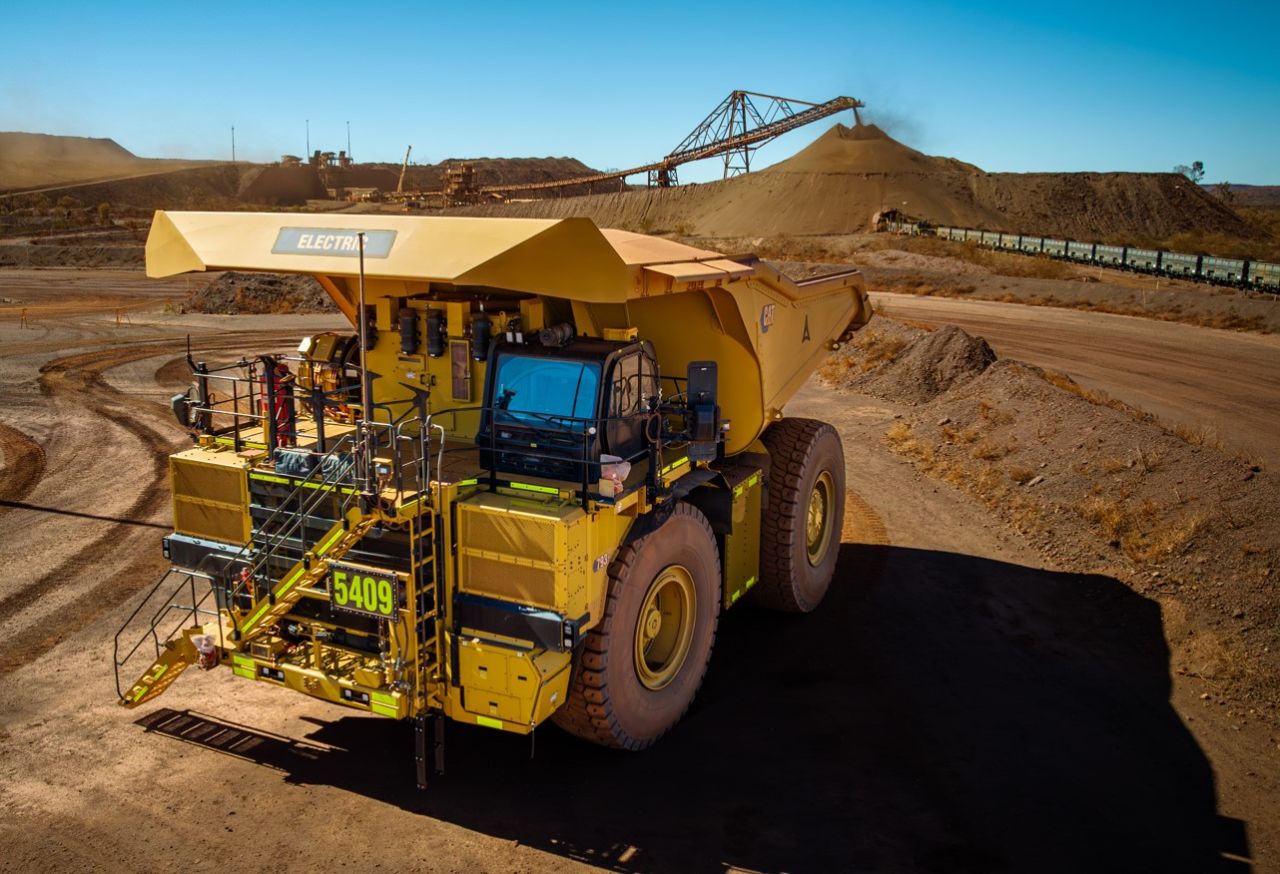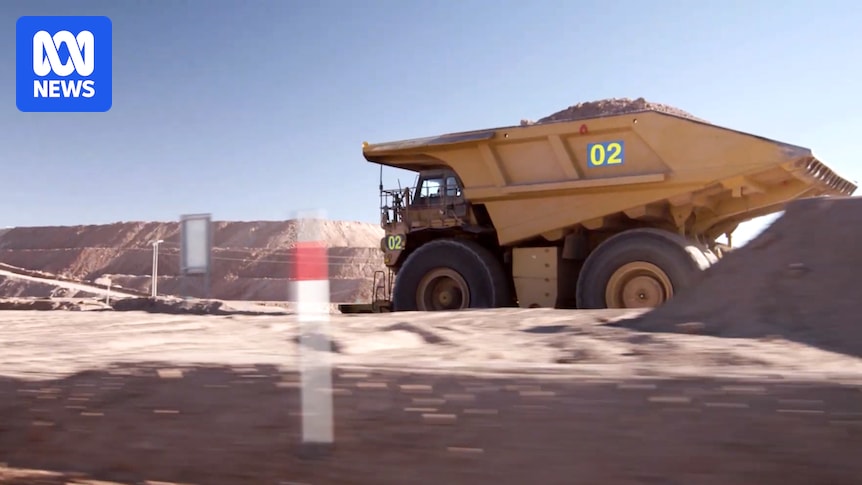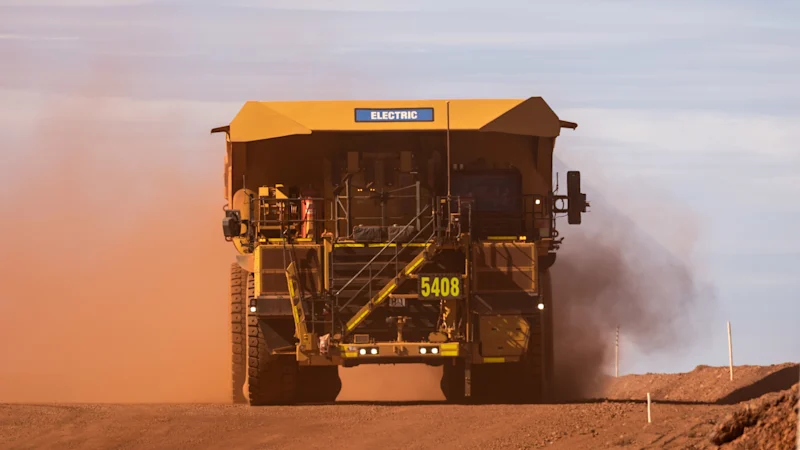
Rounding the bend of a parched haul road in Western Australia’s Pilbara, a yellow truck the size of a two-storey building comes into view, its monster tyres kicking up a wall of red dust.It’s a familiar sight here at Jimblebar, one of BHP’s biggest open-cut mining and processing hubs. At any given moment, more than 50 of these mechanical titans are roaming between the pits and the crushers, carting piles of the country’s most lucrative export commodity: iron ore.BHP, Rio Tinto and Caterpillar are trialling battery-electric haul trucks at BHP’s Jimblebar iron ore mine.Trevor CollensBut something is unusual as this one approaches. There is no black exhaust in the air. No roar of an internal combustion engine. Instead, the 240-tonne truck moves with an uncanny, whisper-quiet hum – because it is entirely electric.Known as the Cat 793 XE, this giant battery-powered prototype is one of two units that American manufacturer Caterpillar has shipped from its Arizona proving ground all the way to the Australian outback as the centrepiece of a joint trial with miners BHP and Rio Tinto.The industry-first collaboration is an attempt to solve one of the Australian resource sector’s toughest puzzles as it faces pressure from governments, investors and wider society to decarbonise: how to eliminate diesel from its heavy-haul transport fleets without compromising relentless, 24/7 efficiency.The stakes for the economy and the climate are immense. Mining in the iron-rich Pilbara has underpinned Australia’s prosperity for more than 60 years, pouring billions of dollars into state and federal coffers. But it has made it one of the nation’s main sources of planet-heating greenhouse gases as well. The region – which also hosts major energy and fertiliser producers – generates about one-fifth of the carbon footprint tracked under Australia’s federal “safeguard mechanism”, which regulates the country’s top 215 industrial polluters.Mining giants in the region have identified ditching diesel for electric haul trucks as a key opportunity to lower that carbon footprint. Yet, though Jimblebar’s early trial results from 100 operating hours and 200 laps show “meaningful progress”, the finish line for some companies has been quietly slipping, leaving their exhaust pipes to continue spewing emissions for some time to come.Only a few years ago, BHP and Rio Tinto had anticipated they would begin deploying battery-powered haul trucks by the end of this decade. Now, those timelines have drifted into the 2030s. Company executives cite a longer than expected runway for the technology to be proven and available at mass scale, requiring them to continue adding new diesel-powered trucks to their fleets to maintain output in the meantime.“No Australian mining operation is currently utilising critical 240-tonne battery-electric haul trucks as the technology is not advanced enough to scale to an operational fleet,” a BHP spokesperson says.The simplicity of decarbonising a regular truck does not translate easily to the hulking haulers used in the mining sector, which are some of the biggest trucks on Earth. Unlike the kilowatt-level batteries that have begun powering lighter vehicles everywhere, adopting the megawatt-scale systems required for heavy-duty mine fleets brings bigger obstacles to overcome – especially in an industry obsessed with uptime and productivity.“In the past, there has been a sense of ‘it’s the environmentalists versus miners’ – that’s no longer the case.”Amanda McKenzie, Climate Council chief executiveFor one, massive battery packs required to meet their extreme energy demands weigh considerably more than diesel tanks, eating directly into payload capacity. Charging them may take half an hour or longer, whereas refuelling can be done in a fraction of that. Then there is the necessity to transform an entire mine-site ecosystem to cater for them, such as building massive charging networks, and enough large-scale renewable energy generation and storage to power those chargers at often remote off-grid locations.While BHP and Rio Tinto say the tech slowdown will not derail their near-term emissions targets – aiming for 30 per cent and 50 per cent operational emissions cut by 2030 respectively – the delayed rollout of electric heavy haulage means deferring billions in planned green capital expenditure, including the cost of buying new vehicles and securing extra renewable energy nearby to cater for them.Environmental campaigners view these delays with deep scepticism, saying highly profitable mining giants possess more than enough capital to force a faster electrification of their diesel fleets.“It’s fantastic that the mining industry is starting to look at this,” says Climate Council chief executive Amanda McKenzie. Switching diesel for electricity will not only slash harmful emissions, but it will reduce long-term fuel and maintenance costs, and insulate operations from global oil shocks, she says.However, McKenzie says BHP and Rio Tinto’s current trajectories lag the Australian government’s legislated 43 per cent emissions target for 2030, and they fall below what scientists say is required to protect humanity from the worst and most immediate impacts of climate change.“Whether it’s the farmer experiencing flood after flood, whether it’s someone in a bushfire-exposed community experiencing much more intense and frequent fires, or whether it’s all of us experiencing insurance premiums going up significantly … the community is bearing the cost,” she says.Not everyone in the industry is willing to wait for the 2030s. Fortescue, the world’s fourth-largest iron ore miner, led by billionaire Andrew Forrest, is taking a radically different approach to its Pilbara rivals. Fortescue has committed to an industry-leading target for “real zero” emissions – the total elimination of fossil fuels from its mines by 2030 without relying on carbon offsets – and it says it has no intention of abandoning it. The miner is about to take delivery of its first 240-tonne haul truck from German-Swiss manufacturer Liebherr, with plans to source hundreds more from Liebherr and China’s XCMG to replace its entire diesel fleet at breakneck speed.Fortescue chief executive Dino Otranto says: “The ramp-up is massive – I’m talking 350 trucks over the next 18 to 24 months. It’s our entire fleet. It’s more than whatever anyone’s ever done before.”To power its sudden new electric fleet and fossil fuel-free operations, Fortescue has brought forward ambitious plans to complete what it expects will be the first fully integrated industrial green energy grid in the world by 2028, which will boast 1.2 gigawatts of solar capacity, more than 600 megawatts of wind generation and between four and five gigawatt-hours of battery energy storage.The speed and scale of this shift is enormous. Currently, 98 per cent of the Pilbara’s electricity supply still comes from burning fossil fuels – chiefly, diesel and gas. “Only 2 per cent of the supply of electricity in the Pilbara is renewable. It’s ridiculous,” Otranto says.BHP, Rio Tinto and Caterpillar are trialling two Cat 793 XE Early Learner battery-electric haul trucks at BHP’s Jimblebar iron ore mine. There is also likely to be a bottom-line benefit. Fortescue expects to save $144 million in fossil fuel costs next year as it ramps up its rollout of electric vehicles and renewables.Between them, BHP and Rio Tinto’s global operations consume about 2.8 billion litres of diesel a year, which, at today’s oil prices, could equate to an annual spend exceeding $6 billion. About two-thirds of the fuel Rio Tinto uses worldwide is consumed at its 18 Pilbara mines. BHP doesn’t break down its figures, but half of its diesel use goes to a fleet of 800 haul trucks.The West Australian government says it is determined to help create the common-use energy infrastructure needed to enable the region’s decarbonisation, a complex undertaking involving dozens of companies and traditional owner groups, spanning vast distances.“The Pilbara Energy Transition is a groundbreaking project that will transform the engine room of our nation’s economy for generations to come,” West Australian Energy and Decarbonisation Minister Amber-Jade Sanderson says.By some estimates, the investment needed to decarbonise the wider Pilbara and cater for huge demand increases from electric trucks, locomotives and machinery could run into tens of billions of dollars between now and 2050, creating an opening for energy infrastructure companies.Traditionally known for its gas pipelines, Sydney-based APA Group is pivoting to clean energy infrastructure in the nation’s north-west. It is already operating giant solar and battery farms at Port Hedland and Chichester, and it is progressing plans for a massive renewable hub near the town of Newman.Crucial to the transition is also the creation of a bigger and more unified grid. APA has been selected to develop the Burrup and Hamersley transmission corridors – two of the state government’s priority routes designed to hook up remote mining hubs to clean power.However, in a region that requires uninterrupted 24/7 heavy industrial power, APA and others in the industry say gas cannot be abandoned overnight.“While batteries play an important role in these energy solutions, peaking gas power generation also has a critical role in delivering longer-duration firming,” APA energy solutions executive Darren Rogers says. “This is particularly the case where 24/7 power is required and when the Pilbara experiences long periods with little renewable generation being available.”Fortescue appears untroubled by such warnings, saying it is on track to be rid of diesel and gas on its sites by 2030. Forrest, the company’s chairman and top shareholder, says more miners would be willing to accelerate their shifts away from fossil fuels and embrace clean energy as quickly as Fortescue is doing if the federal government would wind back its diesel fuel tax credit – a scheme that refunds the 52¢-a-litre excise for “off-road” diesel users, saving major mining companies hundreds of millions of dollars a year. Forrest says it is entrenching diesel use, and this year he launched an advertising blitz calling for the credit to be capped at $50 million per company.The federal government’s refusal to overhaul the credit remains a flashpoint for environmental advocates, who see it as a missed policy lever to accelerate the decarbonisation of the carbon-intensive mining sector.For decades, green groups and mining companies have stood on opposite sides of an entrenched battle line. It makes sense: mining, by its very nature, carves into the earth, posing risks to native vegetation, waterways, biodiversity and the climate. But the battle lines have shifted, the Climate Council says.Recognising that a zero-emissions future is impossible without the earth’s raw materials, campaigners back the need for resources like lithium for electric car batteries, copper for energy grids, even the iron ore needed for steel to make wind turbines. The pressure now is on how sustainably those resources are being mined and processed.“In the past, there has been a sense of ‘it’s the environmentalists versus miners’ – that’s no longer the case,” McKenzie says.“But our argument is we want to see the end of fossil fuels, phasing them out as quickly as possible, and we want to see mining done well, sustainably and in a culturally sensitive way.”The Market Recap newsletter is a wrap of the day’s trading. Get it each weekday afternoon.
Australia’s miners were racing to decarbonise. Why are some tapping the brakes?
A few years ago, BHP and Rio Tinto expected they would be deploying battery-powered trucks by the end of this decade. Now, those timelines have slipped into the 2030s.
1,795 words~8 min read