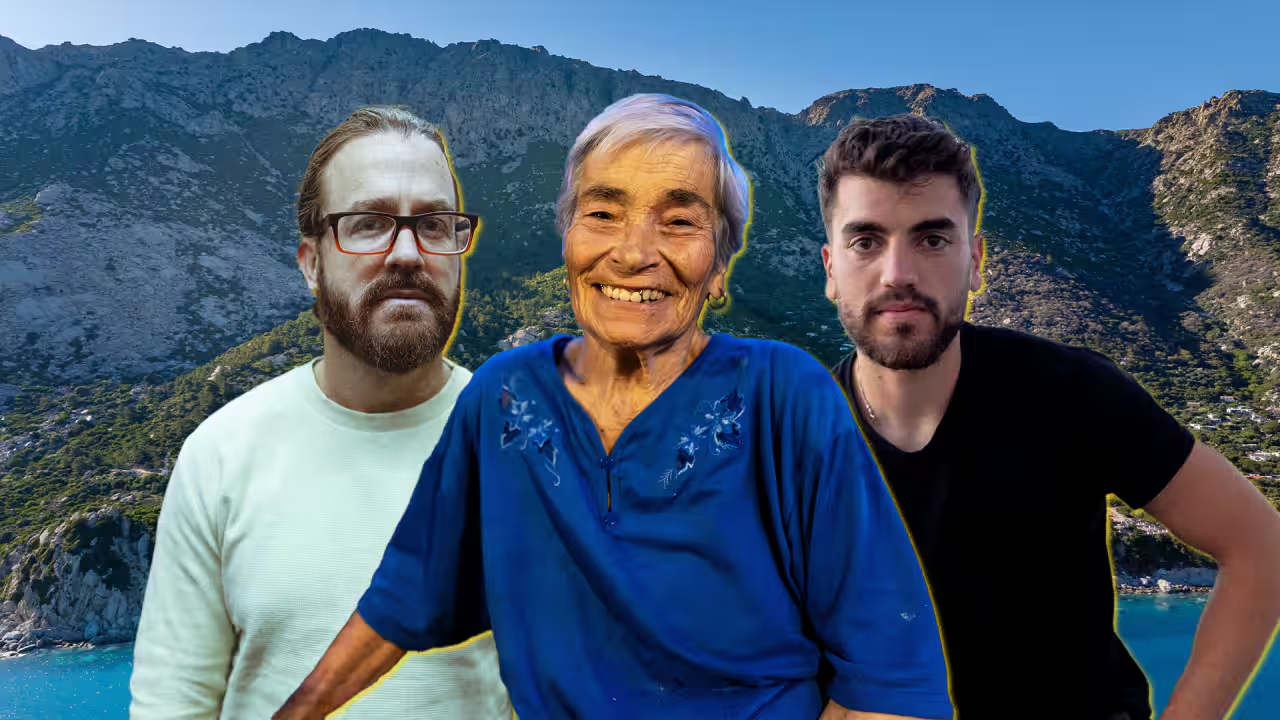
It was only near the end of his life when Stamatis Moraitis became famous for cheating death.On the idyllic Greek island of Ikaria, old timers gathered at the local cafe can still sketch the details of his remarkable story: the man who, in the 1970s, was diagnosed with terminal lung cancer in the US and, given just months to live, decided to move back to this Mediterranean island to die.But when he got home to Ikaria, Moraitis did not die. He survived, for decades, living to nearly 100. Some locals are adamant it is because he ate hot peppers, others because he drank homemade red wine every day.Ikaria, an island in the Aegean Sea, became famous as a longevity hotspot after it was declared a Blue Zone. (Supplied: Daphne Tolis)Moraitis's story has spread far beyond Ikaria though. He has become one of the best-known faces of the so-called Blue Zones: a handful of places around the world where people are said to live extraordinarily long lives, many to 100 or more.Ikaria is one of the Blue Zones, as is Italy's Sardinia, Okinawa in Japan, the Californian town of Loma Linda and the Nicoya Peninsula in Costa Rica.And the longevity secrets of these places have fuelled a wellness industry, complete with Blue Zones cookbooks, how-to guides, wellness products, a health consultancy and even a globetrotting Netflix series.A 2012 article in the New York Times Magazine contended Stamatis Moraitis miraculously recovered from lung cancer after moving back to a Blue Zone. (Source: New York Times Magazine)The business of Blue ZonesMoraitis's fame traces back to a glossy feature in the New York Times Magazine, penned by American explorer Dan Buettner, the man who taught the world about the Blue Zones. Buettner wrote of meeting Moraitis on an expedition to Ikaria around 2011, while investigating the island's Blue Zone status and the secrets of its longest-lived people."He never went through chemotherapy, took drugs or sought therapy of any sort," Buettner wrote of Moraitis. "All he did was move home to Ikaria."Buettner later expanded on Moraitis's miraculous recovery in a best-selling book about the Blue Zones: "His cancer may have just resolved itself. Or his cure may be a product of the same perfect storm of factors that explains why the whole island is outliving the rest of the world."Dan Buettner travelled the world with researchers on expeditions to find new Blue Zones. (Supplied: Facebook)Human stories like Moraitis's have been central to the narrative of the Blue Zones, told and retold by Buettner and others, helping grow the concept into a longevity phenomenon.It has been wildly successful, and lucrative. Soon after he first wrote about Blue Zones, in a 2005 cover story for National Geographic, Buettner started a company centred on the concept. In 2020, he sold it for a reported $US80 million ($114 million).In recent years though, the Blue Zones have been under increasing scrutiny. A fight has broken out between researchers over the science that underpins them, one of the key experts behind the concept has stopped working with Buettner, and now even Stamatis Moraitis's story is facing questions.Enter the scepticThe trouble for the Blue Zones began about as far from a Greek island as one can get: a Canberra library in the dead of winter. Saul Newman, then a PhD postdoctoral researcher working in plant science, had started spending his spare time digging, for fun, into the data around the oldest people who have ever lived.But things weren't adding up, he tells the ABC, and he "discovered these shocking levels of problems in this data".The more he researched, the more he started to wonder if poor record-keeping or pension fraud could be behind many of these claims of extreme longevity, including in the Blue Zones."Nobody before me seemed to have any qualms about the Blue Zones. Why did nobody notice this for 20 years?" Newman says. "There are some extraordinary, unexplained issues."Saul Newman says poor demographic data, age-reporting errors and record-keeping problems go some way to explaining the extraordinary longevity attributed to Blue Zones.
Australian scientist ignites war over the world's longest lives
The Blue Zones grew into a global wellness brand aided by stories of legendary old age. But a bitter feud over the science has shaken their foundations.
3,417 words~16 min read