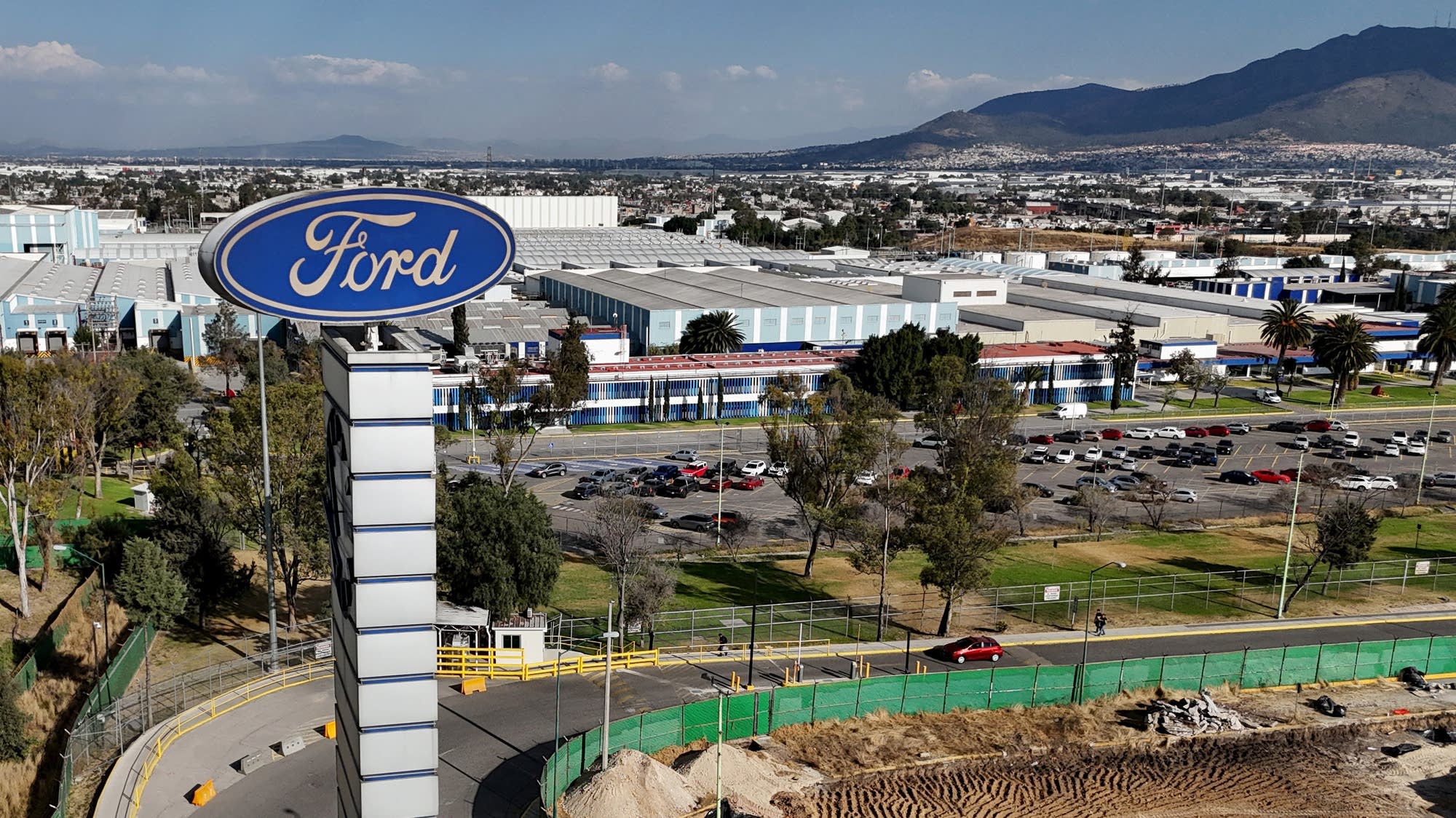
In the last few weeks, chipmaker Micron Technology has signed agreements with both General Motors and Ford Motor Company. The car companies are looking to secure their supply of memory and storage platforms, which are increasingly important as vehicles modernize and become more intelligent. Also, at the beginning of July, the Trump administration announced that the U.S. will not renew the United States-Mexico-Canada Agreement (USMCA) — a trade deal negotiated by President Donald Trump in his first term. The agreement will remain in place for the next decade, as the countries negotiate new trade deals. In the meantime, this could spell trouble for the auto industry, which represents about 18% of trade between the three countries. For more on both of these topics, “Marketplace Morning Report” host Sabri Ben-Achour spoke with Patrick Anderson, CEO of Anderson Economic Group. The following is an edited transcript of their conversation. Sabri Ben-Achour: We've seen these carmakers sign deals with chipmakers. What are these deals doing?Patrick Anderson: What you're seeing with the Ford-Micron deal, and you're seeing it in similar deals, for example, with General Motors, is the recognition of how these electronic components are just as important to them as, say, steel and rubber are, in terms of putting a vehicle together. It totally makes sense for these automakers to make direct arrangements to secure supply for these essential components.Ben-Achour: What does that mean to secure supply? Does that mean that the carmakers, like they are high priority on a list of customers or guaranteed amounts delivered at any given time? What is it?Anderson: Well, of course, every one of these contracts is different. But what we would anticipate is the same kind of terms that are in other supplier contracts, such as certain amounts that have to be prepared, certain prices, timing of delivery, quality assurance. All those things are what we would expect to have in these contracts.Ben-Achour: Chips, again and again, seem to have been the Achilles heel for the auto industry. There were pandemic shortages, there were price pressures when Russia invaded Ukraine. Do agreements like this — how far do they get the auto industry in being more secure, given these threats can come out of nowhere?Anderson: It can't prevent threats that come from nowhere. And, of course, as we're sitting here, we again have disruption in the Strait of Hormuz. But contracts like this are really important in terms of identifying and contractually obligating two parties to buy a certain amount of quantity, to reserve certain quantities for major customers, to assure quality. And it does reduce the risks to the manufacturers, and because of that it also increases the comfort that customers might have if they wanted to, say, go order a Ford for delivery months from now. They’re just a little bit more likely to have a Ford actually show up when Ford Motor Company has made contracts with the major suppliers.Ben-Achour: Any idea of what Micron or the or the chipmaker in this scenario, gets out of a deal like this?Anderson: If you're a chipmaker, you might be selling to laptop makers or makers of console games. And some of those may be very volatile demand. I mean, for example, video games are quite volatile, and “what's the hot console” is something that I can't predict two years from now. But I'm pretty confident predicting that we'll be making F-150s, Honda Civics and Toyota Camrys two, three, and five years from now, because they're such long-standing products and are so important to so many people.Ben-Achour: So, I want to shift gears now and ask about USMCA and trade policy. The USMCA, according to the Trump administration, won't be renewed. It wants different, new trade deals. What is the risk there to the U.S. auto industry?Anderson: The threat here to not renew the USMCA is a very significant one for the auto industry and it's an existential one for the Canadian and Mexican auto industries, which have been integrated with the United States all the way back to the 1960s in an agreement called Auto Pact, which preceded NAFTA, which preceded the USMCA. So, it is a very big deal for all these suppliers, all these businesses, all the transport businesses in Canada and Mexico, as well as in the United States.Ben-Achour: This kind of comes down to what cars or what parts of cars get what tariffs based on where they are from, determined by something called rules of origin. Can you explain what that is, and what the Trump administration wants to change about it?Anderson: It's not uncommon for there to be a part that's built in Canada that goes across the Detroit River into somewhere in Michigan, gets put in a larger assembly, goes back across. So, you have parts that go back and forth across the border two and three times, and even more. And the question of, “Hey, where's that car built?” is never an easy answer when you're looking at a vehicle from an American automaker here. So, the rules of origin are very technical items, you hardly ever see them in the newspaper, but they matter a lot for trade between the United States and Canada, and they're really important for the auto industry.Ben-Achour: If automakers had to move more production back to the U.S., how difficult — and how expensive — would that be?Anderson: The answer is they're already doing it. There were $12.5 billion in auto tariffs applied on Canadian and Mexican parts and automobiles alone in 2025. So, $12.5 billion dollars is a lot of reasons for automakers and suppliers to look for ways to reduce the tariff cost. What hasn't occurred, and what I hope doesn't occur, is a wholesale separation of the industry, meaning basically you create a wall, or effectively a wall. Because that would hurt both the United States and Canada and Mexico. There are a lot of auto production in the United States that depends on high-quality, reasonable cost parts that are assembled in Canada and Mexico, and vice versa. So, we in the United States have a lot to lose if we don't come to a negotiated agreement and renew something like the USMCA.
Why the auto industry needs chipmakers
General Motors and Ford have announced agreements with chipmaker Micron. Plus, a look at what the non-renewal of USMCA might mean for the auto industry.
1,035 words~5 min read