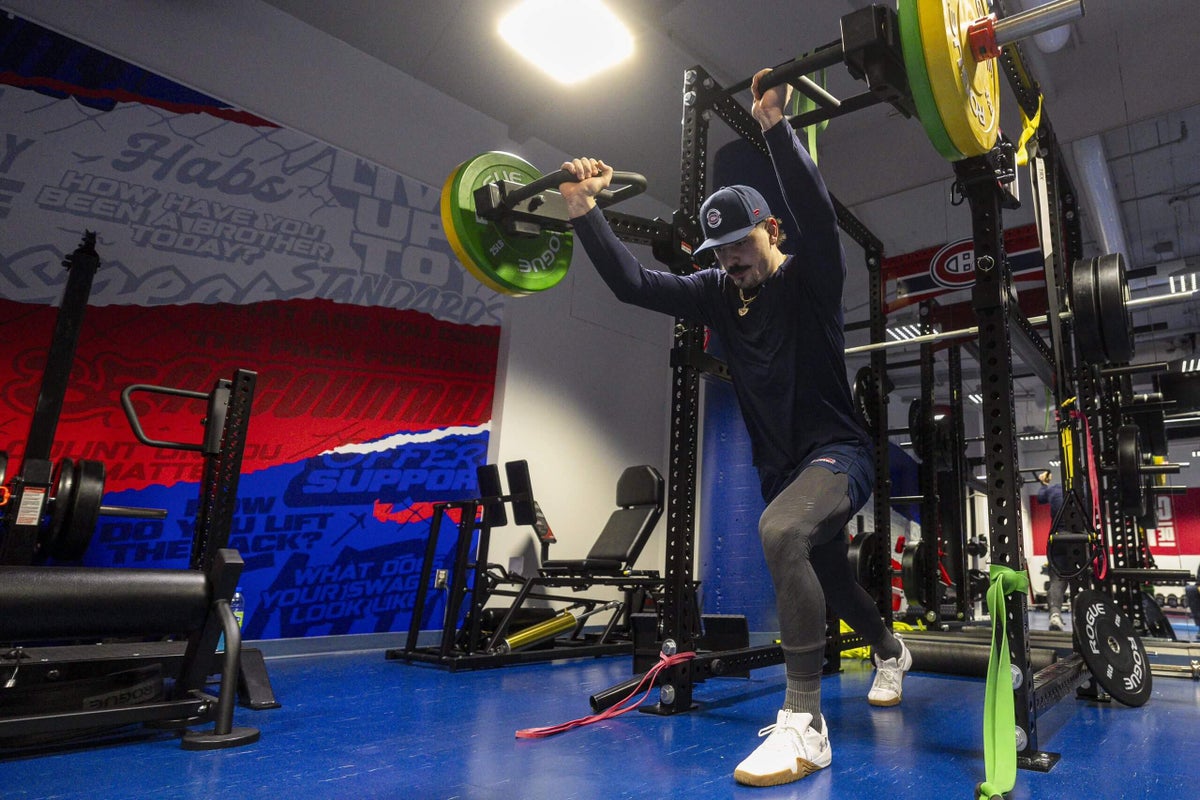
Hockey does not necessarily qualify as a healthy sport. A player lives on millimeters-wide blades in stiff boots, drives into ice that does not give and skates in motions that punish hips, all while trying to evade angry opponents. These are unforgiving restrictions on athletes who, had they selected alternative sports, could be bending ankles, rotating hips and running on grass.In that way, a hockey performance coach’s job is to solve problems that lack ideal answers.“On every stride, their hip is going into deep abduction, external rotation and extension,” Bill DeLongis, head strength coach at Trinity College in Hartford, Conn. “Every stride, if they’re taking a deep and long stride, then their adductors are on stretch. Then bringing their foot back in, they’re going through the complete opposite. They’re going into adduction, flexion and internal rotation at the hip. It’s a lot of different muscles getting put into a lot of different precarious positions throughout.”As a college coach, DeLongis works with players in their teens and early 20s. Even players of this age range arrive on campus with hips showing the strain of constant internal and external rotation.NHL offer sheets are just businessSean Gentille and Sean McIndoeThe desire to ease the complications of training hockey players and keep them healthy is why DeLongis assembled a team of pro, college and independent performance coaches for Strength on Ice, a virtual summit. This year’s summit, the second DeLongis has convened, produced approximately 11.5 hours of material from nine presenters. It focused on strength, conditioning, cognitive training, performance optimization and injury prevention.Participants included:
Training tips from NHL, PWHL performance coaches: Lavender oils, speed tests, ‘skater jacks’
A team of pro, college and independent performance coaches recently gathered for a virtual summit. Here's some of the intel they shared.
1,277 words~6 min read