Media stories, social media posts and the U.S. Centers for Disease Control and Prevention have asserted that selective serotonin reuptake inhibitors (SSRIs)—a class of medication commonly used to treat mental health conditions including depression and anxiety—may increase people's vulnerability to heat, leading to concerns that people who take SSRIs are at increased risk of heat-related illnesses in hot weather.
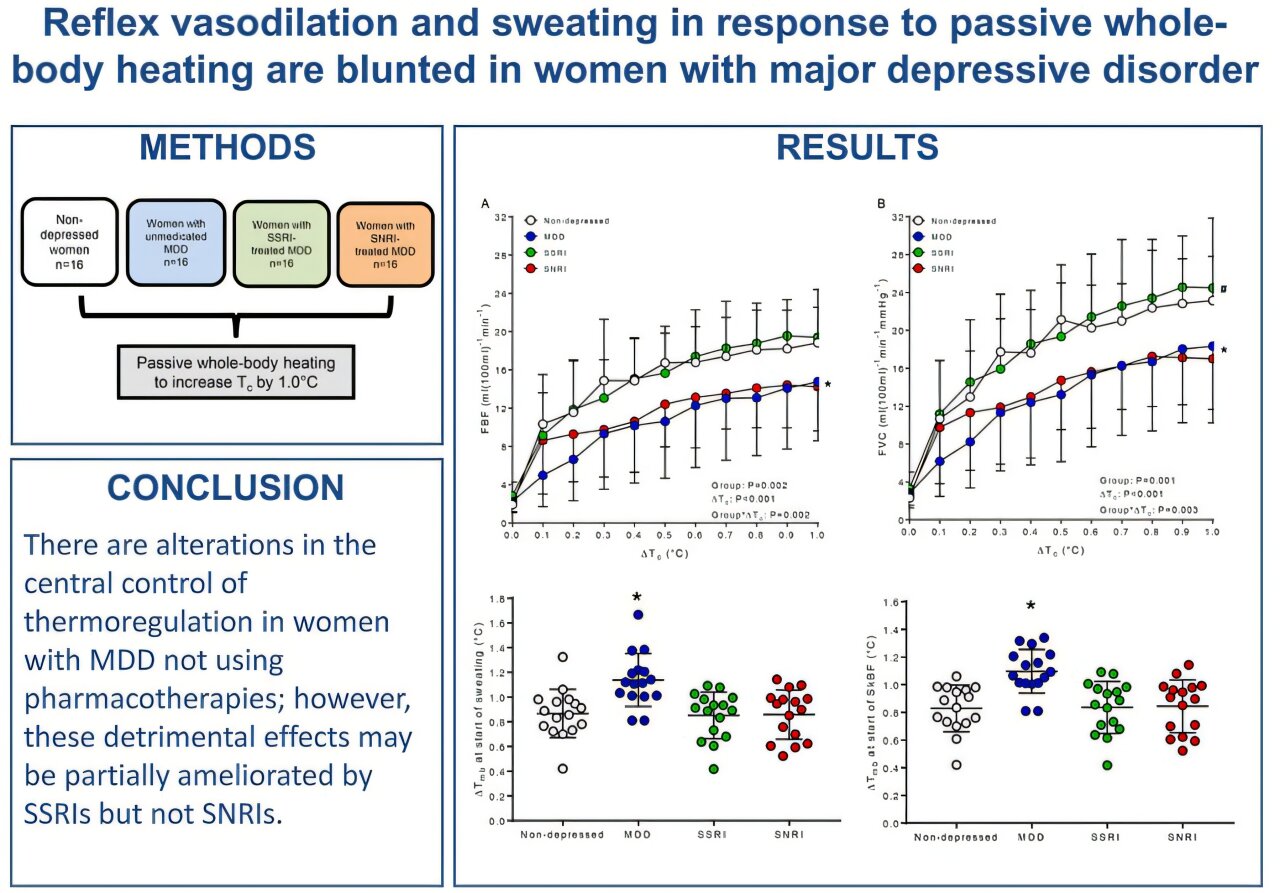
A new study by researchers in the Penn State Department of Kinesiology, however, demonstrated that women with clinical depression who take an SSRI may be better able to withstand extreme heat than those who do not treat their depression with medication.
"The human body primarily cools itself in two ways—by sweating and by increasing blood flow to the skin so that heat can be released to the environment," said Kathleen "Kat" Fisher, first author of the study, who earned her doctorate in kinesiology from Penn State in May. "This study showed that depression interferes with how women's bodies regulate their temperatures in the heat. Fortunately, SSRIs seem to largely restore the body's ability to respond to increases in internal temperature."
Depression changed the heat response
In a recent publication in the Journal of Applied Physiology, the research team compared the physiological responses of women without depression with those of women diagnosed with depression and those treated with various classes of antidepressants. When participants' body temperatures rose, women with unmedicated depression were slower to begin sweating, slower to begin pumping additional blood to the skin, and less efficient at pumping blood to the skin, compared with women without depression and women taking an SSRI to manage their depression.