The sun and its malcontents are in great evidence during Monday’s edition of The Claire Byrne Show (Newstalk, weekdays), which opens with reports from France, where extreme heat has been plaguing our European neighbours for several weeks. So too has it been affecting holidaymakers, including a Mullingar man, Michael Cleary, who calls in with an alarming story. Having flown to Carcassonne with his wife and two children on the Thursday, they found themselves back home in Ireland by Friday morning, after wildfires ripped through their campsite and the surrounding area. Cleary describes their evacuation to a soccer pitch, and then a beach, as smoke swirled around them, buffeted by distant booms of gas canisters exploding in the blaze. There they stood for a few hours with no food or water, their eventual trip home enabled only by his 13-year-old daughter’s quick thinking to grab their passports in their evacuating scramble. Up in smoke went all their other possessions, clothes included. “When we flew back on Friday morning, we were still in the same clothes we’d been wearing on the beach,” he reports. “We looked pretty shocking coming through Dublin Airport.”Closer to home, the meteorologist Cathal Nolan joins the show to issue hot-weather warnings for Ireland itself, advising that temperatures will approach 30 degrees in one or two areas this week. We learn that this places affairs above Ireland’s traditional heatwave threshold, which is 25 degrees, apparently, for a period of five days or more. It’s to his and Byrne’s credit that a segment that may once have had the jocular tone of a summer good-news story carries a little more alarm given our current, er, climate. Thankfully, the Maynooth University behavioural neuroscientist Andrew Coogan is on hand to offer tips on surviving the scorch. “We’re just not used to this here,” he says. “Our buildings aren’t built for it. [They’re] built to retain heat, not expel it like in southern Europe, and we as individuals aren’t used to it. We’d have a couple of hot days in the summer, but I never remember having a week, two weeks, three weeks of this type of weather we’ve been experiencing.”[ Irish holidaymakers: ‘When I stop teaching I won’t be going on holiday in July and August’Opens in new window ]There follow some punts at alternative ways of mitigating the exhaustion and lack of sleep that excess temperatures provoke, not least the institution of a Mediterranean-style midday break. The notion of siestas descending on the residents of Nenagh and Twomileborris is an intriguing one, while seeming quite speculative even by the usual standards of Monday-morning blue-sky thinking. The real answer, according to Coogan, is to keep a level head. “Even if you’re not running at 100 per cent, that’s life,” he says, before adding a counterintuitive remedy for sleep deprivation in sunny times: sunlight itself. “It actually helps us sleep if we get lots of sunlight exposure during the day. We know it can increase our alertness and increase our mood … particularly in the morning, because that’s when the sunlight is most beneficial for our circadian clocks.”Elsewhere in the programme, Byrne speaks with the former swimming champion Chalkie White about the arrest of the disgraced coach George Gibney, who was convicted this week on numerous counts of child sexual abuse. White, an early whistleblower who was himself abused by Gibney for many years, is first asked how he’s doing in the aftermath of the verdict. “Mixed,” he replies. “There’s a certain amount of relief that he’s now a convicted paedophile, [but] this wasn’t the kind of case where anything could make you feel satisfied at the end of it,” he says. “A lot of people have been hurt, a lot of people have been damaged, and I think the only consolation right now is that he’s going to end up in jail.”[ George Gibney: The child sex abuser who became Ireland’s Olympic swimming coachOpens in new window ]Byrne deploys the tact and restraint that make her an excellent interlocutor of such delicate topics. Her gentle questioning allows her guest the space to describe the complexity of his reaction to a story, and an ordeal, that may finally be near its end.White is at his most profound and affecting when he talks about what he has had to do to compartmentalise his trauma, from its initial impact to the repeated reopening of old wounds during his quest for justice. “Much in the way we were taught when we were swimmers,” he tells Byrne, “the visualisation, making sure you get all your splits right, how you train your mind to think about what it’s supposed to be thinking about during the race and not think about anything else, I really use those approaches with the George Gibney thing. I’m here: I’m going to be concentrating on this, not on George Gibney. You can say it’s an avoidance, but it gets one through.”Repeated references are made to one unexpected source of this conviction, the BBC’s Where Is George Gibney? podcast, produced by the Second Captains’ Mark Horgan and Ciarán Cassidy. White describes being ambivalent about taking part in the documentary series until he became convinced that traditional media entreaties, which he says “were making waves but not much impact”, had fallen short.“I thought the podcast might reach more people,” he says, “and because it was being done with the BBC it would have a lot more credibility. When it went out, [because of] the reaction it got, we began to hear that more [victims] were presenting themselves to the police. “Up until then we really had given up all hope. We knew he’d be chased around the world but never thought he would end up back in Ireland and back in jail.”Gibney’s comeuppance is a victory for his victims, and a salutary lesson in the power of audio storytelling. Where so many true-crime offerings provide grisly thrills and exploitative gimmicks, Where Is George Gibney? was a humane and absorbing document of horrific abuse that now appears to have managed that rarest of things: playing no small part in bringing its target to justice. Sunlight, for all its other uses, may still be the best disinfectant.Moment of the weekBroadcaster Oliver Callan. Photograph: Bryan Meade More mention of summer comes on Monday’s Oliver Callan show (RTÉ Radio 1, weekdays) when Dermot Whelan offers an account of a trip to Co Donegal, where the weather was less category-five blaze and a little more gale-force wind. Visiting his daughter in the Gaeltacht, he reflects on the lack of appreciation he had for the 9½-hour journey his own parents made to visit him there way back when. He’s at his most descriptive when conveying the sight of his daughter and her comhscoláirí looking like a “camp of linguistic prisoners lining up against the ferry wall”. Any hope of a thank you is immediately dismissed in favour of his child’s preference for getting her nails done.[ Meet the Irish college class of summer 2026: ‘Students don’t really miss the phone’Opens in new window ]His segment ends, however, with a discussion about the wardrobe drama benighting workplaces across the country: namely whether it’s ever appropriate for men to wear shorts in the office during a heatwave, which results in a tantalising glimpse behind the Donnybrook curtain. “We did a quick scan of the studios here, and there’s only four men, and half of us are wearing shorts.”Should scandalised listeners have been ready to write in outrage to RTÉ’s HR department, Whelan is quick to insist that some provisions towards decorum in male tailoring remain in place. “No beach shorts and no combat shorts with the pockets down the legs,” he asserts, “a good-quality tailored short – and even better if you have the legs for them.”
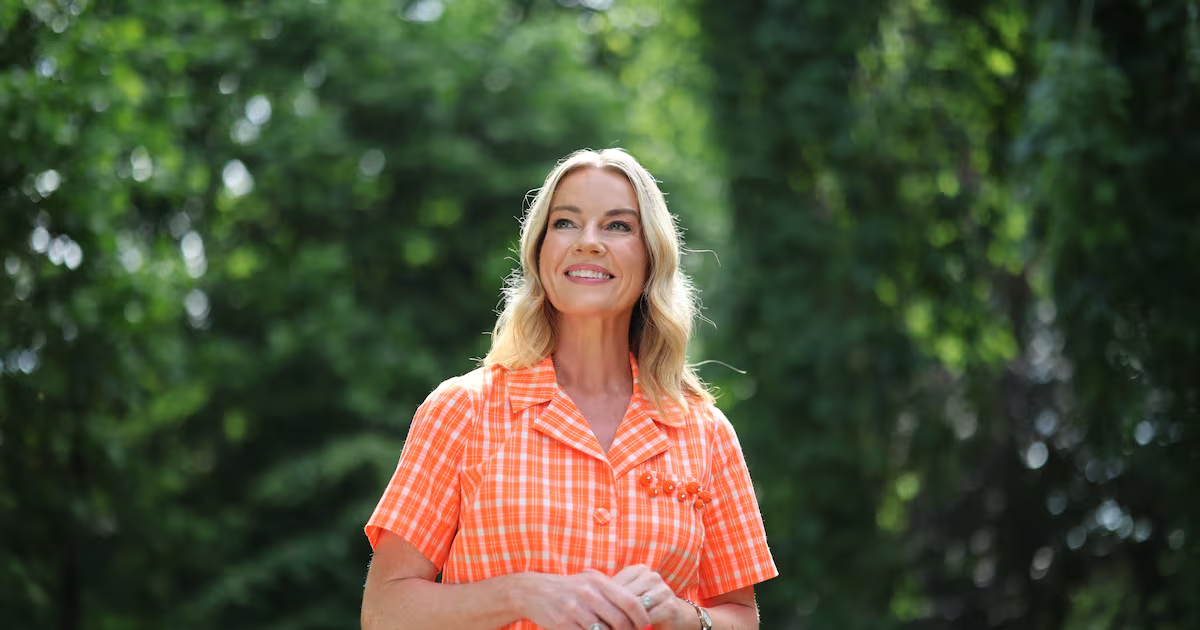
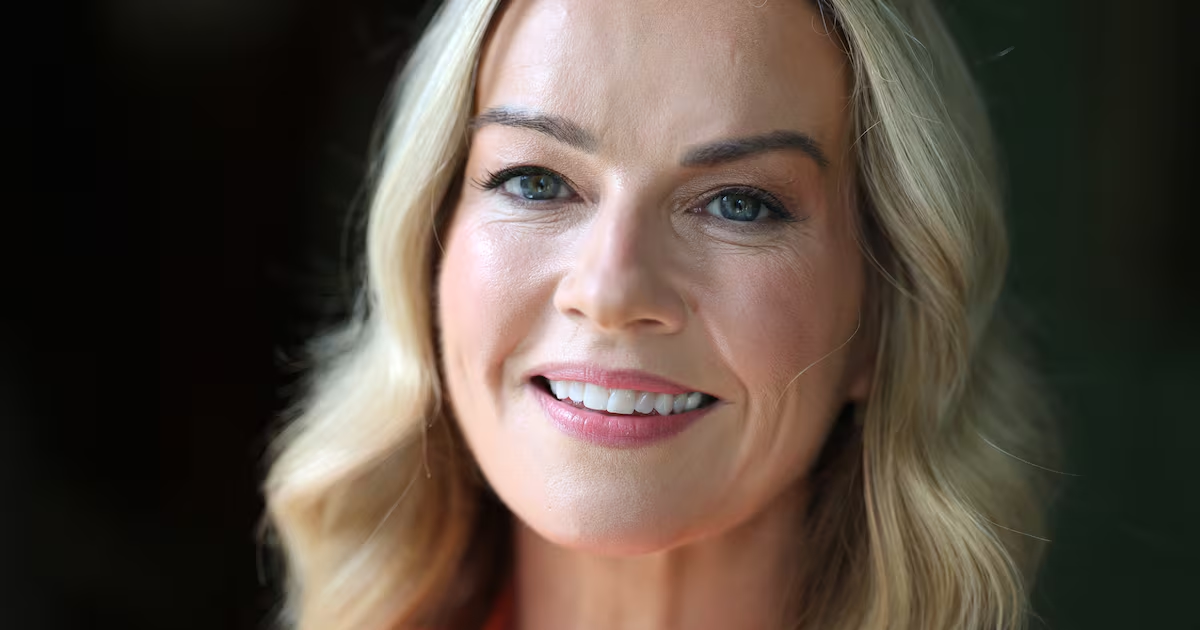
Claire Byrne deploys the tact and restraint that make her so good on delicate topics
Newstalk host gives Chalkie White the space to describe the complexity of his reaction to an ordeal that, with George Gibney’s conviction, may finally be near its end
1,294 words~6 min read