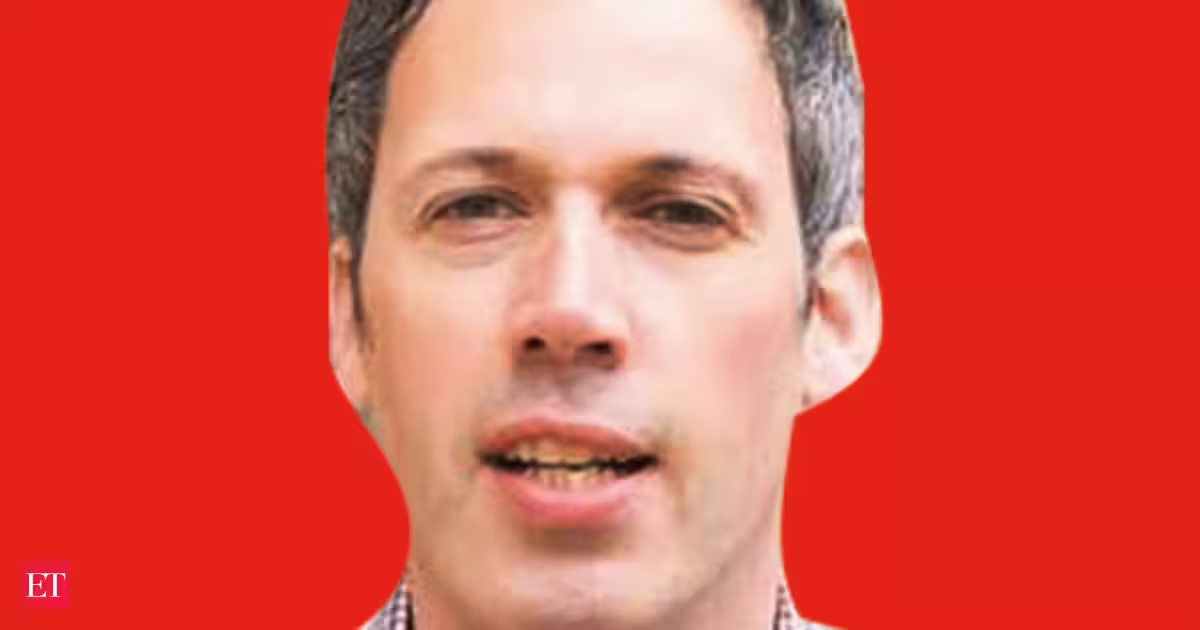
Sander van der Linden is Professor of Social Psychology in Society at Cambridge University. Speaking with Srijana Mitra Das in ET Evoke, he discusses the growing industry of manipulation and lies, which impacts politics, business, media, ecology — and the meaning of intelligence as we face digital technology:Q. What is the core of your research?A. I study how people are influenced by other people and by information and media, with a focus on when that influence turns out to be manipulative, false or inaccurate. I also research how to help people identify misinformation, disinformation and online manipulation.Q. Why do we fall for misinformation — is this a modern social phenomenon or, in fact, an ancient one?A. I think it’s an ancient one but there are some new ingredients, particularly in terms of the way information spreads and gets consumed now. There’s been propaganda since the dawn of time but the way we are exposed to it now, the speed of it and why we believe it is different, in part, due to digital technology.ET BureauThere are various theories on why people are susceptible to misinformation at all. One is that we all have limited processing capacity. We’re inundated by information but we don’t have the ability to sift through it all. We have what’s known as a ‘truth bias’ — most of the time, we just assume things are true because if you had to critically analyse every piece of information that comes at you, you wouldn’t be able to get through your day.Now, when you shift into environments where the base rate of lies and deception are much higher, say, in politics or on social media, applying that rule gets people in trouble.Another theory is that human memory is easy to distort — people are more likely to think something is true if it’s been repeated. This is the ‘illusory truth effect’. The more you repeat something, the faster your brain is at processing it — but then, the brain mistakes fluency or speed with truth.Your brain conflates how easy it is to process something with whether or not it’s true — hence, repeating lies over time is effective. You could begin by believing Earth is flat — but if you hear it repeatedly, you start to think it’s a little truer than if you don’t. Then, you’re also more likely to share it around.There are also theories that assume people have psychological motivations to promote their own group and derogate other groups in society — here, misinformation serves a strategic function. People might know a story isn’t true but sharing it serves a social function because it scores you points by scapegoating a group or promoting your own.By that account, the circulation of misinformation reflects the fact that people also have social goals in life — and not just accuracy goals.Q. Can you tell us about the ‘six degrees of manipulation’ you’ve researched? A. Economists tend to think of supply and demand in ways of thinking — so, when we talk about susceptibility to misinformation, we talk about demand. There are people actively demanding the production of misinformation for their purposes. We wanted to understand, who’s in this marketplace of misinformation production? Who are the suppliers? What are the techniques they use? We spent over a year talking to people who work in professional troll farms, particularly Russian troll farms, as well as former extremists, neo-Nazis, conspiracy theorists, etc. We studied intelligence reports from international organisations that track disinformation and came up with these six techniques which are very prevalent in producing misinformation. These include polarisation — creating ‘us versus them’ mentalities — emotional manipulation rather than talking about evidence, trolling people or baiting them for a response online, impersonating people like politicians or doctors, discrediting or using denial and doubt techniques on scientific or factual narratives and conspiratorial thinking or casting doubt on the mainstream narrative by assuming ‘evil people are plotting behind the scenes’. Most misinformation uses these to lure people and exploit their vulnerability. Q. Which are some industries of misinformation you’ve identified? A. Historically, a famous example is the tobacco industry — there’s well-documented evidence on how they misled the public about the health consequences of smoking for over 50 years. One of the techniques they used is discrediting or sowing doubt about science. It’s easier and quicker to cast doubt on science than convince people of any alternative facts. It started with tobacco — then, the fossil fuel industry copied the same technique to suggest, ‘Oh, we don’t know if humans are really causing climate change?’ This is also used by state actors sometimes to manufacture doubt because they’ve learned that is much easier than convincing people. Today, this is a vast industry — there are ‘disinformation for hire’ firms, many organisations you can pay for ‘influence campaigns’ or ‘psychological operations’, manipulative information campaigns held around, for example, elections which is very consequential. There are hundreds of firms that use sophisticated digital techniques like micro-targeting where, based on the digital footprints people leave online, they can figure out how to persuade and target them with potentially false information. We have a tool called the Cambridge Online Trust and Safety Index (cotsi.org) — it shows the manipulation market in real time. We display how on every social media platform in each country, including India, you can buy fake accounts for manipulative purposes. Fake accounts are used to create bot armies or do ‘astroturfing’, making activity look like it’s organic. We display the cost real time, so people can see how cheap this is and action can be taken. However, in the age of AI, where we now have deepfakes and the democratisation of the ability to produce hyper-realistic disinformation, it’s not just industries anymore. Earlier, troll farms operated with hundreds of people creating fake accounts — now, anyone can do this from their bedroom. AI has allowed anyone to do this at scale because LLMs can automate it for you. Q. Millions of people still deny tangible climate science — many are clearly not politicians benefitting from the fossil fuel industry, so how can we understand their psychology? A. Why people don’t believe in climate change varies across the world. Conspiracy theories about climate change being a hoax or invention tend to be popular in Anglo-Saxon countries, like the United States and United Kingdom, while reasons for not believing in climate change differ in Africa or Asia. A very influential factor here is the huge amount of greenwashing that is taking place — fossil fuel companies bankroll massive campaigns to make it look like they’re green while, in fact, they aren’t. Their campaigns also cast doubt on the science or efficacy of solutions. They’ve realised most people are beginning to understand humans are indeed causing climate change — so, they’ve changed strategy to casting doubt on the solutions, claiming, ‘Green energy won’t be able to work adequately’, etc. There are several techniques to undermine collective action while there is also active greenwashing — for example, when people think about what to do on climate change, they often think ‘recycling’. However, recycling is one of the least effective steps for climate change. It’s useful for your local environment but not really for climate or emissions. Yet, the plastic industry has invested in huge misinformation campaigns to convince people recycling is the answer to climate change — thus, putting the focus on people, not companies. There is also ideological motivation — one reason people don’t believe in climate change is because it’s not popular with the political groups they belong to. Sometimes, people also don’t like the implications of the science which shows they need to change their lifestyle. People don’t like hearing that and so, they deny the science but the underlying motivation is, they don’t like the implications of the science. Q. Does the success of misinformation reflect inadequacy in contemporary education systems — and rising intellectual laziness? A. Historically, misinformation always existed but we’re currently going through a peak. Things are not going well in the world with geopolitical conflict, wars, pandemics and climate change — that means a lot of demand and supply of misinformation. This is typical — around World War II, things were not going well and there was a huge surge in false information. Today, however, this is amplified by digital technology in a way that’s completely unprecedented. People are not used to consuming information on that timescale. People received propaganda in World War II via radio but they had a long time to get used to radio. The same was true of TV. On social media, we’re not talking 20 years for the technology or market to develop, safety testing to happen, etc. With social media, we’re talking five years at best — and with AI, it’s just a couple of years. Things are moving so fast, people don’t have any time to get used to consuming information in new ways. That creates an environment where we have not cognitively prepared ourselves. The heuristics we use are more suited to environments where you talk to someone face-to-face and have some mechanisms to spot deception. Those don’t work online — that creates a mismatch between the digital information space and the ways we have evolved to figure out whether someone is telling the truth. It is partly upto educational institutions to fill that gap — but, unfortunately, there is a massive failure to prepare citizens for the increasing gulf happening in the digital space where most of our activities now take place. Most schools teach critical thinking on ancient philosophers, etc. — but that doesn’t help you figure out what is a deepfake or isn’t. We need a new set of skills that should be taught from as young as four years old, in every school, everywhere — currently, that infrastructure is completely missing and there’s no investment in it.Views expressed are personal.
Misinformation is shaping world, from climate change to wars: Cambridge University Professor Sander van der Linden
Professor Sander van der Linden studies how people fall for misinformation and manipulation. Digital technology accelerates the spread of false information, exploiting human cognitive biases. Industries like tobacco and fossil fuels have long used doubt-casting techniques. Sophisticated firms now offer 'disinformation for hire' services using micro-targeting. Educational systems must adapt to teach new skills for navigating online deception.
1,654 words~8 min read