By Meryl Kao / Staff reporter
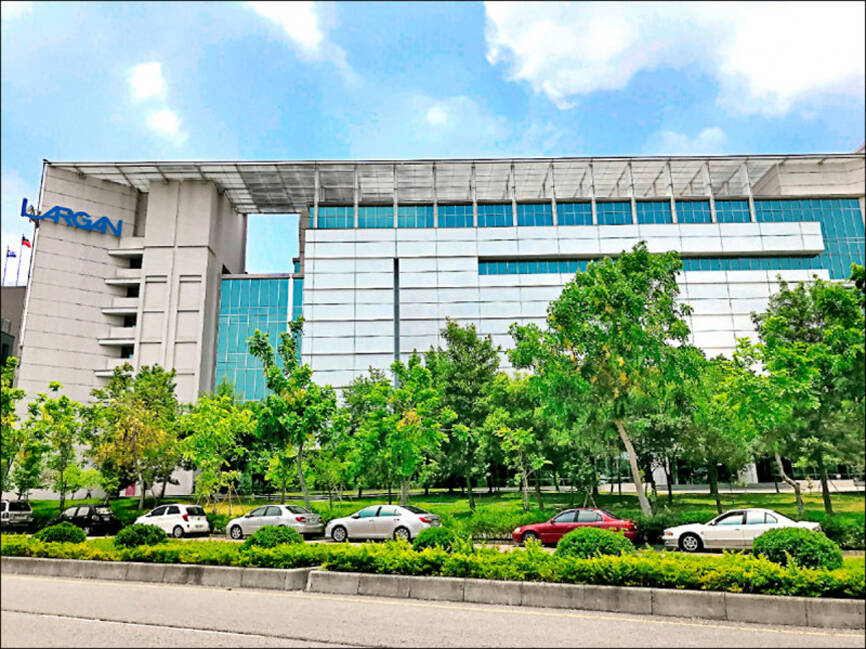
Largan Precision Co (大立光), a key iPhone lens supplier, yesterday reported that its gross margin in the second quarter was flat from the previous quarter at 49.41 percent, albeit down from 53.62 percent a year earlier. The margin outlook for this quarter would depend on yields of its new products, Largan chairman Adam Lin (林恩平) told an earnings conference, adding that yields of new advanced smartphone camera lens modules, particularly variable-aperture lenses, are still improving. The company expects shipments of advanced smartphone camera lenses to increase this quarter from last quarter, when deliveries were capped by stringent particle-control requirements and manufacturing complexity, Lin said.
Largan Precision Co CEO Adam Lin poses for a photograph at the company’s annual shareholders’ meeting in Taichung on June 9.
During the April-to-June period, Largan’s revenue rose 17.07 percent year-on-year to NT$13.66 billion (US$424.51 million), while net profit surged 352 percent to NT$4.67 billion, or earnings per share of NT$35.72, the company said.Capital expenditure last quarter totaled NT$2.78 billion, it said.
This month, revenue is expected to increase from NT$3.71 billion last month, with further growth expected next month as the peak season effect gathers pace, Lin said. September shipments are still expected to be broadly in line with the company’s earlier projections, he said. Shortages of key components, such as memory chips, have not significantly affected customers’ smartphone order forecasts, Lin said. However, factory utilization is still below normal this quarter, he said. Fourth-quarter performance could surpass that of the third quarter, as some customers have pushed back shipment schedules, he added. Development of next year’s smartphone camera lens modules is already under way, as customers typically begin developing new products one to two years in advance, Lin said. The company expects further specification upgrades for high-end smartphone camera lenses, with wider adoption of periscope lenses likely next year, he said. Another key takeaway of the conference was the company’s push into the copackaged optics business to supply fiber arrays. Largan is focusing on fiber arrays rather than complete copackaged optics solutions, and is preparing to send samples to a customer this month for certification, Lin said. The company plans to complete pilot production lines at the end of this quarter and expects to begin mass production and see revenue contribution in the middle of next year, he said. The project would initially focus on fiber array products, with a customer currently requiring a one-row design, he said. If customers later require complete units, Largan would also be able to supply them, he said. The company continues to automate its fiber array production using in-house equipment, with manufacturing precision improved to below 0.3 microns, Lin said. Largan has also developed a viable solution for prism microlens array technology, but it is unclear whether it could compete with semiconductor-based and quartz-glass alternatives, he said. Commenting on Corning Inc’s glass bridge optical interconnect technology, Lin said it is designed primarily for edge couplers, while grating couplers, which Largan is focused on, remain the dominant technology. He also dismissed concerns that edge couplers would replace grating couplers.