The US has the most expensive military in the world.
Tajh Payne/US Navy via Getty Images
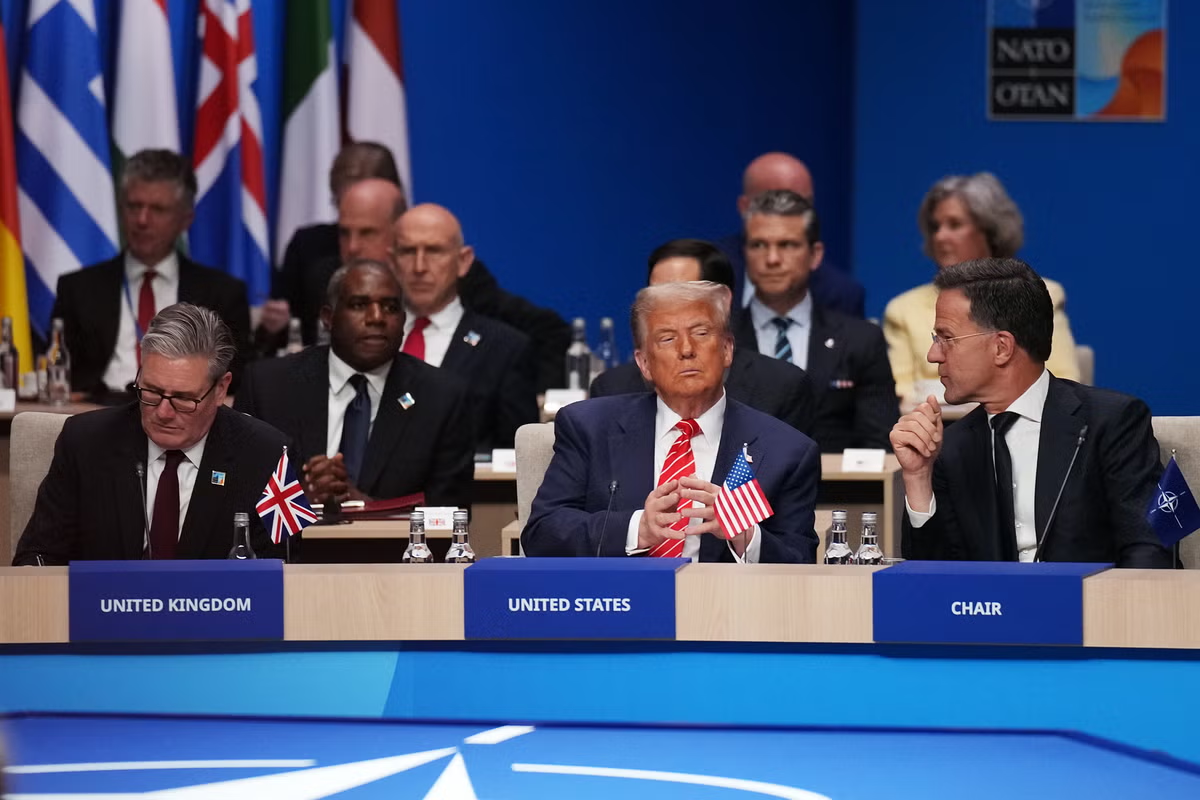
Global military budgets in 2025 totaled $2.6 trillion. The US accounted for more than a third of that total.The US has the world's most expensive military, spending nearly $1 trillion on defense. That's over three and a half times China's reported defense budget, the next largest.From spending on nuclear technology to advanced aircraft and warships, the world's top militaries allocate hundreds of billions of dollars each year to stay ahead.In some countries, big-ticket items such as naval assets, technologically advanced aircraft, or missiles account for the bulk of military spending, while others devote large sums to maintaining large conscription-based troop systems.Ultimately, military spending varies by country depending on location and interests, Gian Gentile, a retired US Army colonel and senior historian at RAND, told Business Insider.Some countries prioritize homeland defense while others value overmatch and far-reaching power projection."The US spends a lot on more sophisticated, extremely precise weapon systems," he said.A military budget can be measured either as a total amount or as a share of a country's GDP, reflecting the burden on the economy. In 2025, countries spent an average of 2.01% of their GDP on defense.In 2025, NATO allies agreed to a defense investment target pushed by US President Donald Trump, which aims to increase allied nations' spending to 5% of their countries' GDP annually by 2035, with 3.5% of the GDP being allocated towards direct military funding and an additional 1.5% going towards defense-related developments.During wartime, spending as a share of GDP typically rises, which in turn strains the civilian economy, said Mark Cancian, a senior advisor at the Center for Strategic and International Studies. Ukraine in 2025, for example, devoted over 20% of its GDP to its military, the highest share globally.Spending statistics help paint a picture of defense priorities, but they don't always translate into readiness for conflict."Readiness is very expensive, and perishable," Cancian said.A country's on-paper investment in its defense systems doesn't always translate directly into military capability, he added. Training and maintenance are often overlooked in analyses of spending on equipment and technologies.A particularly high cost for technologically advanced aircraft, for instance, is maintenance and sustainment.Still, looking at military budgets can reveal how much capital each country relies on to defend itself.Earlier this year, the International Institute for Strategic Studies, a London-based think tank, released its Military Balance report, which included data on nearly every country's defense budget based on each's reported 2025 figures.The report includes each country's total budget (in US dollars), per capita figures, and the defense budget as a share of GDP. Some countries, such as North Korea, Libya, Syria, Cuba, and Afghanistan, did not publicly report their defense budgets.These are the 50 countries that spend the most on their military, ranked by the size of their defense budgets.