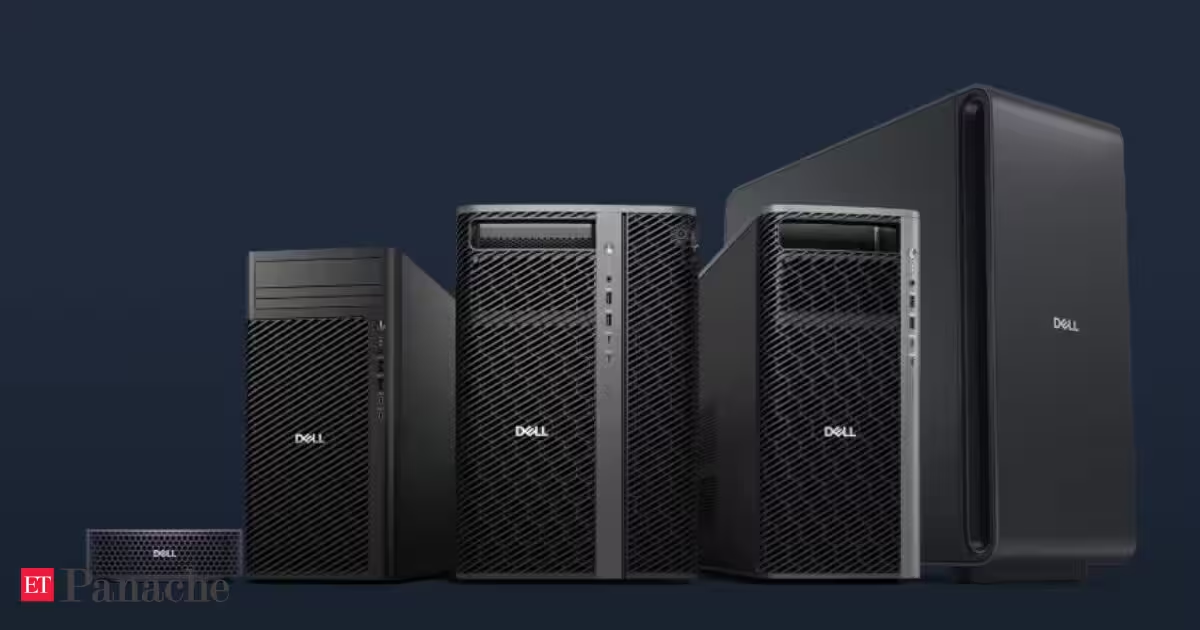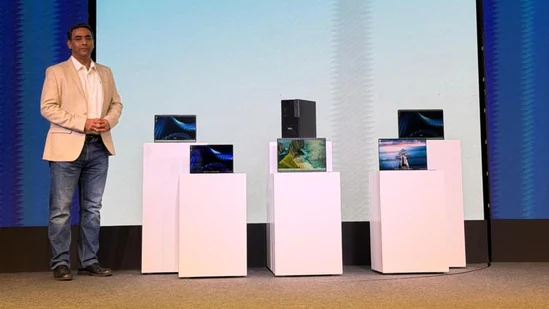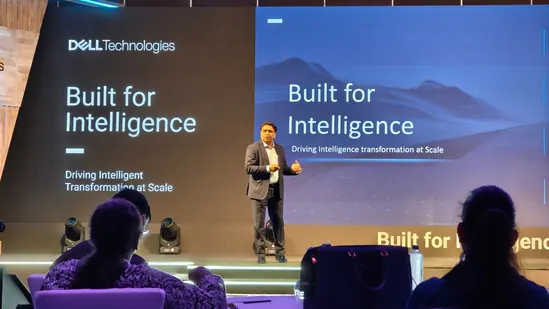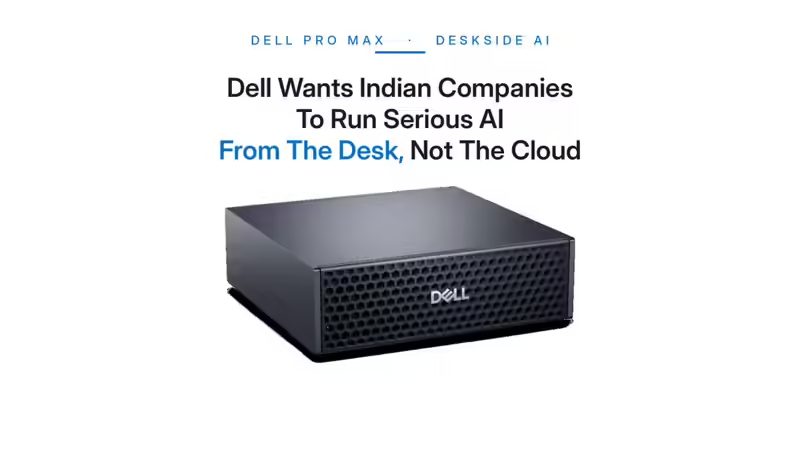
Dell has launched a new range of AI-ready workstations in India, and the long product list carries a bigger idea about where artificial intelligence will run.The company announced the Dell Pro Precision portfolio on 9 July 2026 — a set of laptops and desktop towers built for engineers, architects, designers, video editors and anyone whose work now leans on AI. Alongside the machines, Dell introduced something more strategic: Dell Deskside Agentic AI, a way for a team to run AI agents on its own hardware, in its own office, instead of renting that compute from a cloud provider.The launch splits into two stories. The first is a routine refresh — faster chips, better graphics, thinner laptops. The second is the one that matters. Dell is telling Indian companies that the cloud-only way of doing AI is becoming too expensive, too slow and too risky for the data they care about, and that the answer is to bring the work back to the desk. On its own numbers, running agentic AI on Dell's deskside boxes can cost up to 87 per cent less than cloud APIs over two years.That is the argument. It rests on three questions — why it lands now, how the hardware delivers it, and where it leaves Dell against HP, Lenovo, Apple and the cloud giants in India.Why This Is Happening NowFor two years, most companies treated AI as an experiment. You signed up for a cloud service, paid per use, and tried things out. That model works while usage is small. It breaks when the work becomes agentic.An AI agent keeps working after the first answer. It plans, calls tools, checks its own output, and loops — often many times for a single task. Each loop burns tokens, and tokens are billed. So even as the price per token falls, the number of tokens climbs faster, and the monthly cloud bill climbs with it. A team that runs agents all day can watch its cloud spend behave like a car stuck in first gear at full throttle: a lot of noise, a lot of fuel, and a bill that keeps rising.This is the gap Dell is aiming at. "The nature of professional work is changing rapidly. Data-intensive workflows, real-time collaboration and on-device AI are central to how teams deliver results," said Indrajit Belgundi, senior director and general manager, Client Solutions Group India, Dell Technologies. "India's professional community is at the forefront of AI adoption and they need hardware that matches their ambitions. This launch brings powerful, secure, and locally deployable AI directly to the people who build, design and innovate. With the new Dell Pro Precision portfolio and Dell Deskside Agentic AI, we're helping organizations move AI from experimentation to production, without the cost or complexity of cloud-only approaches."The words that matter are "experimentation to production." Trying AI is cheap. Running it every day, at work scale, on real company data, is where the costs and the risks show up. Dell is selling the machines for that second phase.The demand signal is real, and Dell has data to point at — though the data comes with a caveat. An IDC InfoBrief that Dell and Intel paid for, titled "Powering Future-Ready Computing with Workstations: Built for AI. Built for You," found that across Asia Pacific, 95 per cent of respondents expect workstations to play a critical or important role in their AI plans over the next two years. In India, 95 per cent of the organisations surveyed reported higher productivity among workstation users, 77 per cent cited strong use for AI deployment, and 76 per cent for data preparation. The same share, 76 per cent, expect workstations to make up a bigger slice of their computer fleet within five years. The numbers are useful, and they were also commissioned by the two companies that gain most if you believe them — so weigh them with that in mind.The Real Product Is The EconomicsSet the specifications aside, and Dell Deskside Agentic AI is an argument about money and control. It rests on three claims that cloud-only setups struggle to match: cost, security and data sovereignty.Start with cost, because it is the sharpest. Dell's pitch is that most agentic work runs fine on a mid-sized model, well short of the largest cloud offerings. By Dell's estimate, more than half of agentic workflows run on open-weight models — the freely available ones you can download and run yourself — and the useful heavy lifting sits in the 30-billion to 284-billion parameter range. Models that size do the bulk reasoning that pushes a workflow forward. You can skip the biggest engine in the world and pick one that fits the road you drive. Own that engine, keep it running in your office, and the per-use cloud meter stops spinning. Dell's figure is up to 87 per cent lower spend than cloud APIs over two years.Then security and sovereignty, which in India are fast becoming the same conversation. Under the country's Digital Personal Data Protection framework, companies face growing pressure to keep sensitive data inside their own walls and inside the country. A bank, a hospital or a defence contractor is often barred from sending its data to someone else's servers to be processed. Running the AI on a machine under your own roof keeps the data in the building. For regulated industries, that is the whole reason to buy.The Deskside Agentic AI package puts this together as a bundle rather than a single box. It pairs Dell Pro Precision tower workstations with Dell's AI accelerators — the Dell Pro Max with GB10 or GB300 — adds NVIDIA's open-source reference stack for building agents, layers CrowdStrike security on top, and wraps the lot in Dell's services and support. The idea is that a specialised team can stand up private AI agents quickly, keep the data at home, and know the bill in advance instead of discovering it at the end of the month.Two machines anchor the range. The Dell Pro Max with GB10 is the compact, power-sipping option, built for one person prototyping agents, and it handles models from 30 billion up to 200 billion parameters. The Dell Pro Max with GB300 is the serious one: built on NVIDIA's GB300 Grace Blackwell Ultra desktop superchip, cooled by Dell's own MaxCool system, and aimed at running frontier-class models from 120 billion up to 1 trillion parameters. The GB10 is the machine you learn on; the GB300 is the machine you run the business on.If the GB10 sounds familiar, it should. It is the same class of Grace Blackwell desktop chip that powers NVIDIA's own DGX Spark, the "personal AI supercomputer" the chipmaker has been selling to put a small AI data centre on a single desk. Dell is one of several hardware makers building on that platform — which tells you both how real the deskside-AI category has become, and how crowded it is about to get.What Each Machine Is ForThe workstations come in four families. The naming is a mouthful, so each family gets a plain-English job below.The Dell Pro Precision 5 series 14S and 16S are the thin-and-light entry point. The 14S weighs just 1.4 kilograms, which Dell calls its thinnest and lightest workstation ever, with a three-sided aluminium body. You can pick Intel Core Ultra Series 3 chips with built-in Intel Arc Pro graphics, or AMD Ryzen AI 400 chips with Radeon PRO graphics, and up to 64GB of fast LPCAMM2 memory. These are certified by the big engineering-software vendors, so the CAD and design tools professionals rely on will run properly. The point of these two is reach: workstation-grade reliability in a laptop light enough to carry all day.The Dell Pro Precision 5 series 14 and 16 step up for daily professional work. Both use Intel Core Ultra 9 Series 3 chips with a 50 TOPS NPU — a dedicated chip for on-device AI tasks — and can be fitted with NVIDIA RTX Blackwell graphics. The 14 takes up to 2 terabytes of fast Gen5 storage; the 16 doubles that to 4 terabytes for people working with bigger files.The Dell Pro Precision 7 series 14 and 16 are the mobile powerhouses. The 7 14 runs 45W Intel Core Ultra chips, up to NVIDIA RTX PRO 2000 Blackwell graphics and up to 4TB of storage, at 1.59 kilograms — real power you can still put in a bag. The 7 16 pushes further with 50W chips, a 50 TOPS NPU, up to RTX PRO 3000 Blackwell graphics, up to 64GB of LPDDR5x memory and up to 8TB of Gen5 storage, for AI development, simulation and heavy visual work.The Dell Pro Precision 7 T1 is the desktop tower for the largest datasets and machine-learning jobs, built on Intel Core Ultra Series 2 chips with a dedicated NPU. It is the workhorse that sits under the desk and does the grinding.Across the range, Dell has covered the basics that matter in daily use: Wi-Fi 7, optional 4G or 5G on some models, sharp IR cameras for video calls, and a full set of ports including USB-C, Thunderbolt 4 and HDMI 2.1. Security is enterprise-grade, with TPM 2.0 and ControlVault 3 Plus authentication, both carrying FIPS 140-3 certification, plus Dell's Trusted Workspaces controls for supply-chain and firmware protection. On sustainability, select models are EPEAT Gold registered with Climate+ status, ENERGY STAR certified, and packed in fully recycled or renewable materials.What It Costs, And When You Can Buy ItPricing places the range from prosumer to serious enterprise investment.The Dell Pro Precision 5 Series is on sale now from Rs 1,49,000. The Pro Precision 7 Series starts at Rs 2,25,000, and the Pro Precision 7 T1 tower comes in lower, from Rs 89,000. The Dell Pro Max with GB10 — the deskside AI machine — is available now from around Rs 4,99,000. The thin 5 series 14S and 16S arrive on 10 August 2026. The top-end Dell Pro Max with GB300 is expected later in 2026, and Dell Deskside Agentic AI is available now.Against that, the memory shortage pushing up prices across the industry sits in the background. These machines lean on the fastest, most sought-after memory and storage — LPCAMM2, LPDDR5x and PCIe Gen5 — the exact parts caught in the current supply crunch. Buyers planning large fleet upgrades may find that today's prices are the friendlier ones.Who Dell Is Fighting In IndiaDell describes itself as the global leader in workstations, and in a market this size that claim deserves a test against who else is on the field in India. The desk is getting crowded from two directions at once.On the traditional workstation side, Dell's oldest rival is HP, whose Z desktops and ZBook mobile workstations chase the same engineers, architects and studios with the same NVIDIA graphics and the same ISV certifications. The two have traded the top of the workstation table for years, and HP will match Dell machine for machine on this launch. Lenovo is the third force and the one moving fastest — its ThinkStation towers and ThinkPad P-series laptops ride on Lenovo's strength as the number-two PC brand in India overall, giving it deep enterprise reach to sell workstations into. In pure workstation terms, this is a three-horse race, and it is Dell, HP and Lenovo.Then there is Apple, which skips the CAD-certified "workstation" label but has become a serious rival for exactly the AI-on-the-desk work Dell is targeting. The Mac Studio, with its large pool of unified memory, has turned into a favourite for developers running big language models locally — the same job the Dell Pro Max boxes are built for. For creators and AI engineers who live in the Apple ecosystem, a Mac Studio is the deskside-AI machine they already own.The more interesting contest is on the new deskside-AI ground, and here Dell's partner is also its competitor. NVIDIA sells its own DGX Spark and DGX Station machines built on the same GB10 and GB300 chips inside Dell's boxes. So do ASUS, HP, Lenovo, MSI and others — every major hardware maker has a Grace Blackwell desktop either shipping or announced. Dell is racing the same suppliers it buys from, on a platform NVIDIA controls. Cheaper still, AMD's Ryzen AI mini-PCs offer a budget route to local AI for teams happy below the top tier. Differentiation, in a field where everyone uses the same NVIDIA heart, will come from the wrapper — the security, the services, the financing and the support — rather than the silicon.And the true competitor, the rival Dell describes but stops short of naming, is the cloud itself. Amazon Web Services, Microsoft Azure and Google Cloud are where most Indian AI work runs today, and their pitch is the opposite of Dell's: rent instead of own; scale instantly; skip the capital cost. Dell's counter is the 87 per cent two-year saving, the data that stays in the building, and a bill you can predict. For a startup chasing bursts of scale, the cloud still wins. For a bank, a hospital, an engineering firm or a global capability centre running the same heavy agents every day on sensitive data, Dell's owned-and-onsite argument is strong — and getting stronger as those agents get busier.Why India, SpecificallyThis launch is aimed at a market with an unusually good fit for the pitch. India hosts more than 1,700 global capability centres — the in-house engineering and research arms of the world's largest companies — and they run exactly the data-heavy, simulation-heavy, AI-heavy workloads these machines are built for. Add the country's large IT-services base, its growing media, animation and visual-effects industry, and a wave of AI startups, and the pool of professionals who need a workstation rather than an ordinary laptop is deep and growing.The data-sovereignty angle sharpens it further. As India's data-protection rules tighten, the pressure to process sensitive information locally rises, and a machine that keeps AI work inside the office answers a regulatory need as much as a performance one. Dell is selling into a moment where the technology, the economics and the law are pointing the same way.The Pro Precision refresh keeps Dell competitive in a three-way workstation fight it has led for years. But the Deskside Agentic AI bet is the one to watch, because it is a wager on a bigger shift: that as AI moves from experiment to everyday tool, the economics and the rules will pull serious work off the cloud and back onto the desk. If that shift is real, the company that owns the deskside owns the next stage of enterprise AI. Dell has placed its chips. Now India's buyers get to decide whether the desk, or the cloud, is where their AI belongs.FAQ What is Dell Pro Precision?Dell Pro Precision is Dell's new range of AI-ready workstations for professionals — engineers, architects, designers, creators and power users. It spans thin mobile workstations (the 5 series 14S/16S), mainstream mobile workstations (5 series 14/16), high-performance mobile workstations (7 series 14/16) and a desktop tower (7 T1), launched in India on 9 July 2026.What is Dell Deskside Agentic AI?It is a bundle that lets a company run AI agents on its own hardware in its own office instead of the cloud. It combines Dell Pro Precision tower workstations, Dell Pro Max GB10 or GB300 AI accelerators, NVIDIA's open-source reference stack, CrowdStrike security and Dell services — keeping data local and costs predictable.How much cheaper is deskside AI than the cloud?Dell says running agentic AI on its deskside machines can cost up to 87 per cent less than cloud APIs over two years, because you own the hardware instead of paying per use as agents burn tokens around the clock.What are the Dell Pro Precision prices in India?The Pro Precision 5 Series starts at Rs 1,49,000, the 7 Series at Rs 2,25,000, and the 7 T1 tower at Rs 89,000. The Dell Pro Max with GB10 starts at around Rs 4,99,000. The 5 series 14S and 16S arrive on 10 August 2026, and the Dell Pro Max with GB300 is expected later in 2026.What is the difference between the Dell Pro Max GB10 and GB300?The GB10 is a compact, power-efficient machine for one person prototyping agents, handling 30-billion to 200-billion parameter models. The GB300, built on NVIDIA's GB300 Grace Blackwell Ultra superchip with Dell MaxCool cooling, is for production inference of frontier models from 120 billion up to 1 trillion parameters.Who does Dell compete with in India?In traditional workstations, HP (Z and ZBook) and Lenovo (ThinkStation and ThinkPad P-series) are Dell's main rivals, with Apple's Mac Studio a growing option for local AI. In deskside AI, Dell competes with NVIDIA's own DGX Spark and Station, plus ASUS, HP and Lenovo Grace Blackwell desktops — and, above all, with cloud providers AWS, Azure and Google Cloud.end of article
Dell Wants Indian Companies To Run Serious AI From The Desk, Not The Cloud
Dell’s new Pro Precision workstations and Deskside Agentic AI push a clear idea: as AI moves from experiments to daily work, Indian companies may want more of it running locally, not only in the cloud.
2,798 words~13 min read