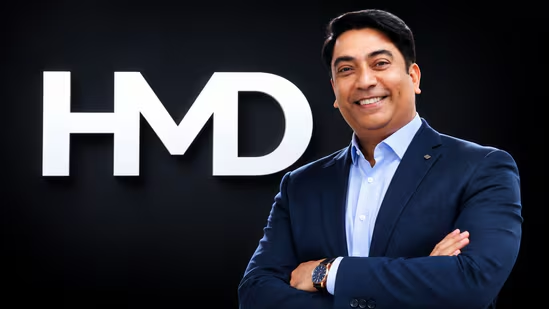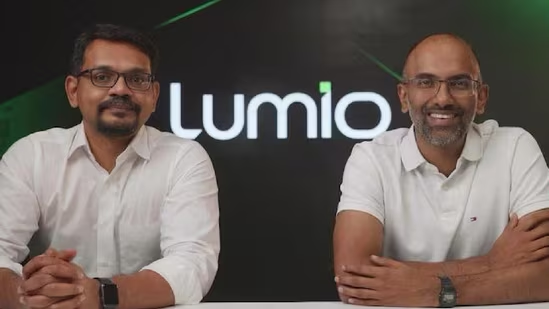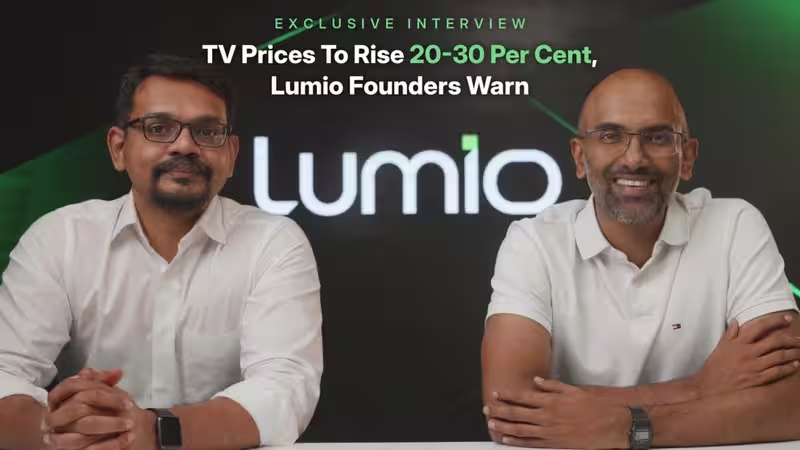
Raghu Reddy delivers a market warning the way other executives deliver quarterly wins: level voice, numbers first, adjectives withheld. Television prices in India, the Lumio chief executive says, are about to climb. This was my 5th interaction with Raghu and Kailash ever since they launched Lumio, and second with Gadgets Now, this being an exclusive one on one over a video call."We anticipate 20 to 30 per cent hikes in TV prices over the next six months," Reddy told me over a video call, with the flatness of a man reading a weather bulletin he has checked three times. The cause is the global memory squeeze that has already mauled smartphone and laptop pricing, a supply crunch severe enough that Reddy cites the most striking assessment on record — a Wall Street Journal piece in which Apple chief executive Tim Cook described the situation as "unlike anything" he had seen in a 40-year career, likening it to a once-in-a-hundred-year flood."Unprecedented times," Reddy said, and then the precision instinct kicked in before any drama could. "Prices have already started going up for smartphones and laptops. TVs — the price increases have not been to that extent in percentage terms, but you'll start seeing significant increases going on until next year. Maybe next year, if prices stabilise, you'll have a new normal."The hikes will land on everybody, he stressed, on different schedules. "Some brands have already taken a fairly big price hike. Some are doing it piecemeal. Some will probably hold off until the end of the year but will then hike prices. It's inevitable." His prescription carries the fatalism of a race engineer watching rain arrive with 20 laps to go: "Prices are up, so in case you want to build a business, you should be willing to sell it at what will be the new normal."Sixteen years of covering this industry has taught me that price warnings are usually theatre — a negotiating position dressed up as a forecast. This one isn't. The component maths is public, and it is ugly.The Chipset Clause That Shields TV MakersBuried inside the gloom sits the most under-reported detail in Indian consumer electronics right now, and it explains why televisions have so far absorbed softer blows than laptops: in the TV business, memory arrives welded to the brain. Welded. Bundled at source, priced at source... and largely spared the spot-market panic everyone else is living through."We're working with our chipset vendors, because in TVs the SoC vendor typically supplies the SoC along with the memory," Reddy explained. A smartphone maker negotiates its DRAM and NAND on the open market, exposed to every spot-price spasm; a television maker buys a bundle, its memory allocation riding on the chipset vendor's own long-term supply agreements. Lumio's exposure runs through MediaTek's procurement desk rather than through the trading floors where phone brands are bleeding. The insulation is partial — the 20-30 per cent forecast applies to Lumio too, Reddy is careful to add — but it buys the one commodity that matters in a shortage: time to plan.A memory crisis is the industry's safety car. It bunches the entire field, neutralises accumulated advantages, and hands the restart to whichever team did its sums on the pit wall. The teams doing those sums have also noticed the grid changing shape. The conversation turned to the argument Ben Thompson has been making on Stratechery — that SK Hynix, Samsung and Micron have overplayed their hand, and that the resulting price umbrella is an engraved invitation for China's CXMT and YMTC, history preparing to repeat the Japan-to-Korea handover one more time. Several large brands are reported to be weighing that fourth option. Had Lumio taken any such meetings? "Too small," Reddy said, with the self-assessment of a man who measures his company against the market rather than against his own press coverage. On the wider theory he permitted himself exactly one sentence of speculation: "It remains to be seen how this entire thing will play out."The Arithmetic Behind The ConfidenceWhy listen to a 14-month-old startup on industry pricing? Fair question. The numbers answer it.Circuit House Technologies, the Bengaluru startup behind the Lumio brand, has crossed Rs 100 crore in gross merchandise value in roughly 13 months of selling televisions. "We're not sure, but it should make us amongst the fastest-growing D2C companies," Reddy said, before permitting himself the firmer half of the claim: "Definitely the fastest-growing home entertainment consumer electronics brand in the country." Note the construction — the confident assertion bounded on both sides by honest qualification. That is Reddy compressed into a single sentence.The figure matters less than its composition. Lumio plays in the upper-premium band of a category dominated by multinationals with five-decade head starts, and the customers arriving at its door are defecting from precisely those multinationals. "We've seen people from LG, Sony and Samsung that accounted for about 50 per cent of the people who upgraded to our TVs," Reddy explained. "If you add Xiaomi, which is the fourth brand, that number goes up to about 65 to 70 per cent." For a 14-month-old brand selling Rs 65,000 televisions, that upgrade mix is the equivalent of a garage band pulling fans from stadium acts.The two men running the show make an instructive study in contrast. Reddy, formerly Xiaomi India's chief business officer, speaks in measured, pre-weighed sentences — humble to the point of understatement, precise to the point of pedantry, a founder with a metronome where most keep an ego. Ask him about market share and he answers with a range, a caveat and a source, in that order. I have interviewed hundreds of executives; the ones who under-claim are rarer than honest spec sheets. Kailash Sankaranarayanan, co-founder and chief operating officer, sits at the opposite end of the mixing desk: voluble, animated, leaning into the camera whenever a feature excites him, which is often. A trained musician and a devoted rock aficionado who arrived via senior stints at Flipkart and Hindustan Unilever, he is the brains behind the software that separates Lumio's televisions from the rest of the Indian market.Their company launched in April 2025 with two lines of Dixon-manufactured Google TVs and a thesis about what it called the slow TV epidemic — the observation that Indian smart televisions, even expensive ones, turn sluggish within months while the panels themselves soldier on for a decade. Backed by $4.3 million in seed funding from Stellaris Venture Partners and 3one4 Capital, and with more than 30,000 customers now served across the country, the founding bet has aged well — helped along by the pricing of dedicated streaming hardware. The Apple TV 4K, by Reddy's telling, has jumped from around Rs 15,000 to Rs 26,000 in India, pushing the fast-interface experience further out of reach. "If you're able to give that experience on a TV, it just goes on to make the TV usable for a much longer timeframe," he said.The Quiet Projector CoupDelivered with characteristic mildness, midway through the conversation, came an announcement most brands would have hired a stadium for: Lumio has become the largest shipped Google TV projector brand in India, online and offline combined. No fireworks. No press event. Just a line dropped between two other answers.The projector bet dates to July 2025, when the company launched the Arc 5 at Rs 19,999 and the Arc 7 at Rs 34,999 into a market where projector penetration sat below 1 per cent of TV households. The category was then a barbell — heritage brands like Epson and BenQ at prices that made buyers wince, and a swamp of grey-market boxes at the bottom. Lumio aimed at the empty middle, and the middle turned out to be where the customers were."Our ASP is at around Rs 22,000, which is almost 3.5 times the ASP for projectors on the e-commerce platforms," Reddy said. "In some sense, we're helping create the mid-premium market over there." The category itself, he added, is one of the few corners of Indian consumer electronics compounding at startup speed: "It's growing at least 60 to 70 per cent year-on-year." The buyer skews young — students, renters, hostel dwellers — people for whom a projector beats both a television they would have to move and a laptop screen they would have to squint at. "For them, instead of buying a TV or watching stuff on a small screen like a laptop, it just becomes a great experience overall."Absolute volumes remain modest, and Reddy flags that himself before anyone can ask — "it's still a small number, which is why we're not talking about the number per se." The candour is the tell. Companies shout when the story is the number; they volunteer smallness when the story is the trajectory.Two Launches Before Diwali, Maybe A Box LaterNew hardware is coming, in categories Lumio has yet to enter. "We're working on at least a couple of other categories," Reddy said. "Hopefully, you should hear from us with at least one launch before Diwali, maybe even two." The guiding filter is the same one that produced the TVs and the projectors. "It might sound a little cliché — tech that sparks joy — but figuring out where experiences are probably not as good as what customers can expect it to be. We're trying to find those solutions that can bridge that gap." He declines to name the categories, and product chief Sudeep Sahu — another Xiaomi alumnus — is deep in the build.Then there is the question that follows Lumio's software everywhere: if the experience is the product, why chain it to a 65-inch panel? The Nvidia Shield built a cult in America on exactly this logic, Amkette's little Android boxes once ran the budget version here, and with Apple TV pricing drifting towards the stratosphere the gap in the Indian market is visible from orbit.Reddy has run these numbers already — he ran category strategy at Xiaomi India for years, and evaluating adjacent segments is the metronomic part of his brain doing what it does. "Has the thought ever crossed? Of course," he said. "We keep evaluating a lot of different sub-categories or sub-segments within the home entertainment space, and this is definitely a core experience that we've built out on the TV. Why not enable it on some of the other devices?" Then, in the same even tone, the brake: "We don't have anything ready yet." Read that as a classic Reddy answer — the door confirmed open, the timeline withheld, zero hype extended on credit. My bet, and it is mine alone rather than anything Lumio said: a box arrives within 18 months. The logic is simply too loud to ignore.The WhatsApp RemoteAll of which brings the story to the software — the part of Lumio that Sankaranarayanan talks about the way guitarists talk about tone, and the part the company believes will decide the next five years. "There's only so much innovation that will happen on the hardware side, and everyone will operate close to each other," Reddy said. "That's how it is." Panels come from the same fabs, chipsets from the same vendors, and the spec-sheet race ends in a photo finish every single year. Software is where the gap opens.The centrepiece is TLDR, the interface layer that sits on top of Google TV across the Vision line. The name is the strategy: Too Long; Didn't Read. "The whole objective of TLDR, as the name stands, is to help people find things fast on the device," Sankaranarayanan said. "A lot of time goes in that frustrating discovery experience. It takes like 20 to 40 minutes to find something to watch. So attacking that, we believe, is a great way to improve user experience."The layer has evolved like a discography. TLDR V1 was the tight debut — a fast launcher that stripped the lag out of getting to content. V2, which arrived with the Vision 9 flagship in April 2026 alongside 34 new features, added movies and shows as first-class citizens. And TLDR Neo — Project Neo, as the company brands it — is the concept album: the release where the band stops refining the old sound and commits to a new one.At the April launch, Neo was a demo. "It was largely a prototype, when we were trying to see what is it that we could achieve," Sankaranarayanan admitted. By early July it had gone out as a public beta, and the refinement shows. The premise is simple enough to state in one line and strange enough to require a second reading: your messaging apps become your television's remote control. Read that again. The remote — the object every Indian household has lost inside a sofa at least once since 1994 — is being replaced by a chat window."You can just talk in any language — there's no barrier to that," Sankaranarayanan said, the tempo of his speech picking up as it always does when the subject turns to his own software. "You can type on WhatsApp, and you'll get the results on the TV pretty much instantly. And the same thing can be done through voice."Send it an Instagram Reel about a film — the kind of thing that already functions as content discovery for an entire generation — and the system works out the title, finds which streaming service carries it, and stages everything on the television, ready to play at the press of a single button. "Whichever OTT is present on it, it's rightly mapped, and then you can just launch it with the click of a button," he explained. WhatsApp and Instagram are live now; more surfaces are coming. The team, he said, is "on a daily basis analysing what are the things that people are using it for, how can we make it better, how do we make it far more useful so that people keep coming back."Underneath the party trick sits a serious conviction about interface history — and it is Sankaranarayanan's conviction above all, the project he spearheaded from prototype to patent filing. "The way in which people interact with devices is changing," he argued. "Fundamentally it's becoming conversational, both through chat and through voice. We believe it's a fundamental shift that hopefully will be how devices are operated in the future." The conviction runs deep enough that the company has lawyered up. "We're also working on it to secure our innovation," he said. "We have filed for a patent with respect to things that we've built out. Hopefully, it also gives us a little bit of an edge when it comes to building this further from a user experience standpoint." A 14-month-old Indian TV brand filing interface patents is itself a statement of intent — this is a company that expects to be copied, and expects to be around long enough for the copying to matter.The next movement arrives within days: Collections. "Today, one way to use Neo is asynchronously," Sankaranarayanan said. "You don't need to be in front of the TV. You can be anywhere, you find something, and you send it to Neo. Then the next time you open the app, you get a collection there with the latest finds." He reaches for a comparison from the golden age of the read-later web: "It essentially becomes something like Pocket or Read It Later. You just collect articles, then later when you have time, you come and get back to it. Neo Collections will work like that. Wherever you find inspiration, you can just send it to it. And then when you come sit in front of the TV, it'll be there for you to consume." A clarification worth making, since "saved for later" invites the wrong mental model: the television stages streams rather than storing them. Everything sits behind the OTT apps and their entitlements; Neo is the concierge, and the concierge holds reservations rather than inventory.Then there is the feature Sankaranarayanan describes with the affection of a B-side that might become the single: photographs. "Simply sharing a photo and seeing that on the screen is a great experience — especially with parents and families," he said. "There's always a WhatsApp group where photos are shared. But when you're sitting in front of the TV, you can't see that on the TV. It's very cumbersome, the typical way in which you have to do that. If you can just send that as a WhatsApp message to Neo, you'll just be able to see that on the TV." The engineering is modest; the emotional payload, in a country where the family WhatsApp group is a civic institution, is anything but.Match — the social discovery feature demoed at the April launch — remains in the workshop. "When we actually sat down to detail out what all it will entail, it's a whole different ball game altogether," Sankaranarayanan conceded, with the candour of a musician admitting the studio version needs another six takes. The honesty is worth pausing on. Plenty of consumer electronics companies demo features that later evaporate; fewer volunteer, on the record, that the hard part turned out to be hard.Every Three Months, A New TrackThe cadence from here is stated policy. "We spent a lot of time just getting the basics in place," Reddy said. "But now that it's all there, and we've got more than 30,000 customers across the length and breadth of the country, you'll start hearing us throwing up new things every three months from here."That is the strategy, stripped of adjectives: prices braced for a flood year and the chipset bundle softening the blow, a projector crown collected before the market noticed the contest, at least one new category landing before Diwali, and a patent filing standing guard over the one idea the rest of the industry missed — that the remote control's replacement was sitting in everyone's pocket all along, disguised as a chat app. In a year when every rival's spreadsheet is bracing for the flood, Lumio has chosen to spend it writing new material. The drummer keeps time. The guitarist is already bending the next note.FAQWill TV prices rise in India in 2026?Yes. Lumio CEO Raghu Reddy expects industry-wide TV price hikes of 20 to 30 per cent over the next six months, driven by the global memory shortage. Every brand will raise prices, he says — some in one jump, some piecemeal, some by year-end.Why are TV makers partly protected from the memory crisis?In televisions, the SoC vendor supplies memory bundled with the chipset, so TV brands like Lumio source through vendors such as MediaTek rather than the volatile spot market where smartphone and laptop makers buy DRAM and NAND.Is Lumio India's largest projector brand?Lumio says it has become the largest shipped Google TV projector brand in India, online and offline combined, with an ASP of around Rs 22,000 — about 3.5 times the e-commerce category average — in a segment growing 60-70 per cent a year.What is Lumio launching next?At least one hardware launch in a new category before Diwali 2026 — possibly two — plus quarterly software releases, with the Collections feature shipping first and the Match social feature still in development.What is Lumio's Project Neo?Project Neo is a conversational layer on Lumio's TLDR software that lets owners search and control their Lumio TV through WhatsApp and Instagram messages or voice, in any language. Send a text or an Instagram Reel, and the matching title appears on the TV mapped to the right streaming app, ready to play. It entered public beta in July 2026, and Lumio has filed a patent around it.How big is Lumio today?Circuit House Technologies, Lumio's parent, crossed Rs 100 crore in GMV in about 13 months and has served more than 30,000 customers. About 50 per cent of its TV buyers upgraded from LG, Sony and Samsung sets; adding Xiaomi takes the figure to 65-70 per cent.end of article
Exclusive: TV Prices To Rise 20-30 Per Cent, Lumio Founders Warn: Here's Why
A 20-30 per cent price wave, a projector coup, two Diwali launches and a patented WhatsApp remote — Lumio's founders map the year ahead.
3,313 words~15 min read