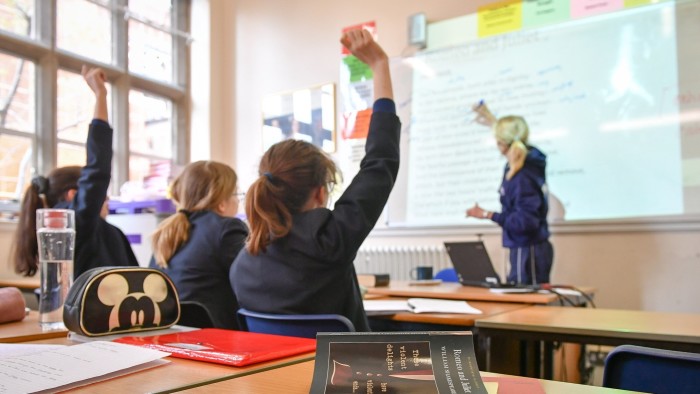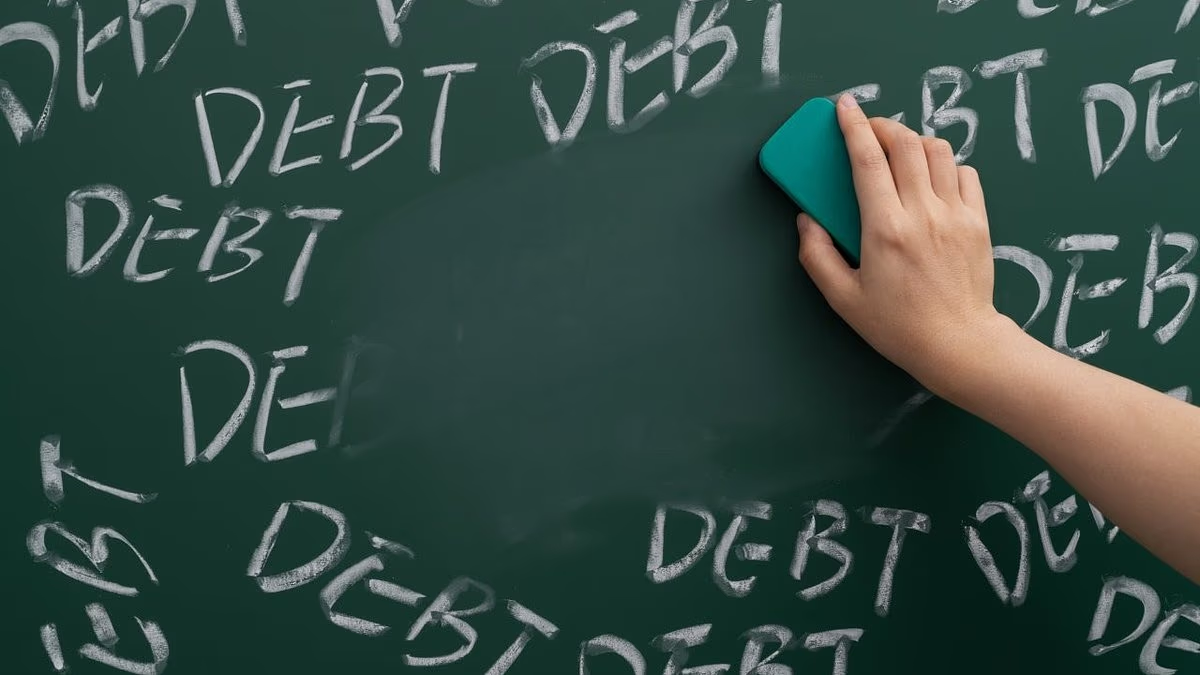
A crisis is quietly unfolding in Britain’s classrooms, leaving a generation of young people unprepared for the real world.A potentially financially devastating gap in the UK education system was laid bare in a House of Commons report, when it revealed a staggering 63 per cent of young people finish secondary school without receiving any meaningful education about money. And I know this is happening, because as a 15-year-old I’m right in the middle of it. Despite plenty of well-meaning campaigns to get financial education on the school curriculum, the reality is that we get very little of it.My experience is an exception, because I am in my first year of studying economics for GCSE, so at least I get some financial education. But there are just ten of us in my 300-strong year group taking economics and I struggle to think of any other subjects where people are learning about money.Beyond this I can recall a few 15-minute sessions in form time on budgeting lessons and that’s about it.Despite navigating a volatile, fast-moving modern economy, millions of teenagers are being set up to make critical lifestyle choices entirely in the dark. From the age of 18, many teenagers take on student loans - a debt that will last almost their entire lifetime - but how many know what that really involvesYou might wonder why my friends and I would need financial education now, as we are only 15.But in three short years’ time, we hope to be driving and owning our first cars, getting jobs, and going to university. The latter is likely to involve student loans, managing our money, budgeting, borrowing on credit cards and overdrafts and much more.Surely, it’s better to start building the solid foundations of financial education now, rather than leave it until then?According to the youth financial education charity MyBnk, even those who do receive financial lessons get a mere 48 minutes of training per month.The findings raise a deeply troubling question: Is financial education being taken seriously enough in our schools? And with the current economic pressures facing households, what can be done to rescue our children from financial illiteracy?A nation of 'cash-clueless' kidsThe consequences of this educational failure are already being felt. The Money and Pensions Service has warned that 47 per cent of children do not receive a meaningful financial education either at home or at school.This leaves millions of children at a societal disadvantage before they even earn their first pay cheque.In stark contrast, the report shows that children who do receive financial education are significantly more likely to save regularly. They are also far more likely to have a bank account, feel confident managing their money and hold a positive attitude toward their financial future.Yet, despite these clear benefits, the system is failing to deliver.A survey of more than 4,000 secondary school teachers in England, conducted by the All-Party Parliamentary Group on Financial Education for Young People, found that a worrying 41 per cent of teachers were not even aware that financial education was a formal part of the curriculum. Currently, money management feels trapped in a bureaucratic limbo. In most schools, it is briefly brushed over in maths lessons – where teenagers are taught the abstract concepts of percentages and compound interest – or buried inside PSHE classes.Too often it relies on overstretched teachers delivering watered-down assemblies or hosting occasional visits from external charities, as they are pushed to prioritise exam content over real-life lessons.What teens want to learn about moneyTeenagers themselves are begging for help. An overwhelming 54 per cent of school-age children say they want more financial education on their curriculum.They are not asking for theoretical maths equations. Instead, they want practical, real-world knowledge that applies directly to the modern landscape.There could be a real benefit here for other subjects too, as by bringing the real-life issues of money and financial life into subjects such as maths, science, or even English, lessons could be made more interesting.Today's teenagers are growing up in a digital world dominated by social media, where they are bombarded with get-rich-quick schemes, cryptocurrency trends and side-hustle culture.They want to understand behavioural economics. They want to know how money actually moves in the real world rather than the abstract concepts they are currently forced to memorise.They want lessons on how to make money grow through investments, how the stock market functions and how to navigate the complex world of cryptocurrency – and why some suggest they should steer well clear of it.Crucially, they need to understand the foundational pillars of adult life: how mortgages work, how to buy a house, what student loans really cost, how to save a rainy-day fund, and how to successfully file taxes.While traditional math calculations are vital, teaching teenagers the practical tools to use in investments, loans and major life purchases, like buying a car, are completely lacking from British classrooms.How many students really understand the student loans they are signing up for, what the implications are of a debt that will last most of their lifetime and how inflation affects the interest rate they pay and how much they will eventually repay?Alternatively, for those who choose not to go to university, how many understand the car finance deals they may sign up to thanks to their income from employment, or why they need an emergency fund, or to pay into their work pension?The London Institute of Banking & Finance Young Persons’ Money Index found that almost one in five respondents to its survey had already signed a financial contract such as a mobile phone deal between the ages of 15 and 18.Beating the scammersThis lack of education isn't just an academic issue – it is actively dangerous.Worryingly, the digital world has made teenagers prime targets for criminal scammers. The same index revealed that 25 per cent of young people had already received a fraudulent email, phone call or text message asking for their bank details.Even more alarming in the smartphone age, 3 per cent admitted they had lost money through online gambling or betting apps.Teenagers and young people emerged as major targets to be ‘money-mules’ in recent years, where criminals and scammers launder money by paying it through their bank accounts, offering them a small payment in return.Without a robust, mandatory financial education in every single school, children are left completely in the dark about the risks out there and how they can avoid scams.As the economy becomes increasingly digital and complex, leaving teenagers to learn about money through trial and error on social media is no longer just negligent – it is a recipe for a generational financial disaster.The Government and schools must act now to overhaul the curriculum before another generation is left to pay the price.
I'm 15 and my generation is still being failed on financial education
Despite plenty of well-meaning campaigns to get financial education on the school curriculum, the reality is that we get very little of it, says Aoibhe Lawton.
1,125 words~5 min read