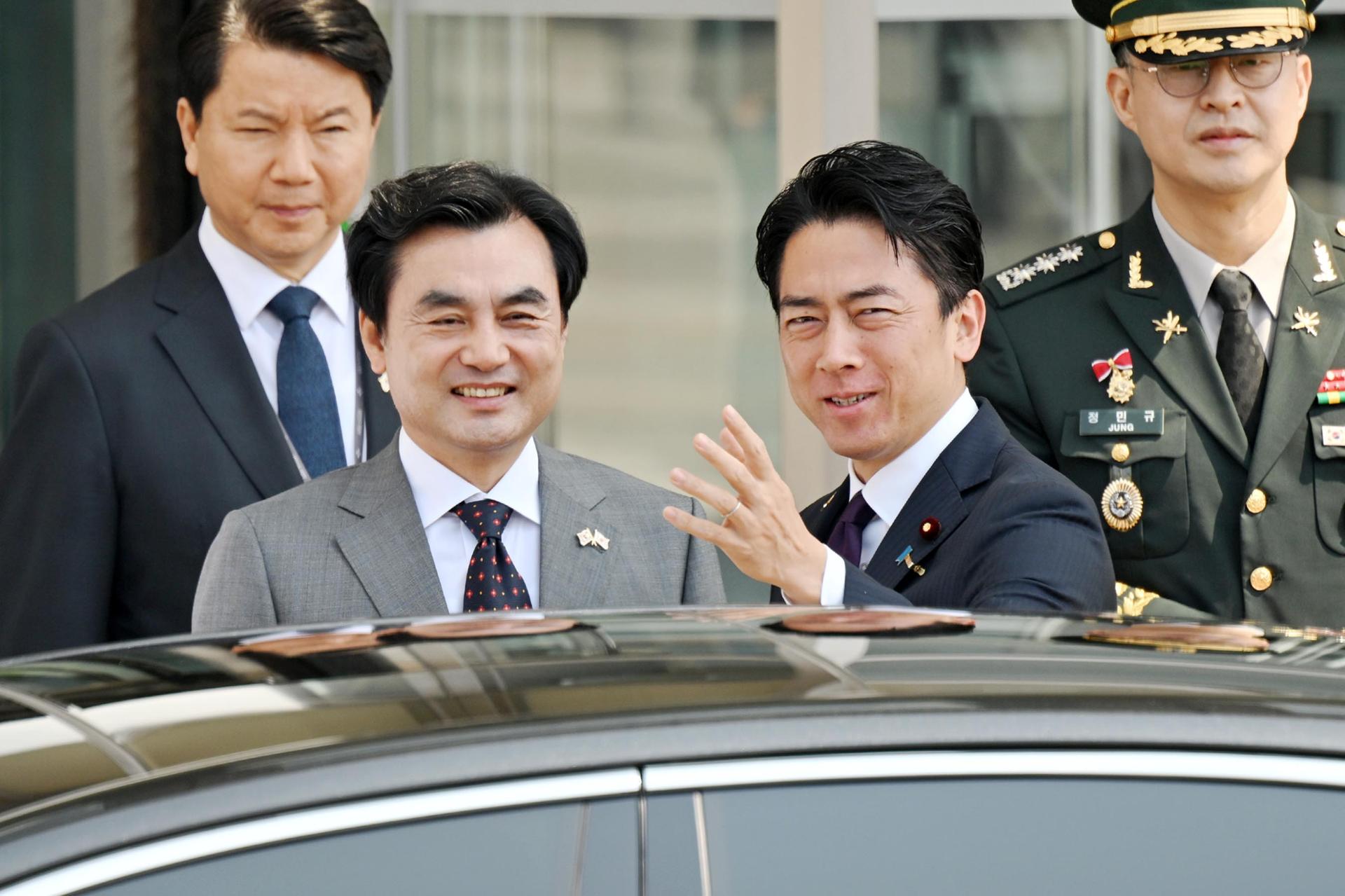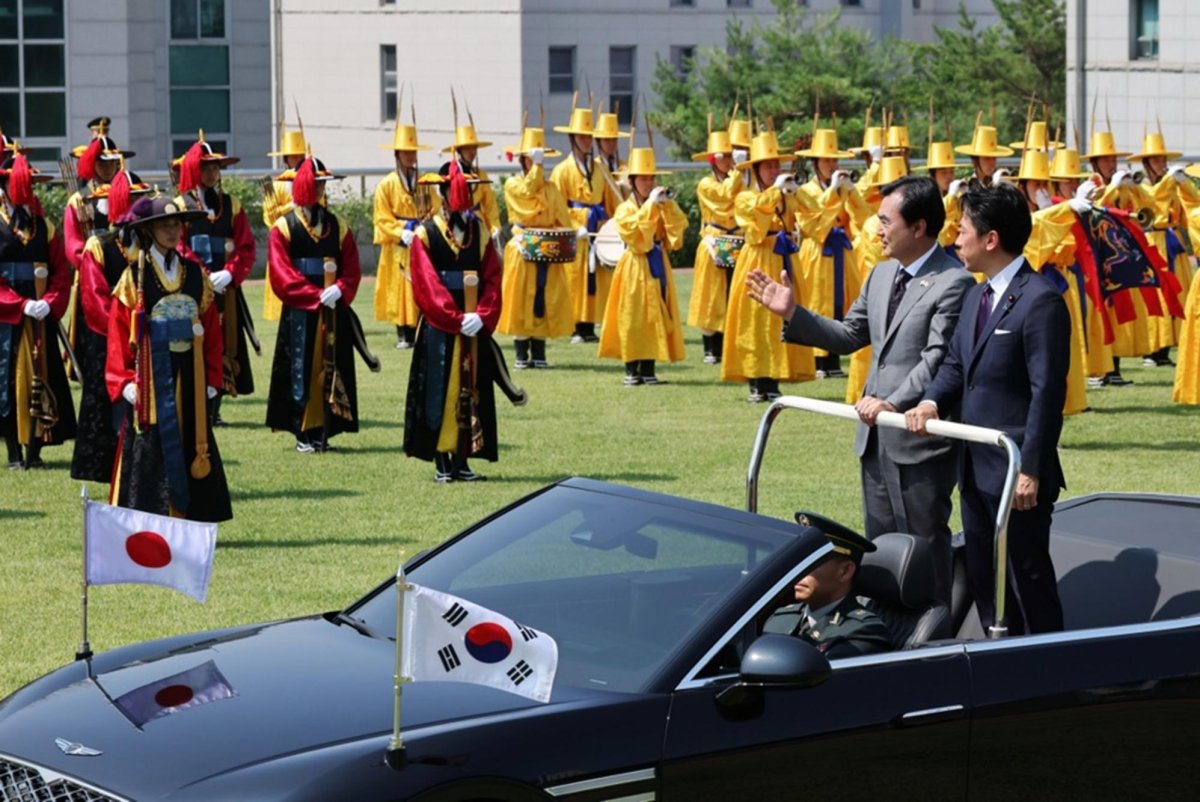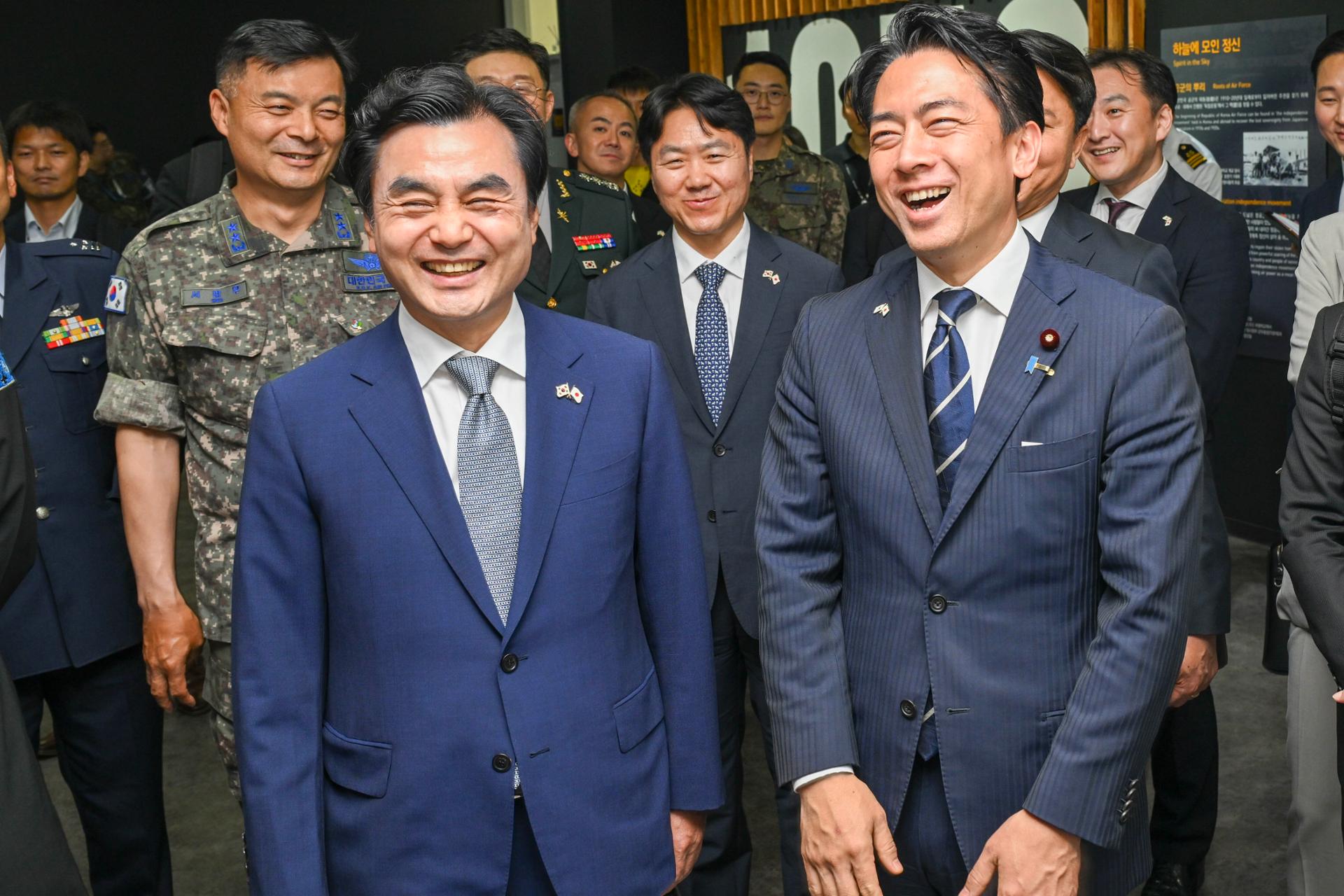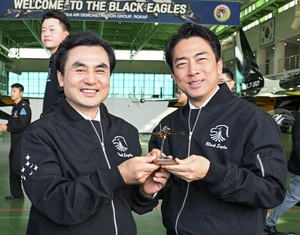
Defense Minister Ahn Gyu-back (left) presents a Black Eagles model aircraft souvenir to Japanese Defense Minister Shinjiro Koizumi during their visit to a South Korean Air Force unit home to the Black Eagles aerobatic team in Wonju, Gangwon Province, about 90 kilometers southeast of Seoul, on June 27, the first day of Koizumi's two-day visit to South Korea. (Ministry of National Defense) North Korea on Thursday used a research institute apparently renamed under its "two hostile states" policy to denounce growing military cooperation between South Korea and Japan, in the latest sign that Pyongyang is institutionalizing its abandonment of inter-Korean reconciliation.The Korean Central News Agency on Thursday carried a commentary by Kang Chol-su, section chief of North Korea's Institute of Enemy State Studies. In it, Kang condemns Seoul and Tokyo's expanding security ties as "a foolish act of courting self-destruction."The Institute of Enemy State Studies is believed to have been renamed and reorganized from the former Institute for National Reunification after North Korean leader Kim Jong-un declared the two Koreas to be separate hostile states, according to Yang Moo-jin, a distinguished professor at the University of North Korean Studies."The institute has been placed under the Foreign Ministry's 10th Bureau, also known as the Enemy State Affairs Bureau, headed by Jang Kum-chol. Kang Chol-su is presumed to be the director of what is known as the enemy policy office," Yang said.Referring to Japan as "a war criminal state dashing toward a military giant," Kang claimed Seoul-Tokyo cooperation was becoming increasingly overt and worsening security on the Korean Peninsula. He cited the recent South Korea-Japan defense ministerial meeting, the resumption of bilateral search-and-rescue drills, and the unprecedented refueling of South Korean Air Force aircraft by the Japan Air Self-Defense Force earlier this year.He also alleged that the two countries were moving toward concluding a "logistic support agreement" that would allow them to provide each other with military supplies, including ammunition, during contingencies.Calling South Korea-Japan security cooperation "a confrontation cooperation targeting the DPRK," Kang argued that it forms part of a broader US-led effort to establish a "triangular cooperation system over the nuclear issue" to militarily contain neighboring countries. He further accused Seoul of pursuing long-range missiles and nuclear-powered submarines while warning that "the reckless military nexus of the enemy states under the eyes of the nuclear weapons state is nothing but a foolish act of courting self-destruction." DPRK is short for the Democratic People's Republic of Korea, North Korea's official name.Kang insisted that the strengthening of military cooperation between Seoul, Washington and Tokyo only reinforces the need for Pyongyang to expand its nuclear capabilities, arguing that continuously developing its nuclear force and exercising its status as a nuclear weapons state remain "the only way to defend peace and security."Yang said the commentary largely reiterates Pyongyang's long-standing position while reflecting the regime's new institutional framework for handling relations with South Korea."The commentary mainly criticizes South Korea-Japan military cooperation as a factor creating security instability on the Korean Peninsula," he said."It expresses concern over and warns against moves toward concluding a South Korea-Japan 'logistic support agreement.' It also frames South Korea-Japan security cooperation as part of efforts to build a South Korea-US-Japan 'triangular cooperation system over the nuclear issue' aimed at pressuring North Korea and keeping China and Russia in check, thereby seeking to encourage solidarity between North Korea, China and Russia."Yang added that the commentary seeks to justify North Korea's continued expansion of its nuclear arsenal and its exercise of what it calls the status of a nuclear weapons state."A notable feature is that North Korea referred to South Korea, the United States and Japan as 'enemy states,' in an apparent attempt to fuel bloc confrontation," he said.While describing the commentary as a relatively low-level response issued in the name of a research institute official rather than a senior government figure, Yang said Pyongyang could still escalate its rhetoric."Overall, the commentary largely reaffirms North Korea's existing position. As it was issued as an individual commentary by the head of a research office, it appears to be a relatively low-level response," he said."Still, separate from this commentary, a stronger Foreign Ministry spokesperson's statement cannot be ruled out, depending on Pyongyang's reaction to developments such as the NATO summit declaration, the South Korea-Ukraine summit, Seoul's $100 million in assistance to Ukraine and the issue of repatriating North Korean prisoners of war."North Korea has reorganized institutions dealing with South Korea under its "two hostile states" policy. The Institute of Enemy State Studies was first mentioned publicly in November 2024, when the North released a white paper on the alleged South Korean drone incident over Pyongyang.Since Kim ordered a restructuring of North Korea's inter-Korean affairs apparatus and the Supreme People's Assembly abolished state bodies, including the Committee for the Peaceful Reunification of the Fatherland, Pyongyang has gradually revealed its new bureaucratic structure through statements and commentaries on South Korea.The transition became more explicit in April, when Jang Kum-chol, the former head of the United Front Department, issued a statement under the title of first vice foreign minister and director-general of the Foreign Ministry's 10th Bureau, confirming that the former inter-Korean apparatus had been reorganized under the Foreign Ministry. Last month, North Korea also issued a statement under the name of an unidentified spokesperson for the Foreign Ministry's 10th Bureau, criticizing the South Korea-EU joint statement.
North Korea uses renamed institute to attack Seoul-Tokyo ties, signals entrenched 'two hostile states' policy
North Korea on Thursday used a research institute apparently renamed under its "two hostile states" policy to denounce growing military cooperation between Sout
889 words~4 min read