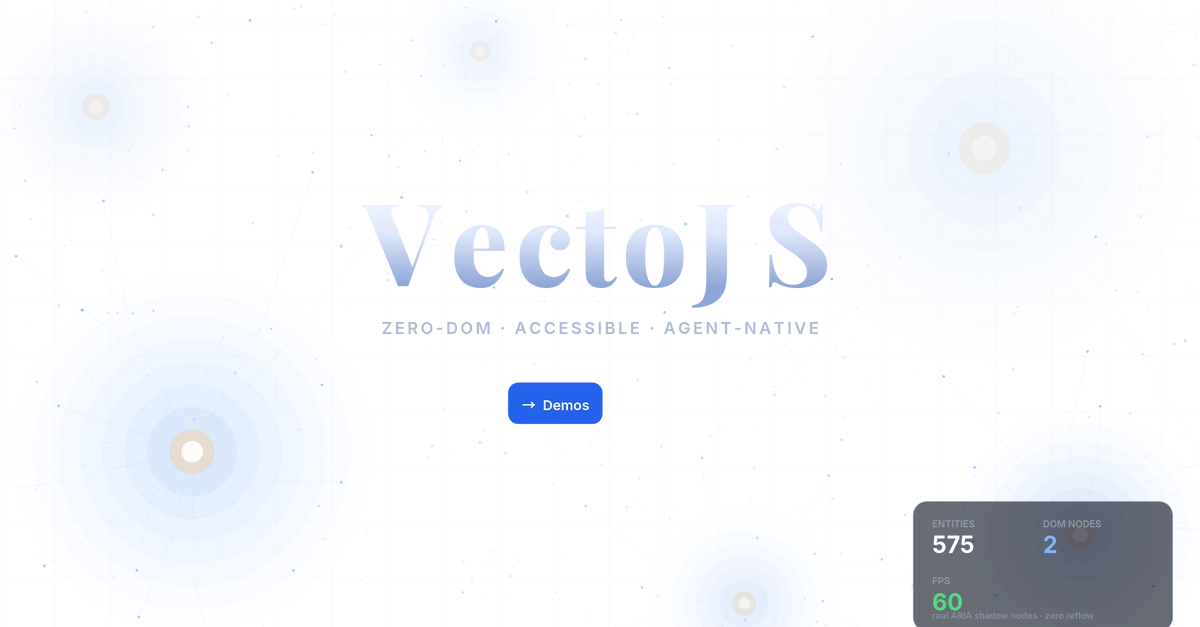
Canvas-native UI runtime with a Virtual Math Tree, semantic accessibility projection, WebGL/WebGPU backends, and agent-drivable controls.
VectoJS is an open-source TypeScript UI framework that renders an entire application to a single <canvas> element instead of the DOM. Every UI framework of the last decade has made a different bet: the DOM is the substrate, and the framework's job is to manage it faster, or hide it behind a nicer syntax. React manages it with a virtual diff. Svelte compiles away the runtime cost of managing it. Tailwind makes styling it less painful. All of them still assume that a UI, underneath, is a tree of HTML elements.
VectoJS doesn't make that assumption. It renders everything — text, buttons, scrollable lists, thousands of live data points — to one <canvas> element. There is no HTML tree underneath. A Button is a plain TypeScript object with a position, a size, and a render() method; the whole UI is a retained scene graph of these objects, walked and drawn every frame like a game engine's scene, not laid out like a document.
class DangerButton extends Button {
override render(r: IRenderer): void {